

Purism, the company developing the Librem 5 smartphone and a series of laptops, servers, and mini-PCs shipped with Linux and CoreBoot, has announced the release of PureOS 10, based on the Debian package base and including only free applications, delivered with the GNU Linux-Libre kernel, devoid of non-free elements in binary firmware. PureOS has been recognized by the Free Software Foundation as fully free and placed on the list of recommended distributions. The size of the installation ISO image, which supports booting in Live mode, is 2 GB.
The distribution takes great care in preserving privacy, offering a range of features for user privacy protection. For instance, a full set of tools for disk data encryption is available, including the Tor Browser, with DuckDuckGo as the search engine, Privacy Badger pre-installed to protect against tracking web activities, and HTTPS Everywhere for automatic redirection to HTTPS. The default browser is PureBrowser (a recompiled version of Firefox). The desktop environment is based on GNOME 3, running on top of Wayland.
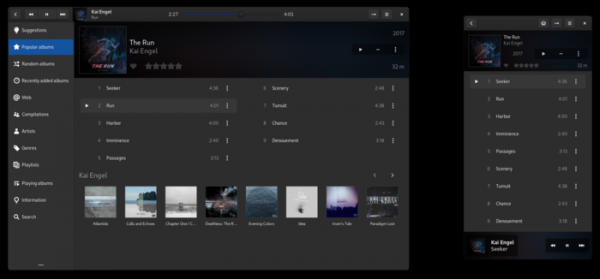
The most notable innovation in the new version is the support for the "Convergence" mode, which offers an adaptive user environment for mobile and desktop devices. The key aim of the development is to enable the same GNOME applications to work seamlessly on both the touchscreen of a smartphone and the larger screens of laptops and PCs in combination with a keyboard and mouse. The application interface dynamically changes depending on the screen size and available input devices. For example, when using PureOS on a smartphone, connecting the device to a monitor can turn the smartphone into a portable workstation.
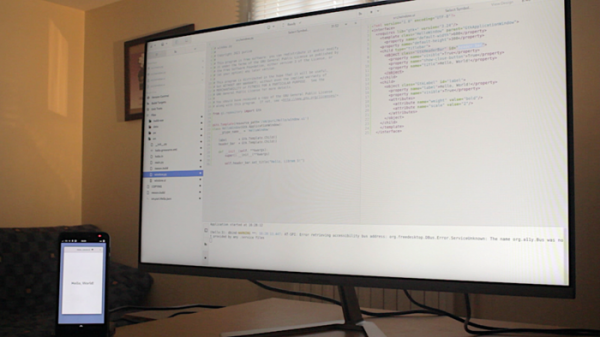
The new release is pre-installed by default on all Purism products, including the Librem 5 smartphone, Librem 14 laptop, and Librem Mini mini-PC. To combine mobile and desktop interface in a single application, the libhandy library is used, allowing the adaptation of GTK/GNOME applications for mobile devices (providing a set of adaptive widgets and objects).
Other improvements:
- Container images now support reproducible builds, ensuring that the provided binaries match their associated source texts. Reproducible builds are also planned for complete ISO images in the future.
- The PureOS store application manager utilizes AppStream metadata to create a universal catalog of applications that can be distributed for smartphones and large-screen devices.
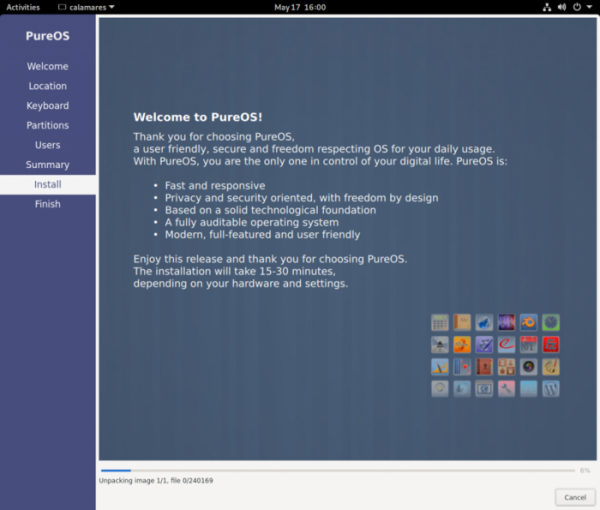
- The installer has been updated to include support for automatic login configuration, the ability to send diagnostic information for troubleshooting installation issues, and improved network installation mode.

- The GNOME desktop has been updated to version 40. The capabilities of the libhandy library have been extended, enabling many GNOME applications to adapt their interfaces for different screen types without modification.
- Added VPN Wireguard.
- A password manager called Pass has been added, which uses gpg2 and git to store passwords in the directory ~/\.password-store.
- A driver for Librem EC ACPI DKMS has been added for Librem EC firmware, allowing user space management of LED indicators, keyboard backlighting, and WiFi/BT indicators, as well as access to battery charge level data.
Main requirements for fully free distributions:
- Inclusion of software with approved FSF licenses in the distribution;
- Prohibition on the delivery of binary firmware and any binary driver components;
- The rejection of immutable functional components, but the possibility of including non-functional ones, provided there is permission to copy and distribute them for commercial and non-commercial purposes (for example, CC BY-ND maps for a GPL game);
- The inadmissibility of using trademarks whose terms of use hinder free copying and distribution of the entire distribution or any of its parts;
- Compliance with the licensing purity of documentation, the inadmissibility of documentation that recommends the installation of proprietary software to solve specific tasks.
Currently, the following projects are included in the list of fully free GNU/Linux distributions:
- Dragora — an independent distribution promoting the idea of maximum architectural simplicity;
- ProteanOS — a standalone distribution evolving towards achieving the smallest possible size;
- Dynebolic — a specialized distribution for processing video and audio data (no longer in development — the last release was on September 8, 2011);
- Hyperbola — based on stabilized snapshots of the Arch Linux package base with certain patches inherited from Debian for improved stability and security. The project develops according to the KISS (Keep It Simple Stupid) principle and aims to provide users with a simple, lightweight, stable, and secure environment.
- Parabola GNU/Linux — a distribution based on the developments of the Arch Linux project;
- PureOS — based on the Debian package base and developed by Purism, which develops the Librem 5 smartphone and produces laptops that come with this distribution and firmware based on CoreBoot;
- Trisquel — a specialized Ubuntu-based distribution for small businesses, home users, and educational institutions;
- Ututo — a GNU/Linux distribution built on the Gentoo base.
- libreCMC (libre Concurrent Machine Cluster), a specialized distribution designed for use in embedded devices such as wireless routers.
- Guix — based on the Guix package manager and the GNU Shepherd initialization system (formerly known as GNU dmd), written in the Guile language (one of the implementations of the Scheme language), which is also used for defining service launch parameters.
Source: opennet.ru
