

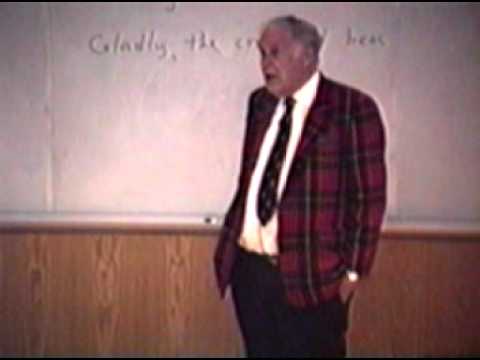
This lecture was not in the schedule, but it had to be added to avoid a gap between classes. The lecture essentially focuses on how we know what we know, if indeed we actually know it. This topic is as old as time – it has been discussed for the last 4000 years, if not longer. In philosophy, a special term has been created to denote it – epistemology, or the science of knowledge.
I would like to start with the primitive tribes of the distant past. It is noteworthy that each of them had a myth about the creation of the world. According to one ancient Japanese belief, someone stirred the mud, and from the splashes, islands appeared. Similar myths existed among other peoples: for instance, the Israelites believed that God created the world in six days and then rested, completing the creation. All these myths are similar – although their plots are quite diverse, they all attempt to explain why this world exists. I will refer to this approach as theological, as it provides no explanations other than 'it happened by the will of the gods; they did what they deemed necessary, and thus the world came into being.'
Around the 6th century BC, philosophers of ancient Greece began to ask more specific questions – what is this world made of, what are its parts, and they tried to approach them more rationally than theologically. As is known, they identified the elements: earth, fire, water, and air; they had many other concepts and beliefs, and slowly but surely all this transformed into our modern understanding of what we know. Nevertheless, this topic has puzzled people throughout all times, and even the ancient Greeks wondered how they knew what they knew.
As you may recall from our discussion about mathematics, the ancient Greeks believed that the geometry that limited their mathematics was reliable and absolutely indisputable knowledge. However, as Maurice Klein, author of the book "Mathematics: The Loss of Certainty," has shown, which most mathematicians would agree with, mathematics contains no truths. Mathematics only provides consistency given a set of reasoning rules. If these rules or the assumptions used are changed, mathematics will be entirely different. There is no absolute truth, except maybe the Ten Commandments (if you are a Christian), but sadly nothing regarding the subject of our discussion. This is unpleasant.
However, some approaches can be applied to derive various conclusions. Descartes, considering the assumptions of many philosophers before him, took a step back and asked, "What can I be certain of, no matter how small?"; in response, he chose the assertion, "I think, therefore I am." From this assertion, he attempted to derive philosophy and gather a wealth of knowledge. This philosophy was not sufficiently justified, so we did not gain any knowledge. Kant claimed that everyone is born with a firm understanding of Euclidean geometry and many other things, meaning there is innate knowledge given, if you will, by God. Unfortunately, just as Kant was articulating his thoughts, mathematicians were developing non-Euclidean geometries that were just as consistent as their prototype. Thus, Kant's words amounted to nothing, just like almost everyone who has tried to reason about how they know what they know.
This is an important topic, as science is often called upon for justification: one can frequently hear that science has shown this or that, proved that it will be like this; we know this, we know that – but do we really know? Are you sure? I intend to examine these questions more closely. Let’s recall a rule from biology: ontogeny recapitulates phylogeny. This means that the development of an individual, from a fertilized egg to a student, schematically mirrors the entire preceding process of evolution. Thus, scientists claim that during the development of the embryo, gill slits appear and disappear again, and therefore they suggest that our distant ancestors were fish.
Sounds good if you don’t think about it too seriously. It provides a decent understanding of how evolution occurs, if one believes in it. But I'll go a bit further and ask: how do children learn? How do they acquire knowledge? Perhaps they are born with predetermined knowledge, but that sounds a bit unconvincing. To be honest, extremely unconvincing.
So, what do children do? They have certain instincts, and by following these instincts, children start making sounds. They produce all these sounds that we often call babbling, and this babbling apparently does not depend on the child's place of birth – in China, Russia, England, or America, children will babble in largely the same way. However, depending on the country, the babbling will develop differently. For example, when a Russian child says the word 'mama' a couple of times, they receive a positive response and thus will repeat those sounds. By trial and error, they discover which sounds help achieve the desired outcome and which do not, thereby learning many things.
Let me remind you of what I have said several times – there is no first word in the dictionary; each word is defined through others, meaning the dictionary is circular. Similarly, when a child tries to construct a coherent sequence of things, they encounter difficulties when faced with inconsistencies which they must resolve, as there is no first thing for the child to learn, and 'mama' does not always work. Confusion arises, for instance, like the one I am about to illustrate. Here’s a well-known American joke:
The words of a popular song (gladly the cross I’d bear)
and how children hear it (gladly the cross-eyed bear)
(In Russian: violin-fox/wheel creak, I’m a master emerald/core — a pure emerald, if you want bull plums/if you want to be happy, damn ass/back a hundred steps.)
I’ve also experienced such difficulties, not in this specific case, but there are several instances in my life that I can recall when I thought I was reading and speaking probably correctly, but those around me, especially my parents, understood something entirely different.
Here, serious errors can be observed, as well as how they occur. A child faces the need to make guesses about what words of a language mean and gradually learns the correct options. Nevertheless, correcting such errors can take a long time. One cannot be sure that they are completely fixed even now.
You can go very far without understanding what you’re doing. I’ve already talked about my friend, a Ph.D. in mathematics from Harvard University. When he finished Harvard, he said he could calculate derivatives by definition, but he doesn’t truly understand it; he just knows how to perform it. This is true for many things we do. For riding a bike, skateboarding, swimming, and many other things, we don’t necessarily have to know how to do them. It seems that knowledge is something greater than can be expressed in words. I wouldn’t dare claim that you can’t ride a bike, even if you can’t tell me how to do it, but you ride past me on one wheel. Therefore, knowledge can take many forms.
Let’s summarize what I’ve said. There are people who believe that we have innate knowledge; if you consider the situation as a whole, you might agree with this, considering, for example, that children have an innate tendency to produce sounds. If a child is born in China, he will learn to produce many sounds to achieve what he wants. If he is born in Russia, he will also produce many sounds. If he is born in America, he will still produce many sounds. The language itself is not that important here.
On the other hand, a child has an innate ability to learn any language, just like any other. They memorize sequences of sounds and understand what they mean. They have to assign meaning to these sounds themselves, as there is no initial part for them to remember. Show the child a horse and ask them: 'Is the word "horse" the name of the horse? Or does it mean that it has four legs? Perhaps it refers to its color?' If you try to explain to the child what a horse is by showing it, the child will not be able to answer this question, but that’s what you mean. The child won’t know which category to assign this word. Or, for example, take the verb "run." It can be used when you engage in quick movement, but you can also say that colors have run on the shirt after washing, or complain about the time rushing by.
A child experiences great difficulties, but sooner or later, they correct their mistakes by recognizing that they misunderstood something. As years go by, children become less capable of this, and when they grow up enough, they can no longer change. Obviously, people can be mistaken. Think, for instance, of those who believe they are Napoleon. No matter how much evidence you present to such a person that it is not true, they will continue to believe. You know, there are many people with strong beliefs that you do not share. While you might consider their beliefs to be insane, saying that there is a foolproof way to acquire new knowledge is not entirely accurate. You might say, 'But science is very precise!' Let's examine the scientific method and see if that’s really the case.
Thank you for the translation, Sergey Klimov.
To be continued…
Who wants to help with — write in private messages or to the email magisterludi2016@yandex.ru
By the way, we have also launched the translation of another cool book — )
We are especially looking for those who can help translate . (we translate for 10 minutes, the first 20 have already been taken)
Table of contents and translated chapters
- Intro to The Art of Doing Science and Engineering: Learning to Learn (March 28, 1995)
- “Foundations of the Digital (Discrete) Revolution” (March 30, 1995)
- “History of Computers — Hardware” (March 31, 1995)
- “History of Computers — Software” (April 4, 1995)
- “History of Computers — Applications” (April 6, 1995)
- “Artificial Intelligence — Part I” (April 7, 1995)
- “Artificial Intelligence — Part II” (April 11, 1995)
- “Artificial Intelligence III” (April 13, 1995)
- “n-Dimensional Space” (April 14, 1995)
- “Coding Theory — The Representation of Information, Part I” (April 18, 1995)
- “Coding Theory — The Representation of Information, Part II” (April 20, 1995)
- «Error-Correcting Codes» (April 21, 1995)
- «Information Theory» (April 25, 1995) Done, just need to publish
- «Digital Filters, Part I» (April 27, 1995)
- «Digital Filters, Part II» (April 28, 1995)
- «Digital Filters, Part III» (May 2, 1995)
- «Digital Filters, Part IV» (May 4, 1995)
- «Simulation, Part I» (May 5, 1995)
- «Simulation, Part II» (May 9, 1995)
- «Simulation, Part III» (May 11, 1995)
- «Fiber Optics» (May 12, 1995)
- «Computer Aided Instruction» (May 16, 1995)
- «Mathematics» (May 18, 1995)
- «Quantum Mechanics» (May 19, 1995)
- «Creativity» (May 23, 1995). Translation:
- «Experts» (May 25, 1995)
- «Unreliable Data» (May 26, 1995)
- «Systems Engineering» (May 30, 1995)
- «You Get What You Measure» (June 1, 1995)
- (June 2, 1995) translating in 10-minute segments
- Hamming, «You and Your Research» (June 6, 1995).
Who wants to help with — write in private messages or to the email magisterludi2016@yandex.ru
Source: habr.com
