

National Research University Higher School of Economics (HSE) reported, mathematician Ivan Remizov from Nizhny Novgorod has discovered a way to obtain a conditionally simple solution to second-order differential equations with variable coefficients. For almost two centuries, such equations have been considered unsolvable. However, they play a key role in mathematics and natural sciences as they are used to describe dynamic processes.
Historically, the limitation was associated with the results of French mathematician Joseph Liouville, who, as early as 1834, demonstrated that solutions of such equations cannot be expressed using a finite number of standard operations and elementary functions. As a result, mathematicians were forced to either seek particular solutions or use approximations, which excluded universal methods and greatly complicated calculations. In other words, a general formula that could simply plug in 'numbers' to yield a solution did not exist.
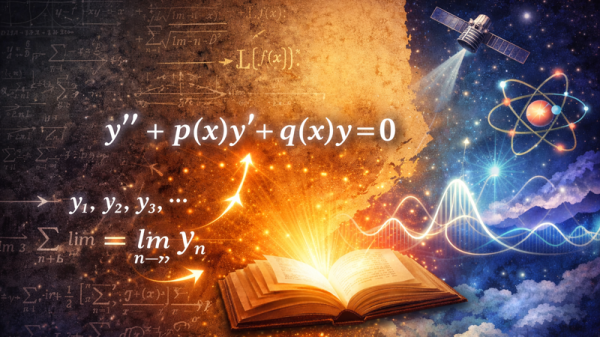
Ivan Remizov proposed a new approach by expanding the class of permissible mathematical operations. He did not argue with Liouville but simply added another mathematical tool to the equations—the limit of a sequence. To do this, the mathematician utilized Chernoff's theorem and Laplace transform. This allowed him to construct a universal formula that formally provides a solution to any equation from the 'unsolvable' class, circumventing the classical limitations of the theory.
"The essence of the idea is that a complex, constantly changing process is broken down into an infinite number of simple steps. For each of these segments, a separate approximation is constructed—a elementary fragment that describes the behavior of the system at a specific point. Individually, these pieces provide only a simplified picture, but as their number approaches infinity, they seamlessly combine into a perfectly accurate graph of the solution," explained the press release from HSE.
Second-order differential equations are used not only for modeling real-world events but also for defining new functions that cannot be specified otherwise. These include, for example, the so-called special functions of Mathieu and Hill, which are critically important for understanding how satellites move in orbit or how protons behave in the Large Hadron Collider.
A slightly more complex mathematical language about the discovery can be read found on the HSE website. The work is available in English published entirely in the 'Vladikavkaz Mathematical Journal'.
Source:
Source: 3dnews.ru
