

Today, educational software encompasses a suite of applications aimed at developing specific skills in students. However, such systems first emerged over a century ago — engineers and inventors have traveled a long path from imperfect mechanical "educational machines" to the first computers and algorithms. Let's delve into this in more detail.
Photo: / CC BY
Early experiments — some successful and others not
Educational software originated in the late 19th century. For a long time, the primary sources of knowledge remained mentors and books. The educational process consumed too much of teachers' time, and the results were often less than satisfactory.
The successes of the industrial revolution led many to what seemed like an obvious conclusion: students could be taught faster and more efficiently by replacing teachers with mechanical learning machines. An educational "conveyor belt" would thus prepare specialists with less time investment. Today, attempts to mechanize this process appear naive. However, this "educational steampunk" laid the foundation for modern technologies.
The first patent for a mechanical device for learning grammar was obtained in 1866 by American Halcyon Skinner. The machine consisted of a box with two windows. In one, the student would see pictures (such as a horse). In the other window, they would type the name of the object using buttons. However, the system did not correct errors or perform checks.
In 1911, a device for teaching arithmetic, reading, and spelling was patented by psychologist Herbert Austin Aikins from Yale University. The student combined three wooden blocks with shaped cutouts in a special wooden case. These blocks depicted, for example, elements of a simple arithmetic problem. If the shapes were correctly matched, a correct answer was formed at the top of the panels ().
In 1912, the foundation for new and more successful automated teaching methods was laid by American psychologist (Edward Lee Thorndike) in the book "Education". He believed the main drawback of textbooks was that students were left to their own devices. They might overlook important points or move on to new material without mastering the old. Thorndike proposed a fundamentally different approach: a "mechanical book," where the following sections could only be accessed once the previous ones had been properly completed.

Photo: / Unsplash.com
In Thorndike's extensive work, the description of the device took up , and he did not elaborate on his thoughts. However, this was enough for Sidney Pressey, a professor at Ohio University, inspired by the psychologist's work, a teaching system called the Automatic Teacher. On the machine's drum, the student would see a question and answer choices. By pressing one of four mechanical keys, they would select the correct answer. Afterward, the drum would rotate, and the device would "offer" the next question. Additionally, a counter tracked the number of correct attempts.
In 1928, Pressey patented his invention, but he did not fully realize Thorndike's idea. The Automatic Teacher could not teach but allowed for quick testing of knowledge.
Following Sidney Pressey, many inventors began to construct new "teaching machines." They combined 19th-century experience, Thorndike's ideas, and new-century technologies. By 1936, in the U.S., But then World War II began, halting work in this area, and substantial advancements would be delayed for nearly 20 years.
Frederick Skinner's Teaching Machine
In 1954, Cambridge University professor Burrhus Frederic Skinner formulated the main principles of studying grammar, mathematics, and other subjects. The concept as programmed learning theory.
It states that the main component of a learning device should be a strict program with elements for studying and testing material. The learning process is step-by-step—students do not progress until they have studied the required topic and answered the control questions. That same year, Skinner introduced a "teaching machine" for use in schools.
Questions were typed on paper cards and displayed frame-by-frame in a special window. The student entered the answer on the device's keyboard. If the answer was correct, the machine punched a hole in the card. What set Skinner's system apart from others was that after the first series of questions, the student would receive only those questions they had not answered correctly. The cycle repeated until there were no more unresolved tasks. Thus, the device not only tested knowledge but also taught students.
Soon, the machine was put into mass production. Today, Skinner's invention is considered the first device to successfully combine the results of theoretical research in pedagogical psychology with the technological innovations of that time.
The PLATO system, which existed for 40 years
Based on the theory of programmed learning, in 1960, a 26-year-old engineer (Donald Bitzer), who had just received his degree from the University of Illinois, the PLATO (Programmed Logic for Automated Teaching Operations) computer system.
PLATO terminals connected to the university mainframe . Their display was an ordinary television, and the user’s keyboard had only 16 keys for navigation. University students could study several thematic courses.
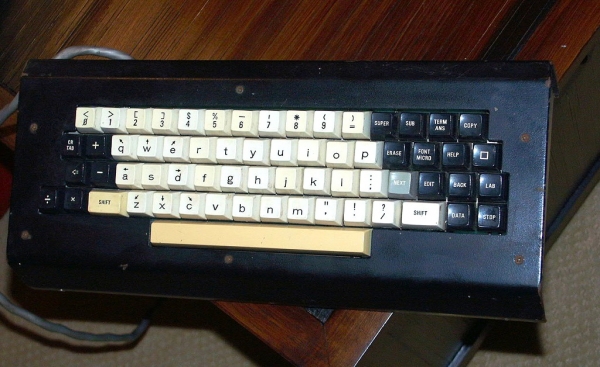
Photo: / PD / Клавиатура PLATO4
The first version of PLATO was experimental and had significant limitations: for example, the ability for two users to work simultaneously was available only in 1961 (in the updated version PLATO II). In 1969, engineers introduced a special programming language for developing not only learning materials but also games.
PLATO evolved, and in 1970, the University of Illinois entered into an agreement with Control Data Corporation. The device entered the commercial market.
Six years later, 950 terminals were already working with PLATO, and the total volume of courses amounted to 12,000 instructional hours across many university disciplines.
Today, the system is no longer used—it was discontinued in 2000. However, the PLATO Learning organization (now Edmentum), which was responsible for promoting the terminals, continues to develop educational courses.
“Can robots teach our children?”
With the development of new teaching technologies in the 1960s, criticism also began—mainly in popular American media. Headlines in newspapers and magazines like "Teaching Machines: A Blessing or a Curse?" spoke for themselves. from skeptics boiled down to three main topics.
First, there was insufficient methodological and technical training for teachers amid an overall shortage of staff in American schools. Second, the high cost of equipment and the limited number of courses. For instance, schools in one district spent $5,000 (a huge sum at that time) only to find that there were not enough resources for comprehensive education.
Third, experts were concerned about the potential dehumanization of education. Too many enthusiasts talked about a future where teachers would no longer be needed.
Subsequent developments showed that these fears were unfounded: instructors did not turn into silent assistants to computers, the cost of equipment and software fell, and the quantity of educational materials increased. But this only happened in the 1980s and 1990s, when new developments overshadowed the successes of PLATO.
We will talk about these technologies next time.
What else we are writing about on Habr:
Source: habr.com
