

Recently, I conducted a small survey for Habr readers on programming languages such as Rust, Dart, and Erlang to find out how rare they are in the Russian IT market.
In response to my research, I received a lot of comments and questions regarding other languages. I decided to gather all your feedback and conduct another analysis.
The study included languages such as Forth, Ceylon, Scala, Perl, Cobol, as well as some other languages. Overall, I analyzed 10 programming languages.
To make it easier for you to absorb the information, I conditionally divided the languages into two groups: rare (little demand and low supply) and popular (languages in demand in the Russian IT market).
The basis of my analysis, as in the previous case, consisted of data obtained from the Headhunter portal, from LinkedIn, as well as personal statistics from my agency. For a more accurate analysis of rare languages, I used the Amazing Hiring service.
For those who do not know what Amazing Hiring is — let me explain. This is a special service that "parses" all information about specialists from the entire internet. With its help, you can find out how many specialists list a particular language in their skills.
So, let’s start with popular programming languages.
Demanded Languages
Verilog, VHDL
These primary hardware description languages are quite popular in the Russian IT market. 1870 specialists indicated on Headhunter that they know Verilog. A search for VHDL will yield 1159 resumes. 613 specialists are proficient in both languages. Two developers listed knowledge of VHDL/Verilog in their resume titles. Separately, 19 developers know Verilog as their primary language, and 23 know VHDL.
68 companies are offering jobs to developers knowledgeable in VHDL, while 85 are for Verilog. Of these, there are 56 overlapping vacancies. 74 jobs have been posted on LinkedIn.
Interestingly, these languages are popular among young specialists aged 18 to 30.
Since VHDL and Verilog often go together, I will demonstrate the approximate ratio of the number of resumes to the number of vacancies using the VHDL language as an example. For clarity, I have highlighted separately the developers who mentioned knowledge of VHDL in their resume titles, as shown in the figure:
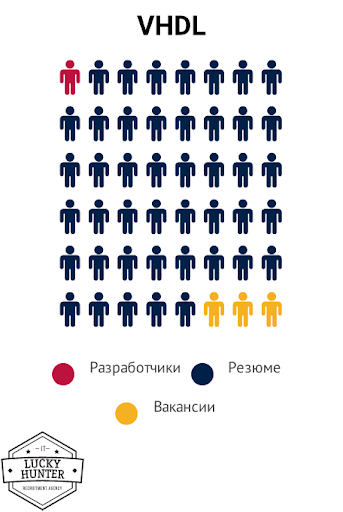
The image shows the ratio of the number of vacancies to the number of posted resumes. Developers specializing in VHDL hardware description are indicated in red.
Scala
Arguably one of the most popular and sought-after languages on the list. The language has made it into various rankings. It ranks 18th among the most popular languages. It is also one of the favorites among developers, ranking 12th in the list, and furthermore, Stack Overflow has classified Scala as one of the most expensive programming languages. The language comes in just after Erlang, holding the 8th position. The average global salary for a Scala developer is $67,000. Scala developers earn the most in the USA.
On Headhunter, 166 professionals have included knowledge of Scala in their resume titles. A total of 1,392 resumes have been published on Headhunter. This language is highly popular among young specialists. Scala is usually associated with Java. LinkedIn has 2,593 resumes, of which 199 are specifically Scala developers.
In terms of demand, the situation is very good. There are 515 active job postings on Headhunter, of which 80 list Scala in the job title. On LinkedIn, 36 companies are specifically looking for Scala developers. In total, 283 companies are offering jobs for people knowledgeable in Scala.
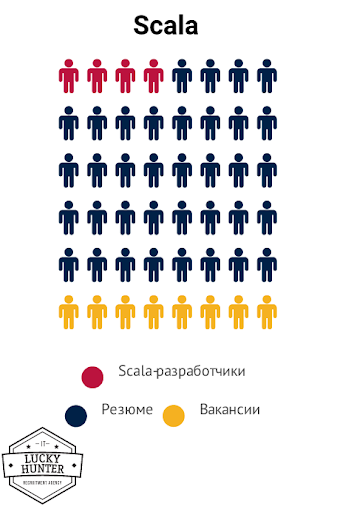
The image shows the ratio of the number of job vacancies to the number of published resumes. Scala developers are indicated in red.
Besides the fact that Scala developers are in demand in the Russian market, they receive high salaries. According to my agency's statistics, Scala developers cost more than Java developers. Currently, we are in the process of finding a Scala developer for a company in Moscow. The average salary offered by employers for middle + level specialists starts from 250,000 rubles.
Perl
The most 'rare' language in my list of rare languages turned out to be Perl. Over 11,000 IT specialists listed Perl as a key skill, with 319 including the language in their resume titles. On LinkedIn, I found 6,585 specialists knowledgeable in Perl. There are 569 active vacancies on Headhunter and 356 on LinkedIn.
There are fewer developers who have included knowledge of Perl in their resume titles than there are published vacancies. Perl is not only a popular language but also one that is in demand in the market. Here are the statistics:
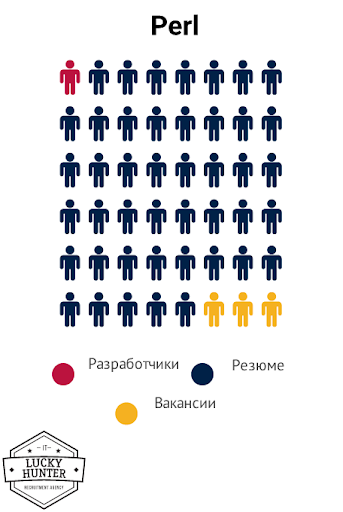
Statistics shows that Perl is one of the most expensive programming languages (the global average is $69,000) and one of the most popular in the world. More than 4% of developers are proficient in Perl.
Despite the high prevalence of the language, job offers for Perl developers have long been coming from existing IT projects on the market. In the last three years, my agency has not received a single request to find a Perl developer for a new IT project or startup.
Statistics:
If we compare the demand for all popular programming languages, the picture looks like this: the most popular language among those used is Perl. There are 925 job offers for Perl on HeadHunter and LinkedIn. Scala follows closely behind Perl with 798 job offers.
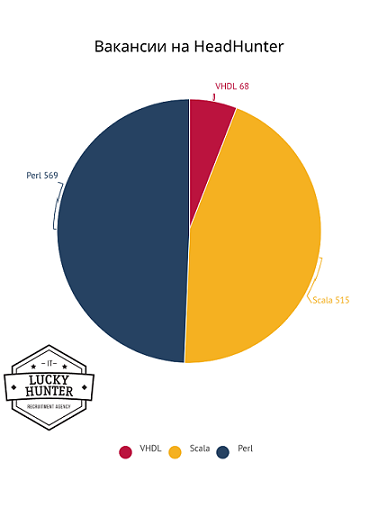
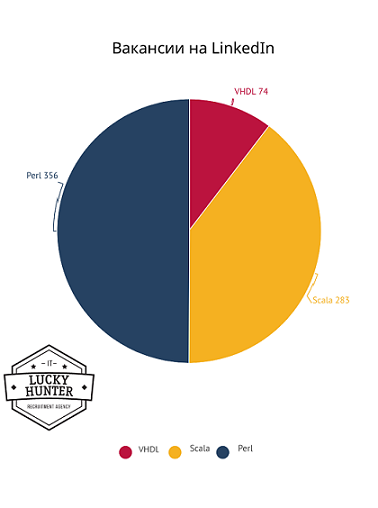
The diagrams presented show the number of published vacancies for programming languages: VHDL, Scala, Perl.
Rare programming languages
Forth
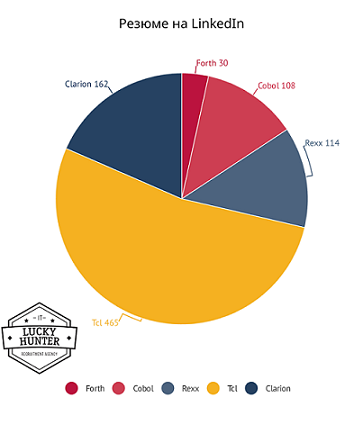
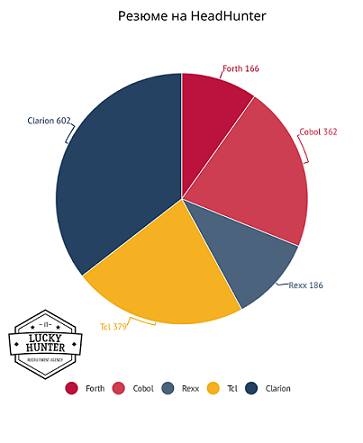
The Forth programming language emerged in the 1970s. It is currently not in demand in the Russian market. There are no vacancies on either Headhunter or LinkedIn. 166 specialists have listed knowledge of the language on Headhunter and 25 on LinkedIn.
The vast majority of applicants have over 6 years of experience. Specialists with knowledge of Forth request salaries ranging from 20,000 rubles to 500,000 rubles.
Cobol
One of the oldest programming languages. Most developers are older (over 50 years) with significant work experience. This is also confirmed by a recent ranking , which mentions that the most experienced programmers code in Cobol and Perl.
I found a total of 362 resumes on Headhunter and 108 resumes on LinkedIn. Knowledge of Cobol is mentioned in the resumes of 13 specialists. As with Forth, there are currently no job offers for those skilled in Cobol. Only one job for Cobol developers was found on LinkedIn.
Rexx
Developed by IBM and reaching the peak of its popularity in the distant 90s, the Rexx language has now become one of the rarest languages on my list.
186 developers mentioned knowledge of Rexx in their resumes on Headhunter and 114 on LinkedIn. However, I could not find any job vacancies for Rexx developers on either platform.
Tcl
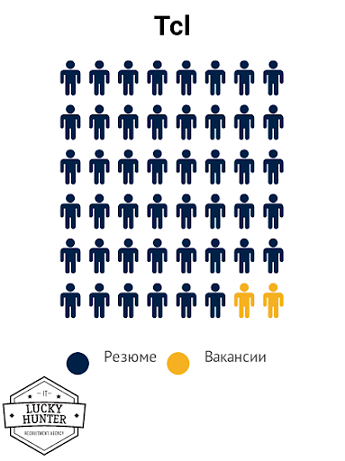
There is demand for the language, but I wouldn't classify it as in high demand. There are 33 job postings on Headhunter and 11 on LinkedIn. The salaries offered to those with "Tcl" knowledge are not very high, ranging from 65,000 rubles to 150,000 rubles. A total of 379 developers listed the language on Headhunter and 465 on LinkedIn. Only one developer included Tcl in their resume title.
This is how the ratio of job postings to resumes mentioning Tcl skills looks:
Clarion
I didn't find any active job postings requiring Clarion knowledge. However, there are some offers. 162 people stated on LinkedIn that they know this language, while 502 specialists listed it on Headhunter, with three including it in their resume title. Amazing Hiring found 158 specialists who are familiar with the Clarion language in some capacity.
Ceylon
Developed by Red Hat in 2011. Based on Java. Hence the name of the language: the island of Java is known as a coffee supplier, while the island of Sri Lanka, formerly known as Ceylon, is a global tea supplier.
The language is indeed extremely rare. There are no job postings and practically no resumes. I found literally one resume on Headhunter. The Amazing Hiring service lists only 37 specialists across Russia.
Statistics:
When comparing all rare languages by the number of resumes, interesting statistics emerge: on LinkedIn, the most specialists indicated knowledge of Tcl, while on Headhunter, Clarion turned out to be the most popular language on the list. The least popular language among developers was Cobol.
My small analysis showed that Ceylon is indeed a rare language, with no demand or offers in the Russian IT market. Other rare languages include Forth, Cobol, Clarion, and Rexx. In contrast, Perl and Scala proved to be highly sought-after and popular languages, which can be confidently removed from the list of rare programming languages.
Source: habr.com
