

The seventh release of the Orbitiny Desktop environment has been published, built from scratch using the Qt framework. The project aims to combine innovative ideas that have not been seen before in user environments with traditional elements such as panels, menus, and icon placement on the desktop. Currently, the focus is on launching in X server-based environments, but support for Wayland may be added in the future. The code is written in C++ and is distributed under the GPL license.
In the new version
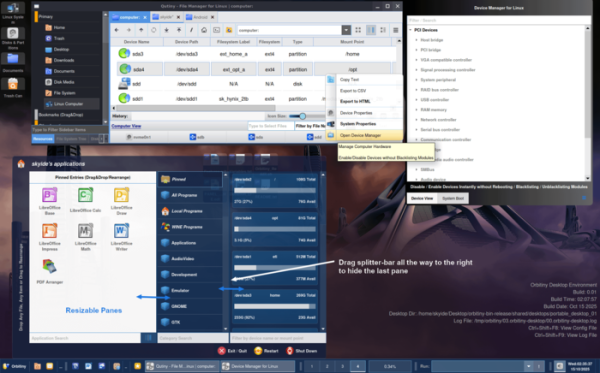
- An interface called 'Linux Computer' has been added, providing access to system information and a list of available devices, allowing users to disable and activate devices without manually blacklisting the associated kernel modules or rebooting the system. It can be accessed via a desktop shortcut, a button in the file manager's sidebar, or the 'computer:' handler.
- In the Qutiny file manager, a section for system information titled 'System Properties / Information' has been implemented. Context menu options for opening a directory in a new window and exporting a list of selected files in HTML format have been added. When viewing search results, users can switch between viewing modes: a compact list, a full list, and icons.
- Enhanced capabilities for resizing panels have been introduced.
Features of Orbitiny Desktop:
- A panel that supports functionality extension through plugins, drag-and-drop manipulation (for instance, files can be moved from the desktop to the panel, and applets can be swapped), and saving different profiles that define their own set of applets and settings. There are 18 plugins available, such as an applet that implements a start menu for navigating installed applications.

- Support for screen gestures, initiated by tracing a specific shape on an empty area of the desktop while holding the mouse button. Up to 12 screen gestures can be defined for each mouse button. For instance, a gesture can be linked to launch a required program.
- A custom set of utilities and applications, such as a file manager, a notification output system, a file search interface, and a screenshot creation tool. The desktop can be launched in any existing user environments, including KDE and GNOME—in this case, Orbitiny displays its own full-screen window that covers the existing desktop.
- The ability to use any directory for desktop content placement (not bound to $HOME/Desktop). Different desktops are displayed on each screen.
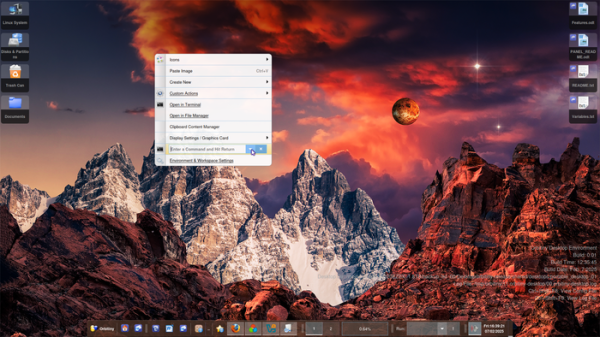
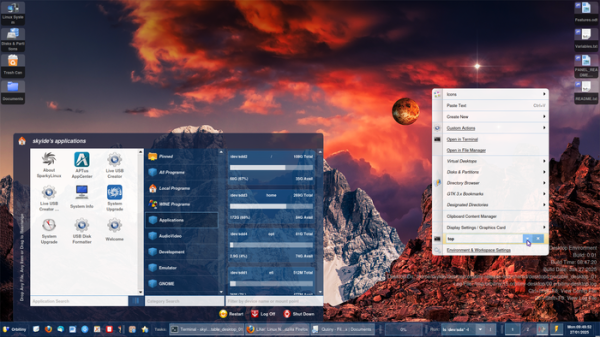
- Support for defining personal context menus that do not block other applications. An integrated interface in the context menu for navigating directory content (Directory Browser). A button in the context menu to run arbitrary commands on selected files.
- Display of special tags on file icons copied or moved to the clipboard. The tag also appears when the content of the directory changes.
- The ability to merge files by dragging one file onto another with the mouse.
- Support for pasting from the clipboard to the end or the beginning of an existing file. If pasting occurs in a directory, a file is created automatically. It is possible to paste from the clipboard directly into multiple selected directories.
- A feature to open a terminal emulator for the selected directory (if multiple directories are highlighted, multiple terminals can be opened at once).
- Support for defining actions that can be applied to selected files.
- A dashboard window showing ongoing tasks and installed applications.
- Portable Mode, in which all necessary working files and programs are placed in a separate directory or on a Flash drive to recreate the existing environment on another system.
- Built-in support for Wine and DOSBOX — you can click on an exe file, and it will run in Wine.
- Support for MAFF (Mozilla Archive Format) files for packaging web page content into a single archive.
- The ability to bind multiple commands to a single shortcut (for example, one command for a left mouse click and another for the middle one).
- The ability to change the scale of icons on the desktop through the context menu or by using Ctrl+mouse wheel.
- The ability to bind actions triggered by double-clicking on assigned empty areas of the desktop.
- A device manager that allows enabling and disabling available hardware devices at the kernel module load and unload level.
- Built-in configurator (Control Panel).
Source: opennet.ru
