

As our latest research shows our article on ISTQB certification. The first part What is ISTQB, the levels of ISTQB certification, and how necessary is it for you?
ISTQB is a non-profit organization that addresses issues of development in the software testing field, founded by representatives from 8 countries: Austria, Denmark, Finland, Germany, Sweden, Switzerland, the Netherlands, and the United Kingdom.
ISTQB Tester Certification is a program that allows specialists to obtain an international certification in testing.
As of December 2018,
Sounds great, right? However, is certification really necessary? What advantages does having a certificate give to testing specialists, and what opportunities does it open up for them?
Which ISTQB to choose?
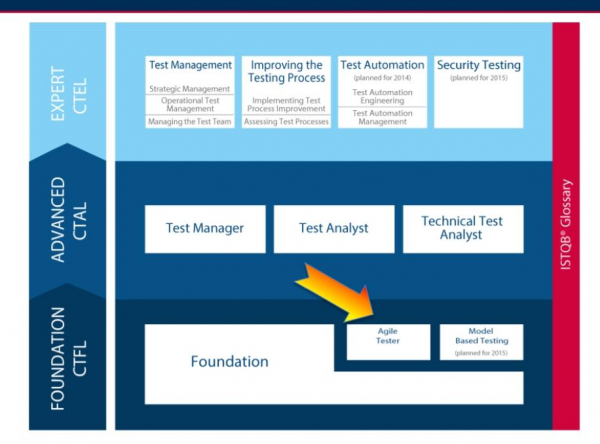
First, let's break down the certification options for testing specialists. ISTQB offers 3 levels of certification and 3 specializations for each level according to the matrix:
What you need to know about choosing levels and specializations:
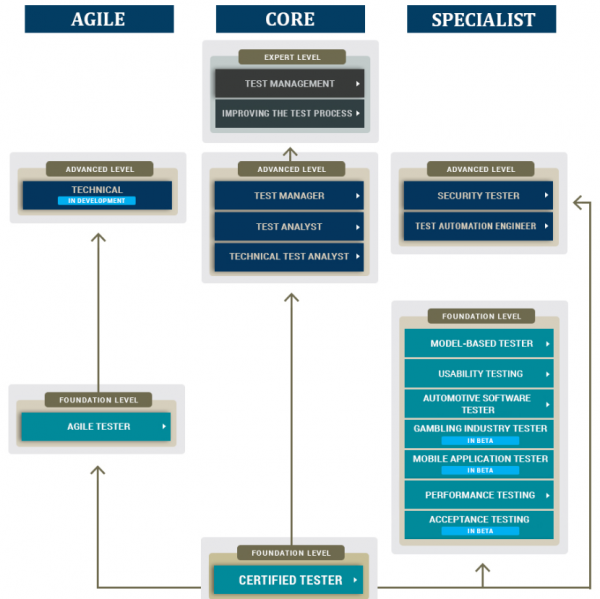
1. Foundation Level (F)
Core specialization – the basis for any higher-level certificate. 2. Level F
Specialist specialization – a narrow specialization certification is provided for it: usability, mobile application, performance, acceptance, model-based testing, etc. 3. Level F and Advanced (AD)
Agile specialization – demand for such certificates has increased by more than 20% in the last 2 years. 4. Level AD
– certification is available for: — test managers;
— test automation engineers;
— test analysts;
— technical test analysts;
— security testing.
5. Expert Level (EX)
– involves certification in test management and process improvement in testing. By the way, when choosing certification levels for the specialization you need, refer to the information on the main website.
When choosing certification levels for the direction you need, refer to the information on the main website. , as providers' websites may have inaccuracies in their descriptions.
Let's talk about the advantages
From a QA specialist's perspective, certification is:
1. First of all, confirmation of qualifications and competence by international experts in the field of testing, which, in turn, opens access to new labor markets. At the international level, the certificate is recognized in 126 countries worldwide – a paradise for remote work or a prerequisite for relocation.
2. Increased competitiveness in the labor market: although most employers do not require the ISTQB certificate from applicants, about 55% of test managers note that they would prefer to have a 100% staff of certified specialists .
3. Confidence in the future. A certificate does not guarantee a top salary upon employment or automatic promotion at work, but it serves as a kind of 'non-depreciable asset,' below which your work will not be valued.
4. Expansion and systematization of knowledge in the QA field. Certification is an excellent way for a QA specialist to grow and enrich their knowledge of testing. And if you are an experienced tester, it helps to update and organize knowledge in the subject area, including through international standards and industry methodologies.
From the company's perspective, certification is:
1. An additional competitive advantage in the market: companies with a staff of certified experts provide low-quality consulting and QA services much less frequently, which positively reflects on their reputation and the stream of new orders.
2. A bonus when participating in large tenders: having certified specialists gives companies an edge when competing in tenders.
3. Risk reduction: having a certificate indicates that specialists are well-versed in testing methodologies, which reduces the risks of conducting low-quality test analysis and may increase testing speed by optimizing the number of test scenarios.
4. Advantages in the international market when providing testing services for software intended for foreign clients and foreign software.
5. Growth of competencies within the company. through mentorship and training of non-certified specialists to recognized international standards in testing.
For companies, there are several additional interesting bonuses and areas offered by ISTQB:
An international award in the field of software testing for outstanding long-term contributions to software quality, innovation, research, and the promotion of the software testing profession.
Award winners are experts in testing and development, authors of research, and new approaches in testing.

The program recognizes organizations with demonstrated commitment to software testing certification. It includes four levels of partnership (Silver, Gold, Platinum, and Global), and the organization's partnership level is determined by the number of certification points it has accumulated (Eligibility Grid).
What are the features:
1. Inclusion in the list of partner organizations on the ISTQB website.
2. Mention of the organization on the websites of the ISTQB National Council of Members or exam providers.
3. Privileges regarding ISTQB-related events and conferences.
4. The right to receive a beta version of the new ISTQB Syllabi program with the opportunity to contribute to its preparation.
6. Honorary membership in the exclusive 'ISTQB Partner Forum'.
7. Mutual recognition of ISEB and ISTQB certification.
In turn, ISTQB publishes information about the conference on its official website, and event organizers participating in the Conference Network provide a discount:
— to ISTQB certificate holders for participation in the event;
— to partners Partner Program.
This is a collection of examples and practices from companies and institutions in various countries collaborating with ISTQB. For instance, the development of a new direction considering testing trends in the country (Canada), the advancement of ISTQB certification among students (Czech Republic).
What do testing specialists think about ISTQB certification?
Opinions of the specialists from the 'Quality Laboratory'.
Anzhelika Pritula (ISTQB CTAL-TA certification), leading testing specialist at 'Quality Laboratory':
– What motivated you to obtain this certificate?
– It is a necessary requirement abroad to get a job as a serious tester. At that time, I was living in New Zealand and was hired by an organization that develops an anesthesia control system for operating rooms. The system is government-approved in NZ, so there was a mandatory requirement for the tester to be certified. The company paid for both of my certifications. I only had to prepare and pass.
– How did you prepare?
– I downloaded free textbooks from the official website and prepared using them. I studied for the first general exam for 3 days, and for the second advanced one – for 2 weeks.
I must mention that my experience may not be applicable to everyone, as I have an education in development. By that time, I had spent 2 years working in software development before transitioning to testing. Furthermore, my English is almost at a native level, so it wasn’t a problem for me to prepare and take exams in English.
– What advantages and disadvantages do you personally see in ISTQB certification?
– The advantages are undeniable; this certificate was required everywhere when applying for jobs. Additionally, having an advanced certificate in test analysis later became a pass for working in the Ministry of Economy NZ and subsequently in a subsidiary of Microsoft.
The only downside is the high cost. If the certificate isn’t paid for by the company, the expense is significant. When I took it, the basic one cost 300 dollars, and the advanced one – 450.
Artem Mikhalyev, account manager at 'Quality Laboratory':
– What is your opinion and attitude towards ISTQB certification?
– In my experience, this certificate is primarily obtained by employees of companies participating in tenders in Russia. As for the assessment of knowledge during certification, I believe it is a good preparation.
– Please tell me more about tenders.
– Usually, to participate in tenders, a company needs a certain number of certified employees. Each tender has its own conditions, and to participate, you must meet the criteria.
Yulia Mironova, co-trainer of Natalia Rukol's course "Comprehensive Training System for Testers under the ISTQB FL Program," holder of the ISTQB FL certificate:
– What sources did you use to prepare for the exam?
– I prepared using exam dumps and with the help of the comprehensive training system (CTS) for ISTQB from Natalia Rukol.
– What advantages and disadvantages do you personally see in ISTQB FL certification?
– The main advantage: the person had the patience to study and pass the theory – which means they are eager to learn and can adapt to new projects and tasks.
The main disadvantage is the outdated course program (2011). Many terms are no longer used in practice.
2. Opinions of specialists from different countries:
What do testing and software development specialists from the USA and Europe think:
“Creative thinking is more valuable than certification. In hiring situations, I generally prefer someone with direct work experience over a certified specialist. Moreover, if the certification of a certified specialist does not add value to the work, it becomes more of a negative indicator than a positive one.”
Joe Cole Mendon, Massachusetts.
“Certificates can help in selecting the best part of specialists in the labor market, from which you can then choose a subset that truly meets all the requirements. Certificates are not a cure-all for staffing problems and will not serve as a reliable, ironclad guarantee of an employee's necessary skills.”
Debashish Chakrabarti, Sweden.
"Does having a certificate mean that the project manager is a good specialist? No. Does it mean that he is interested in spending time on himself and promoting the profession through continuous education and participation? Yes."
Riley Horan, St. Paul, Minnesota
3. What's happening in the job market: is certification in testing necessary for job applications?
We based our analysis on publicly available job data from LinkedIn and examined the ratio of certification requirements for testing specialists to the total number of testing vacancies.
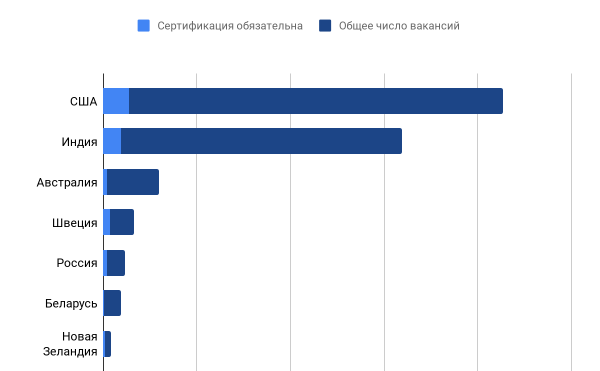
Observations from the labor market analysis on LinkedIn:
1. In the overwhelming majority of cases, certification is not a mandatory requirement for employment as a testing specialist.
2. While certification is issued indefinitely, some job postings include timed requirements for obtaining the certificate (Certified ISTQB Foundation level in the past 2 years will be a plus).
3. Applicants for high-qualification vacancies in specialized areas of testing are required to have the coveted paper: automated testing, test analysis, test management, senior QA.
4. ISTQB is not the only option for certification, equivalents are also accepted.
Conclusions
Certification may be a mandatory requirement for certain companies or government projects. When deciding whether to obtain an ISTQB certificate, consider the following realities:
1. When choosing a candidate for a testing specialist position, the determining factors will be experience and knowledge, rather than possession of a certificate. However, among applicants with similar skills, preference will be given to certified specialists.
2. Certification aids career development (for 90% of managers, it is important to have 50-100% certified testers on the team); additionally, in some foreign companies, obtaining a certificate is a reason for a salary increase..
3. Certification helps boost your confidence.It also helps you develop the ability to think about things from different angles, allowing you to grow as a specialist.
In the first part of our article We have attempted to answer the question: “Is an ISTQB certificate really necessary?”; if it is, then for whom, which one, and why. We hope this article was useful for you. Please share in the comments if any new horizons opened up for you after obtaining your certificate or, in your opinion, if ISTQB is just another useless piece of paper.
In the second part of the article QA engineers from the 'Quality Lab' Anna Paley and Pavel Tolokonin will share their personal experiences of how they prepared, registered, took the test, and obtained ISTQB certificates both in Russia and abroad. Subscribe and stay tuned for new publications.
Source: habr.com
