


In of our article on ISTQB certification aims to answer the questions: Who? and Why? is this certificate needed. A little spoiler: collaborating with ISTQB opens more doors primarily for the employer company than for the newly certified holder.
In The second part of the article features our colleagues sharing their stories, impressions, and insights about taking the ISTQB test, both in the CIS and abroad.
How to take certification abroad?
Pavel Tolokonin,
a leading testing specialist at the ‘Quality Lab’
I work remotely and spend a considerable amount of time traveling. When the question arose about taking the certification exam, I was not in Russia.
Next, I will explain how to find an authorized certification center in the desired country, what organizational questions to ask, what pitfalls may arise before and after the exam, and share my personal experience of taking it.
I was in Southeast Asia and considered several countries: Thailand (where I lived), Vietnam (where I traveled), and Malaysia (which is relatively easy to reach). Each ISTQB member country has brief information listed on the official page:, which, in turn, contains information about:
- specific organizations where you can enroll for a preparatory course or take certification;
- levels of certification;
- the language in which the certification is conducted;
- contacts of responsible persons.
At this stage, I already ruled out Vietnam: certification is available only in Vietnamese.
In most cases, after studying the local site, you can simply choose a specific organization, but there may be cases where the local site is inactive. With my Thai this precisely happened. What can be done here: As a rule, if an organization is certified for training, it is also certified to conduct the exam.
You can also review the list of accredited operators in the section and check the contacts of local representatives on their organizations' websites. I even managed to write to the contact address on the main ISTQB website, but no one responded.
After researching the Thai and Malaysian exam schedules, I decided on the one Thai center in Bangkok. The next step was communication, and here is what I asked (even though some of this information was on the website):
- the main question: Can I, a foreigner temporarily in the country on a tourist visa, take the exam?
- what documents, in what form and by what deadlines need to be submitted?
- according to which (the textbook on which the exam is based; at the time of writing, there are 2 options – from 2011 and 2018) can the exam be taken and how to specify the specific one?
- how can I arrange for extra time on the exam, if English is not my native language?
- how many days in advance and in what manner should the payment?
- where and how long in advance do I need to arrive on the day of the exam.
Speaking about my specific experience, I needed to provide the following information before the exam and payment:
- name;
- current address;
- phone;
- as well as:
- send a copy of the passport page (which also serves as confirmation that English is not my native language);
- indicate the date and time of the exam from the proposed options;
- specify the syllabus.
Payment needed to be transferred to a bank account so that the funds were credited no later than 5 days before the exam. By the way, the cost of taking the exam varies by country. While in Russia, the cost of the ISTQB FL exam is €150, in Thailand it is 10,700 THB, or about €300.
In general, most foreign websites I examined (Vietnamese, Malaysian, Thai) provide information quite comprehensively and clearly. The Thai company also pleased me with quick responses (within 1-2 hours), even during official public holidays.
What I didn’t ask, but should ask:
- In what format is the exam conducted? (agree, there's a difference – solving questions from a paper sheet or marking options on a tablet, with the ability to change answers and quickly sort unanswered/marked questions);
- how long will it take to process the results?
- in what time frame and in what form is the certificate provided?
- where will the information about the certificate be posted?
Total: I chose the exam based on the 2011 syllabus (as there is more preparation material available for it), sent all the information, and made a bank transfer to the account, about which I immediately notified the company. They confirmed the receipt of the payment and my registration for the exam.
Important point! Three days before the exam, I received an official letter confirming my registration along with all contact information. This was not on my list, and I was fortunate that the information was included in the letter. My contact person provided their mobile number, which played a crucial role in my story.
A few words about my preparation
I prepared independently, using the syllabus and glossary downloaded from the official website (all the necessary materials are available), plus I used to understand which sections I struggled with (the questions from the dumps did not match the actual exam at all).
I created a Google spreadsheet where I wrote down my answers, compared them with the correct ones, noted which section they belonged to, and thoughtfully reread them. Looking ahead, I will say that I ultimately scored 100% on the most challenging topics because I constantly worked on them.
The exam took place on a Saturday in Bangkok. The testing company was located in a large business complex in the city center, where I arrived a few hours before the exam, as I was traveling from another city. I checked at the reception if the correct office was located there, but when I tried to go through, I received the standard Thai response: 'No can, madam. Today is Saturday, the offices are closed, please come back on Monday.' AAAAAAAAH!!! 'This can't be,' I thought, 'this is the right address, here's the office sign, here's the letter confirming my exam, I’ll try again.'
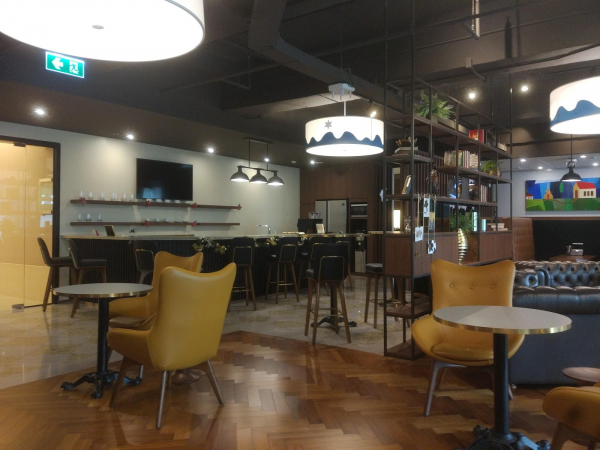
Company lobby
The secretaries honestly called the office on the internal phone and reiterated that everything was closed and no one was answering. AAAAAAAAAAAAAAAA!!! And here the mobile number of the company representative came into play. I called and found out that on that day, two people were taking the exam in the center, including me, so the office would open half an hour before my exam, and right now it was empty. When I waited for the necessary time, I was all alone, even though the office was large, with many classrooms for lessons and exam rooms.
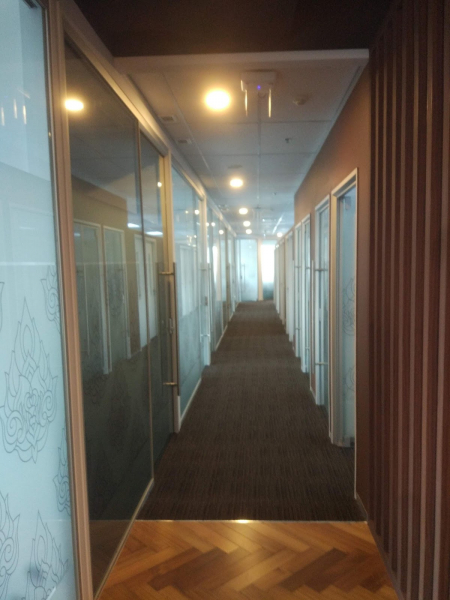
Examination rooms and classes
Since there was no one else to wait for, I was offered to start "right now." The exam took place in a small room: a table, a chair, a compartment for belongings, a tablet, a sheet of paper, a pen, and a pencil.
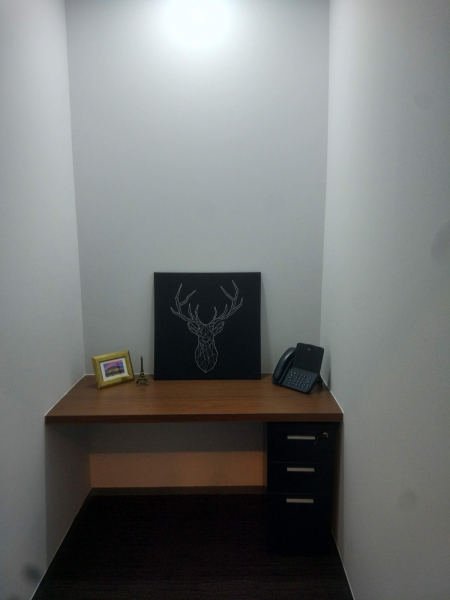
In a similar room, instead of a picture of a deer, I had a tablet.
They showed me the interface of the program, and the 75-minute countdown began. Taking the exam electronically is very convenient, and another huge plus is that you find out the results immediately.
What happens after the exam?
First of all, you will most likely receive an official letter with the results from the center where you took the exam. Secondly, you will receive a letter from the accredited organization that actually issues the certificate. In my case, it was GASQ. They also sent a letter with a link to register me as a certified specialist on their website and for subsequent registration on the site. . Here you need to be careful with the data: my first and last name were mixed up, which required additional correspondence to correct. A few days after all the formalities, if you took the exam after 2017, you should appear here:
- on the website
- on the website .
You will also receive an electronic certificate.
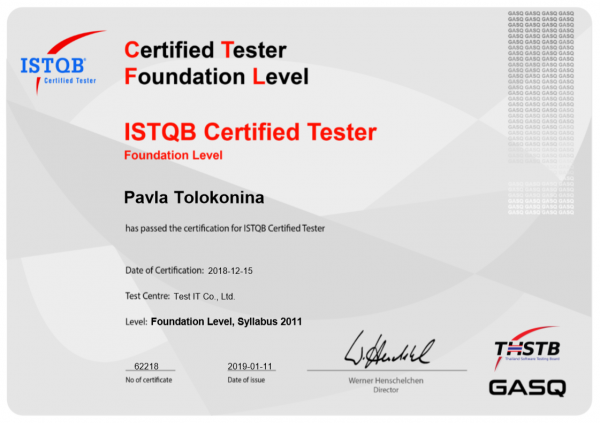
My experience shows that in case of questions, it is better to correspond with the company where you took the exam—as the most interested party. For example, I received the certificate, appeared on the GASQ website, but they added me with a delay of a couple of months—I had to correspond with the operator who, in turn, was resolving the issue with GASQ about where they lost my registration. Overall, as it turned out, going through certification abroad is not difficult at all. I hope this description helps you if you decide to repeat my experience. .
How I prepared for certification in Belarus
Anna Paley,
test manager at the "Quality Laboratory"
I first thought about taking the ISTQB certificate exam like this: "An international certificate confirming competencies in testing? That's great, I definitely need to take it!"
Then there was a period of critical reflection:
1) Will this certificate give me an advantage in the job market and in my company?
1) Will this certificate give me any advantage in the job market and within my company?
2) Is the exam format in the form of a test with multiple-choice answers? Will it accurately assess my knowledge level?
3) Why is it so expensive?
4) Why are there so many certified specialists – is it worth it?
I had many doubts, and I decided to test the waters by enrolling in the course "Comprehensive Preparation System for ISTQB FL (CPS)" by Natalia Rukol. Why not study independently? I'm a procrastinator, I juggle many tasks at once, and I often struggle to focus long enough to read a book cover to cover, so the organized presentation of the syllabus material seemed the most optimal. Plus, the practical sessions definitely appealed to me as they would be useful in my work.
Everything was not in vain, I thought, and I began studying the course. I also used the glossary and syllabus when I felt that the webinar knowledge was insufficient (for example, on the topic of testing types).
In addition to that, I received:
1) Feedback from experts in testing – which is helpful.
2) A practical training session after each theoretical lesson (a person remembers only 50-60% of information from a presentation and up to 90% if they practice the theory themselves).
3) Analysis of all complex and niche topics from the syllabus, such as static testing.
4) As the most useful bonus: I still use practical tasks on basic and advanced testing techniques.
After completing the course and some time for reflection, I finally decided to take the exam. I am from a small town, Mozyr, in the Republic of Belarus. Currently, you can only take the exam in two cities: Minsk and Gomel, which is not very convenient for other residents. Personally, I had to get up at 4 AM to get to Minsk in time for the exam.
Other than that, there were no problems. Belarus has its own ISTQB partner and certification center. I met the ISTQB direction curator in Belarus, Natalia Iskortsova, during my preparation courses at the Quality Laboratory; she assisted with consultations.
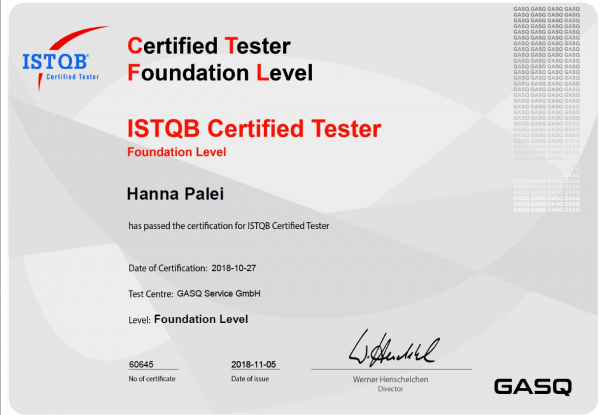
Having thoroughly prepared, I registered without any issues, passed the exam, received my certificate, and validated it on the website. My efforts paid off, I am now a certified software testing specialist.
Was certification necessary?
Personally for me – yes, but not as a fact of its existence, rather as proof of skills and experience at a certain level. In no way as a final destination, but more as a logical conclusion of a completed stage and a sort of 'check-in point'.
That's all the stories for today
I hope this information helps you somehow on your path to the coveted certificate. But these are all our stories; how did you prepare for, take, and obtain your ISTQB? Who has the most exotic country for taking the exam? What impressions and perhaps adventures do you have related to certification? Share your stories in the comments, let's discuss!
Source: habr.com
