

Saudi scientists have conducted a series of experiments with solar cells in the shape of a small sphere. The round shape of the photovoltaic cell allows for better capture of reflected and scattered sunlight. While this may not be a practical solution for industrial solar farms, spherical solar cells could prove to be a real breakthrough for a range of applications.
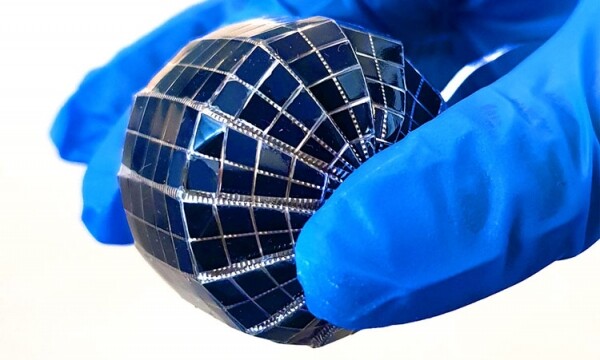
A group of researchers from the King Abdullah University of Science and Technology has expanded its work on creating solar panels with varying degrees of surface curvature with new research. In particular, they a spherical solar cell the size of a tennis ball and conducted numerous experiments with it. This was made possible by the 'corrugation' technology for flat solar panels, where grooves are created in the silicon substrate using lasers, providing safe bending points for the panels.
A comparison of the performance of flat and spherical cells of the same area in a room with an artificial solar radiation source showed that under direct lighting, the spherical solar cell produces 24% more output power than a traditional flat solar cell. After heating the cells with 'solar rays', the advantage of the round cell increases to 39%. This is due to the fact that heating reduces the efficiency of the panels, and the spherical shape dissipates heat into the surrounding space more effectively and suffers less from overheating (retaining high efficiency for a longer period).
If both the round and flat solar cells were to capture only diffuse light, the output power from the round cell was 60% greater than that from the flat cell. Moreover, a well-chosen reflective background, as the researchers experimented with various natural and artificial reflector materials, allowed the spherical solar cell to outperform the flat one in terms of energy generated by 100%.
Researchers believe that spherical solar cells could drive the development of the Internet of Things and other autonomous electronics. Collectively, they promise to be cheaper than the use of flat solar cells. Spherical solar panels do not require sun-tracking systems and may also perform better in indoor settings.
In the next phase of research, scientists plan to test the effectiveness of spherical solar panels in various locations around the world under a wide range of potential lighting conditions. They also hope to create large-area spherical solar cells, ranging from 9 to 90 m². Finally, the researchers intend to explore other forms of curved surface solar cells, hoping to find the ideal solution for specific applications.
Source: 3dnews.ru
