

Canonical has announced the preparation of separate builds of Ubuntu 24.04, specifically optimized for the Milk-V Mars board, which is equipped with a 4-core 64-bit StarFive JH7110 processor (1.5GHz) based on the RISC-V (RV64GC) architecture. Notably, this is the first compact board based on the RISC-V architecture, comparable in size to a credit card (board dimensions 85 x 56 mm). The board is also remarkable for its relatively low cost for RISC-V boards—priced at $39 for the minimum configuration with 2 GB of RAM.
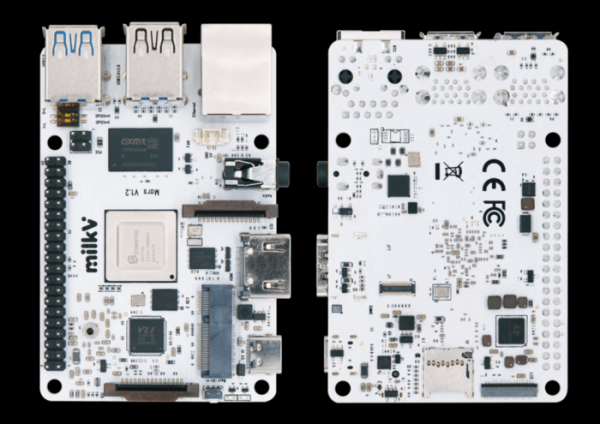
The board comes in configurations with RAM sizes of 1, 2, 4, or 8 GB (LPDDR4) and features slots for eMMC and Micro SD cards, three USB 3.0 ports, one USB 2.0 port, an HDMI 2.0 port supporting 4K resolution, an RJ45 (Ethernet) socket, an M.2 E-Key slot for connecting Wi-Fi/Bluetooth modules, an MIPI CSI (Camera Serial Interface) interface, and a 40-pin GPIO. It is possible to connect two monitors to the board (one via HDMI and the other via MIPI DSI) and to organize power through Ethernet (PoE). Hardware acceleration for H.264, H.265 (4K@60fps), and JPEG decoding, as well as H.265 (1080p@30fps) and JPEG encoding, is supported.
Two versions of the Ubuntu builds are available for download—a pre-assembled boot environment for copying to an SD card and an installation image for installation on eMMC, USB drive, or NVMe. The builds correspond to Ubuntu Server 24.04 with the Linux 6.8 kernel. Among the limitations mentioned in Ubuntu are the lack of support for the integrated GPU and incomplete PCIe support (an NVMe drive can be used, but currently, connections for Wi-Fi modules and external GPUs are not supported), with only the USB 3.0 ports being supported as of now, while the USB 2.0 port is unavailable.
It is noted that as part of a strategic cooperation agreement between Milk-V and Canonical, the Ubuntu distribution will also be adapted for use on other Milk-V devices, including future products. The Ubuntu platform will be promoted as the primary supported and maintained system for all Milk-V board variants, with an emphasis on supporting computational acceleration mechanisms and AI.
In addition to Milk-V devices, specially optimized builds of Ubuntu 24.04 are also available for AllWinner Nezha, Microchip Polarfire, SiFive Unmatched, Sipeed LicheeRV Dock, and StarFive VisionFive 2 boards. Builds for RISC-V architecture boards are also in development by Debian, Armbian, Alpine, DietPi, Fedora, and Arch Linux.
RISC-V provides an open and flexible instruction set architecture that enables the creation of microprocessors for various applications without requiring royalties or imposing usage restrictions. RISC-V allows for the development of fully open SoCs and processors. Currently, multiple variants of microprocessor cores, over a hundred SoCs, and already produced chips are being developed based on the RISC-V specification by various companies and communities under different open licenses (BSD, MIT, Apache 2.0). RISC-V support has been included since Glibc 2.27, binutils 2.30, gcc 7, and Linux kernel 4.15.
Source: opennet.ru
