

The UBports project, which took over the development of the mobile platform Ubuntu Touch after Canonical stepped away, has released the OTA-16 (over-the-air) firmware update. The project is also developing an experimental port of the Unity 8 desktop, now renamed to Lomiri.
The Ubuntu Touch OTA-16 update has been created for smartphones including OnePlus One, Fairphone 2, Nexus 4, Nexus 5, Nexus 7 2013, Meizu MX4/PRO 5, VollaPhone, Bq Aquaris E5/E4.5/M10, Sony Xperia X/XZ, OnePlus 3/3T, Xiaomi Redmi 4X, Huawei Nexus 6P, Sony Xperia Z4 Tablet, Google Pixel 3a, OnePlus Two, F(x)tec Pro1/Pro1 X, Xiaomi Redmi Note 7, and Samsung Galaxy Note 4. In addition to these devices, stable builds are now being prepared for Xiaomi Mi A2 and Samsung Galaxy S3 Neo+ (GT-I9301I) compared to the previous release. Updates for the Pine64 PinePhone and PineTab will be provided separately, without the 'OTA-16' label.
According to the developers, OTA-16 has become one of the largest releases in the project's history, second only in significance to OTA-4, which transitioned from Ubuntu 15.04 to 16.04. The Qt framework has been updated to version 5.12.9 (previously it was 5.9.5), resulting in changes to approximately one-third of the binary packages, including updates to packages that dependencies on older Qt components or those reliant on deprecated features of old Qt branches. The transition to the new Qt release allows developers to shift towards implementing the next significant stage — updating the base environment from Ubuntu 16.04 to Ubuntu 20.04.
The Qt update also brought functionality necessary for integrating gst-droid, a GStreamer plugin for Android. This plugin enables hardware acceleration in the camera application (viewfinder) on PinePhone devices and supports video recording on 32-bit devices originally supplied with Android 7, such as the Sony Xperia X.
Another important new feature is the default inclusion of the Anbox environment installer, which allows for running Android applications. Devices supported for installing Anbox include Meizu PRO 5, Fairphone 2, OnePlus One, Nexus 5, BQ Aquaris M10 HD, and BQ Aquaris M10 FHD. The installation of the Anbox environment occurs without modifying the root file system of Ubuntu Touch and without being tied to specific releases of Ubuntu Touch.
The default web browser Morph has been significantly updated, with a complete redesign of the download management system. Instead of a blocking interface dialog that appeared at the start and end of downloads, a progress indicator has been implemented in the panel. In addition to the general download list, a 'Recent Downloads' panel has been added to display only the downloads initiated during the current session. A button has been added to the tab management screen to reopen recently closed tabs. The ability to customize the identifier transmitted in the User Agent header has been restored. An option for permanent blocking of access to location data has been added. Issues with scaling settings have been resolved. Using Morph on tablets and desktops has been simplified.
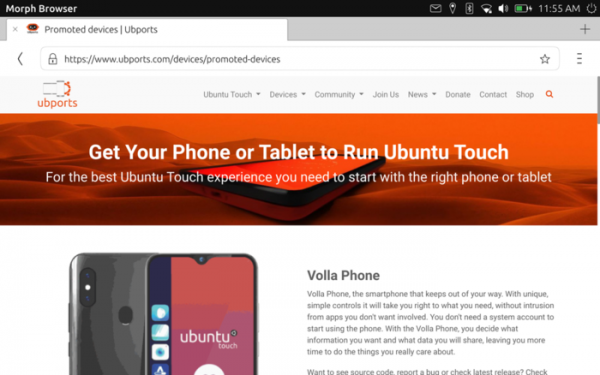
Support for the obsolete web engine Oxide (based on QtQuick WebView, which hasn’t been updated since 2017) has been discontinued, replaced long ago by the QtWebEngine engine, which all core Ubuntu Touch applications have migrated to. The removal of Oxide will cause applications that rely on the outdated engine to stop functioning.
Source: opennet.ru
