

The tiniest magnetic vortex structures called skyrmions (named after the British theoretical physicist Tony Skyrme, who predicted this structure in the 1960s) are expected to become the foundation of future magnetic memory. These are topologically stable magnetic formations that can be excited in magnetic films and subsequently read out. Writing and reading occur using spin currents, transferring the spin angular momentum of electrons. This means that writing and reading can be carried out with extremely small currents. Moreover, maintaining the magnetic vortex does not require a constant power supply, leading to energy-efficient non-volatile memory.
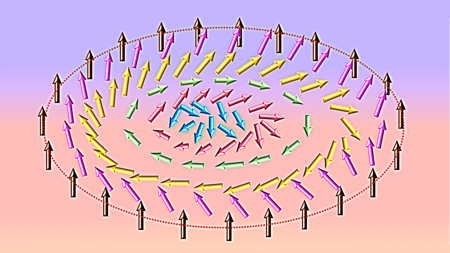
In recent years, scientists in and have been closely studying the behavior of skyrmions and reasonably believe that these structures will significantly increase the density of magnetic recording. Furthermore, recently British and American scientists , to significantly increase recording density using skyrmions without the complexities of reducing the diameter of vortex structures, which could lead to a faster realization of scientific ideas into commercial products.
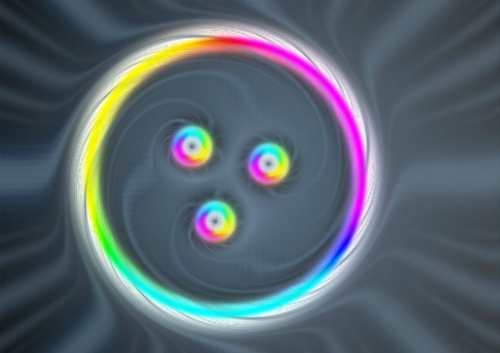
Instead of traditional binary recording, where 1 and 0 would represent the presence or absence of a skyrmion, researchers from the University of Birmingham, Bristol, and the University of Colorado Boulder presented a combined vortex structure they dubbed a "skyrmion bag." Undoubtedly, a "bag" of skyrmions is better than a single skyrmion. The number of skyrmions in the bag can be any, which will allow it to represent more values than just 0 or 1. This is a direct path to increasing recording density. To some extent, this is comparable to multi-level recording in NAND flash cells. One need not be reminded how rapidly the flash memory market has expanded since the mass production of NAND TLC memory, allowing three bits to be recorded in each cell.
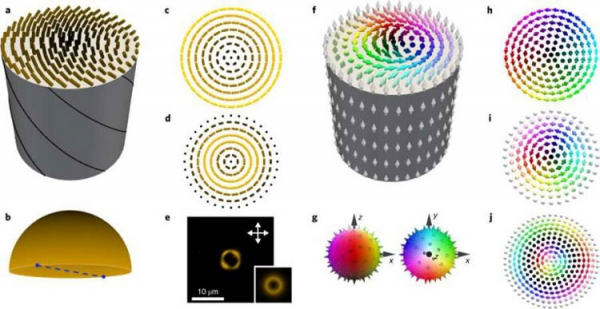
The creation of the structure of skyrmion bags was presented by scientists from England as an abstract model and reproduced the phenomenon in a simulation program. Their American colleagues replicated the phenomenon in practice, although they used liquid crystals instead of magnetic structures to initiate the vortex structures. Liquid crystals, as is known, are controlled by magnetic fields, which allows them to be used for setup experiments to visualize magnetic phenomena. We look forward to transferring the experiments to magnetic films.
Source: 3dnews.ru
