

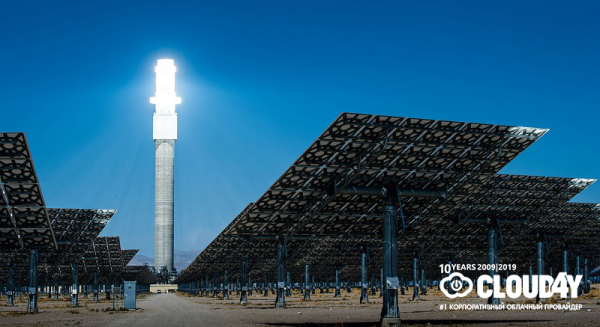
Harvesting and utilizing solar energy is one of humanity's most significant achievements in energy. The main challenge now lies not in collecting solar energy, but in storing and distributing it. If this issue can be resolved, traditional fossil fuel-powered facilities could be phased out.
SolarReserve is a company that offers the use of molten salt in solar power plants and is working on alternative solutions for storage problems. Instead of harnessing solar energy to generate electricity and storing it in solar batteries, SolarReserve suggests redirecting it to thermal storage systems (towers). The energy tower will receive and store energy. The ability of molten salt to remain in liquid form makes it an ideal medium for thermal storage.
The company's mission is to prove that its technology can make solar energy a constant power source, operational around the clock (like any fossil fuel power plant). Concentrated sunlight heats salt in the tower to 566 °C, and it is stored in a massive insulated tank until it is needed to create steam to drive a turbine.
However, let's take it step by step.
Beginning
SolarReserve's Chief Technologist, William Gould, has spent over 20 years developing CSP (concentrated solar power) technology using molten salt. In the 1990s, he was the project leader for the Solar Two demonstration facility, built with the support of the U.S. Department of Energy in the Mojave Desert. A decade earlier, a structure was tested there that confirmed theoretical calculations regarding the commercial generation of energy using heliostats. Gould's task was to develop a similar project, substituting heated salt for steam, and to find evidence that the energy could be stored.
When choosing the capacity for storing molten salt, Gould hesitated between two options: a boiler manufacturer with experience in traditional fossil fuel power plants and Rocketdyne, which produced rocket engines for NASA. The choice was made in favor of the rocket builders, partly because, early in his career, Gould worked as a nuclear engineer at the massive construction company Bechtel, which was involved with the California San Onofre reactors. He believed that he wouldn't find a more reliable technology.
The nozzle of a jet engine, from which hot gases emerge, actually consists of two casings (an inner and an outer), with milled channels through which fuel components in liquid phase are pumped, cooling the metal and preventing the nozzle from melting. Rocketdyne's experience in developing such devices and working in high-temperature metallurgy was beneficial in developing the molten salt technology for the solar power plant.
The 10 MW Solar Two project successfully operated for several years and was decommissioned in 1999, confirming the viability of the idea. As William Gould himself admits, the project had some issues that needed to be resolved. However, the core technology used in Solar Two is also operational in modern plants like Crescent Dunes. The mixture of nitrate salts and operating temperatures are identical; the only difference is the scale of the plant.
The advantage of molten salt technology is that it allows for power delivery on demand, rather than only when the sun is shining. The salt can retain heat for several months, so a sometimes cloudy day does not affect the availability of electricity. Furthermore, the emissions of the power plant are minimal, and of course, there are no hazardous waste products generated as a byproduct of the process.
Operating principles
The solar power plant uses 10,347 mirrors (heliostats) installed over 647.5 hectares (that's more than 900 football fields) to concentrate sunlight onto a central tower 195 meters tall, filled with a molten salt 'filling.' This salt is heated by sunlight to 565 °C, with the heat stored and later used to convert water into steam to operate generators that produce electricity.
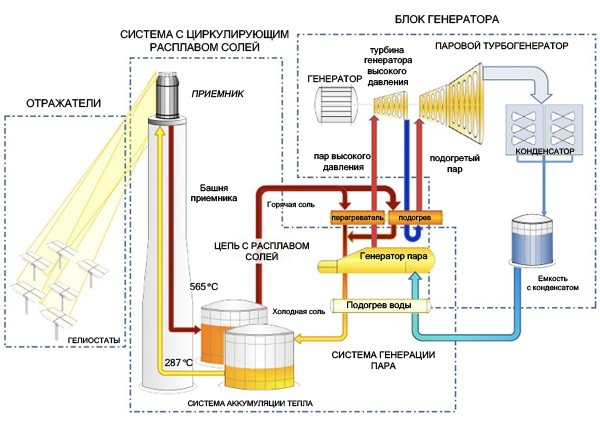
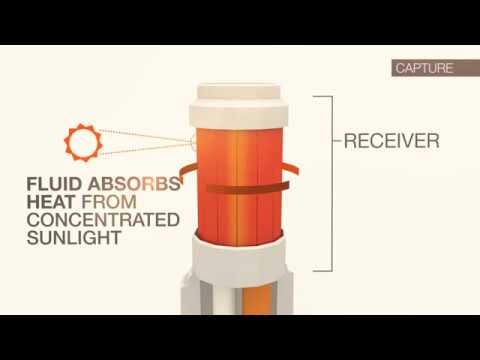
The mirrors are called heliostats, as each can tilt and rotate to accurately direct its beam of light. Arranged in concentric circles, they focus sunlight onto a 'receiver' at the top of the central tower. The tower itself does not glow; the receiver is matte black. The glowing effect comes from the concentration of sunlight heating the container. The hot salt drains into a stainless steel tank with a capacity of 16,000 m³.
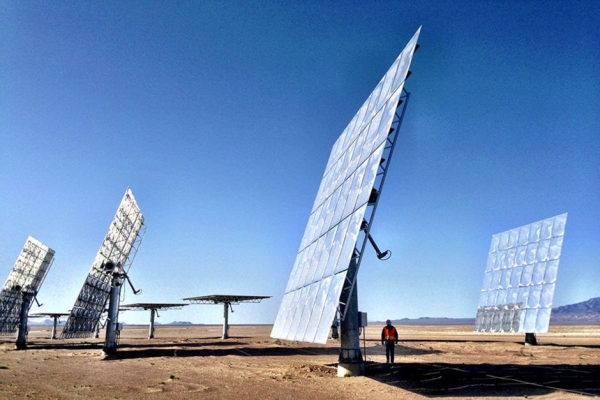
Heliostat
The salt, which at these temperatures looks and flows almost like water, passes through a heat exchanger to generate steam for driving a conventional turbine generator. The tank holds enough molten salt to power the generator for 10 hours. This equates to 1,100 megawatt-hours of storage, nearly ten times more than the largest lithium-ion battery systems installed for renewable energy storage.
A Difficult Path
Despite the promising concept, it's hard to say that SolarReserve has achieved success. In many ways, the company remained a startup, albeit an energetic and vibrant one in every respect. After all, the first thing you'll notice when looking towards the Crescent Dunes power plant is the light. So bright that it's impossible to look at. The source of light is the 195-meter tower, proudly rising over the desert lands of Nevada, roughly halfway between the small town of Reno and Las Vegas.
How the power plant looked at different stages of construction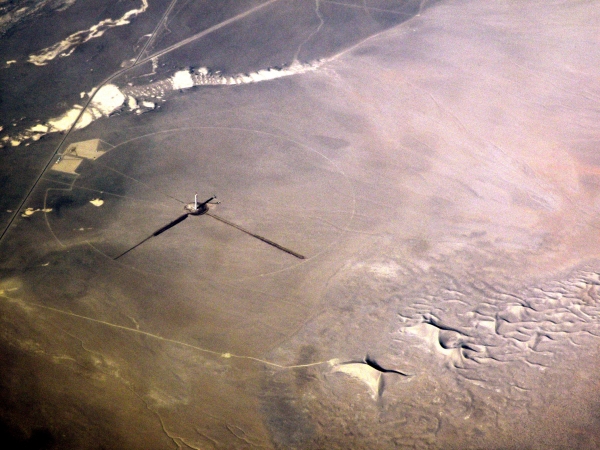
2012, construction begins
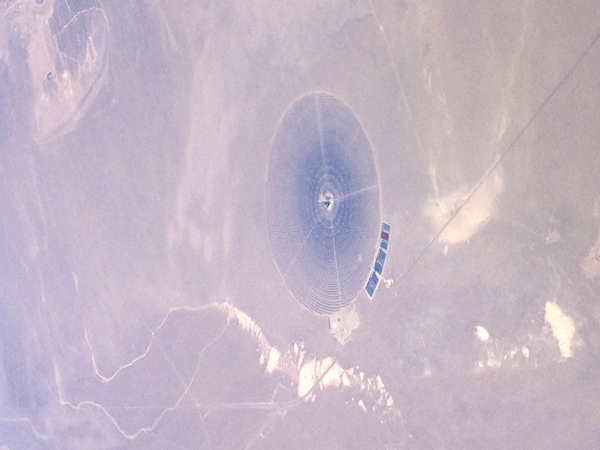 2014, the project is nearing completion
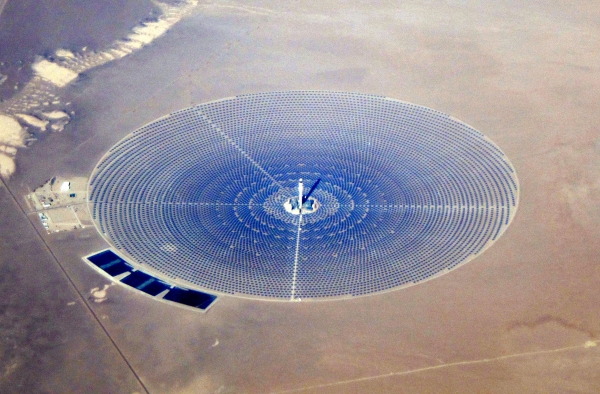
December 2014, Crescent Dunes is almost ready for operation
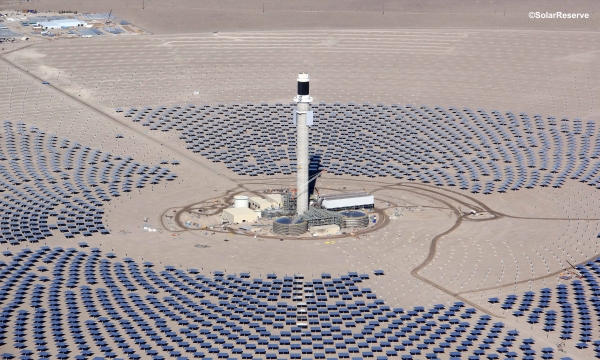
The finished station
About an hour's drive from here lies the famous Area 51, a secret military facility that was threatened with a summer storm by the entire internet in order to "rescue" aliens from the hands of the American government. This proximity leads travelers who witness an unusually bright light to sometimes ask locals if they have witnessed something unusual or even extraterrestrial. They are then sincerely disappointed to learn that it is just a solar power plant surrounded by a field of mirrors nearly 3 km wide.
Construction of the Crescent Dunes began in 2011 with loans from the government and investments from NV Energy, Nevada's main utility company. The power plant was completed in 2015, approximately two years later than planned. However, even after its construction, things did not go smoothly. For instance, in the first two years, pumps and transformers for heliostats frequently broke down and did not operate properly due to insufficient capacity. As a result, the output capacity at Crescent Dunes was lower than expected in the initial years of operation.
There was also another challenge — with birds. When caught in the "sights" of concentrated sunlight, an unfortunate bird . According to representatives of SolarReserve, their power plants managed to avoid regular and mass "cremation" of birds. In collaboration with several national organizations, a special plan was developed to mitigate any potential threats to the power plant. This program was approved in 2011 and is designed to reduce potential risks to birds and bats.
But the biggest problem for Crescent Dunes was a leak in the hot salt storage tank discovered at the end of 2016. According to the technology, a giant ring, supported by pylons at the bottom of the tank, distributes molten salt as it is received from the receiver. The pylons were supposed to be welded to the floor, while the ring needed to have some movement since temperature changes cause materials to expand and contract. Instead, due to engineers' errors, all of this was tightly welded together. As a result, during temperature fluctuations, the bottom of the tank sagged and leaked.
The leak of molten salt itself does not pose a significant danger. When it reached the gravel layer beneath the tank, the molten material cooled instantly, turning back into salt. However, the power plant's shutdown lasted for eight months as investigations were conducted into the causes of the leak, those responsible for the incident, the consequences of the emergency, and other related issues.
The troubles for SolarReserve did not end there. The plant's performance was lower than planned in 2018, with the average capacity factor at 20.3% compared to the expected 51.9%. As a result, the U.S. National Renewable Energy Laboratory (NREL) launched a 12-month study on the costs of the CSP project, focusing on performance issues and unexpected expenses. Ultimately, the company faced a lawsuit, was forced to change its leadership, and by 2019 was compelled to declare its .
This is not the end.
But even this did not spell the end for the development of the technology. There are similar projects in other countries as well. For instance, similar technologies are employed at the Mohammed bin Rashid Al Maktoum Solar Park — the world's largest collection of solar power plants located in a single area in Dubai. Or, take Morocco, where there are even more sunny days compared to the USA, potentially leading to higher efficiency at the power plant. Preliminary results indeed show that this is the case.
The CSP Noor III tower with a capacity of 150 MW in Morocco exceeded performance and storage fill expectations in the first few months of operation. Moreover, the financing costs for energy storage projects in the tower align with anticipated forecasts, assures Xavier Lara, senior consultant for CSP at the engineering group Empresarios Agrupados (EA).
Noor III Power Station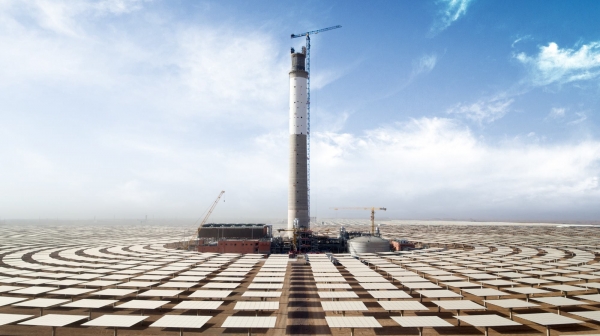
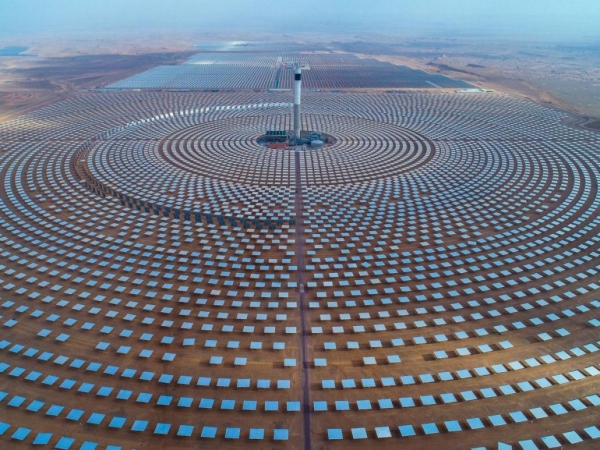
Launched in December of last year, the Noor III power station demonstrates remarkable performance. Noor III, installed by the Spanish company SENER and the Chinese energy construction corporation SEPCO, is the largest operational tower plant in the world and the second in terms of integration of molten salt storage technology.
Experts believe that reliable early data on the performance of Noor III regarding output, generation flexibility, and storage integration should alleviate reliability issues with CSP towers and storage, thereby reducing capital costs for future projects. In China, the government has already announced a program to create 6000 MW of CSP with storage. SolarReserve is collaborating with the state-owned Shenhua Group, which builds coal-fired power plants, to develop a 1000 MW molten salt CSP generation capacity. But will such storage towers be built in the future? That’s the question.
However, just days ago, Heliogen, a company owned by Bill Gates, announced a breakthrough in concentrated solar energy. Heliogen was able to raise the temperature from 565 °C to 1000 °C, thus opening up the possibility of using solar energy in the production of cement, steel, and petrochemical products.
What else is useful to read in the blog
→
→
→
→
→
Subscribe to our -channel, so you don't miss our next article! We write no more than twice a week and only when necessary. We also remind you that you can Cloud4Y's cloud solutions.
Only registered users can participate in the survey. , please.
A liquid salt power plant is
An obsolete technology
A promising direction
Originally nonsense
Your option (in the comments)
97 users voted. 36 users abstained.
Source: habr.com
