

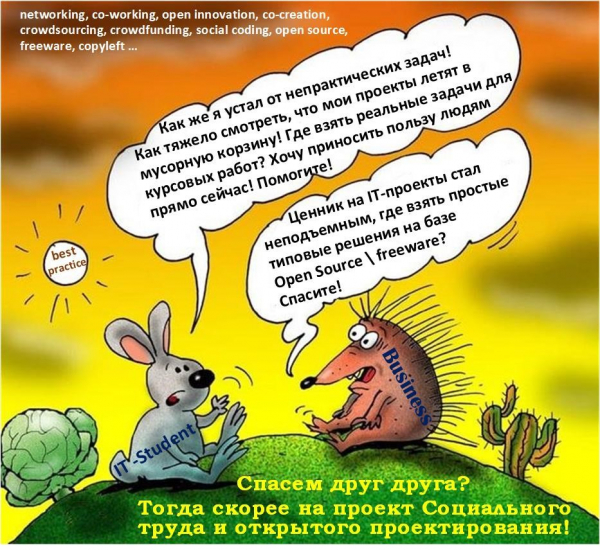
The evolution of motivation and incentive principles in the development of information systems and other high-tech products is ongoing. In addition to classical, strictly monetary-capitalist forms, alternative forms have been increasingly popular for a long time. Half a century ago, the giant IBM, through its program "Share," called for the free exchange of application programs for its mainframes developed by third-party programmers (not out of charitable motives, but that does not change the essence of the program).
Today: social entrepreneurship, crowdsourcing, "Writing Code Together" ("Social Coding," GitHub and other social networks for developers), various forms of freeware licensing, Open Source projects, idea exchanges, and free exchange of knowledge, technologies, and programs.
A new format of interaction "Social Labor and Open Design" and the concept of its information resource (website) is proposed. We welcome the new startup (if it is indeed new). The formula for the proposed approach includes: networking, co-working, open innovation, co-creation, crowdsourcing, crowdfunding, scientific organization of labor (SOL), standardization and unification, typification of solutions, activity and non-financial motivation, free exchange of experience and developments copyleft, Open Source, freeware, and "everything, everything, everything."
1 Environment and Scope of Application
Let's consider the formats: charity, classic business, socially responsible business (classic entrepreneurship combined with charity), social entrepreneurship (socially oriented entrepreneurship).
With business and charity, it is very clear.
Socially responsible business is exemplified in a rough and not always accurate (there are exceptions) but very clear way: when an oligarch, having exploited the population of his city (country), beautified a small city square, first of course buying himself a couple of castles, luxury yachts, a sports team, etc.
Or created a charitable foundation (possibly with the aim of optimizing his business's taxes).
Social entrepreneurship is typically a "grant-based business" aimed at solving the problems of socially vulnerable residents: orphans, large families, pensioners, and people with disabilities.
Although "socially oriented entrepreneurship" primarily embraces charity, and only secondarily aims to generate income, large Russian social entrepreneurship funds have also been established with the funds (target capital) of oligarchs. Social entrepreneurship is often distinguished from charity by its move towards self-financing; thus, in general, it is still a business (entrepreneur = businessperson).
Some on Habr assert that
You can also find examples of projects there.
"Social labor and open design" — or STOP — embraces a somewhat different philosophy. This format is for those who are not only willing to help others but also want to organize their activities and those of others (the entire society) as effectively as possible.
This project aims for maximum efficiency in education and production through collective work (collectivization), conducting open design (public project management), standardization and unification of project solutions, developing concepts and building universal basic platforms based on them, replicating template projects, and borrowing the best solutions (practices) instead of constantly "reinventing the wheel," i.e., reusing the developments of others.
At the initial stage of this movement, it is planned to carry out development on a volunteer basis: truly socially beneficial activities usually imply public initiatives. The movement is based on the following approaches:
x-working (co-working and others), x-sourcing (crowdsourcing and others), involving both experts – altruists (professional developers) and novice specialists (students), i.e., "mass and mastery is the motto ..." An essential component is the scientific organization of labor.
The concept of 'Social Labor and Open Design' can be applied in various areas of public life, but here we will focus on the IT sector. Therefore, we will refer to the STOP branch in relation to IT (automation) as STOPIT: the STOP project in the context of IT. Although this is a conditional division, since, for example, management technologies for project and process management are considered 'IT-related', they are not only used in automation projects.
There are similar forms, for example, is a public educational project aimed at fostering collaboration between the non-profit sector and IT specialists.
However, STOPIT focuses on any IT-oriented 'demands and offers.' STOPIT is not just an educational project; it is not solely about 'collaboration between the non-profit sector and IT specialists' and other 'not only' aspects.
Social labor and open design represent a new type of social entrepreneurship IT greenhouse where the term 'entrepreneurship' is better replaced with 'activity.'
2 Concept of 'Social Labor and Open Design' and Motivation
Roles
The concept of the IT greenhouse STOPIT includes three roles: Customer, Intermediary, Performer. The Customer formulates the 'demand', more precisely - asks and formalizes 'what needs to be done.' The Customer can be any company or individual who wishes to solve a specific task they face. In this case, it is about automating something.
The Performer formulates the 'offer', i.e., notifies 'what they are ready to do.' The Performer can be a company, a group of developers, or just a developer who is generally willing to address the Customer's task 'on a voluntary basis' (pro bono).
A mediator is an entity that connects demand and supply and controls the resolution of the task, ensuring satisfaction for both the Customer and the Executor. The satisfaction of the Executor is also important, as the work is generally done on a volunteer basis. Instead of the principle of 'money for work received, and then let the grass not grow,' here the factor comes into play, whereby the Executor is motivated to implement their product through non-financial incentives. This can sometimes be 'more valuable than money.'
By the way, the STOPIT technology easily overcomes another challenge of modern IT structure: if the Customer is satisfied, then the implementation project is considered successful, regardless of the objective parameters of the project's compliance with the set task. In our case, public oversight will reveal such situations, and the public assessment of the success of the implementation project will be based not on the popular principle that 'it's not necessary to think about the quality of the project if you and the Customer are both in the same salad,' but on substance.
2.1 Customer Motivation
There is always a desire to receive an automation system for free or 'almost for free'—one for which there is no budget or 'it's unclear which to choose,' as 'every seller praises their own product' (even if the product is poor). For many, the cost of IT projects has become exorbitant. Where can one find simple, typical solutions of the Open Source freeware class and affordable resources for their implementation and subsequent support?
Sometimes, one-time tasks are required, or there is a need to check 'is this necessary,' 'how does it work in principle.' For example, if a project office is absent in the company, but there is a desire to understand how the project would proceed if it existed. A 'foreign project manager' (project administrator) is attracted on a volunteer basis, for instance, a student or freelancer.
Within the framework of the STOPIT concept, the Customer receives a ready-made solution to their task with source code, a free license, the ability to duplicate, a conceptually developed architecture of the solution, and documented code. During the discussion of the implementation, they were able to see alternative solution options and make a choice independently (agree with the choice).
There is hope that the proposed approach will provoke the following situation: if several organizations need to solve a similar task (both require the same product), it makes sense to combine efforts to develop a standard solution (or platform) and based on it tackle the task, meaning they get together, create a basic solution collectively, and then each customizes the common approach for themselves (adapts it).
A variation of crowdfunding or simply a collaborative effort on a shared task is possible based on principles such as ‘two heads are better than one’ or through forced cooperation, like: I will help you with your project, and you help me with mine, since you have expertise in my area, and I have it in yours.
The Client presents a set of requirements, but we are not considering them yet (mainly the requirement for disclosure of the implementation history, open bug tracking, etc.).
2.2 Motivation of the Executor
The basic class of Executors, at least initially in the development of the STOPIT direction, is expected to be student project groups. It is important for students to work on a real practical task, gain practical experience, and see that their contributions are not discarded but are actually used (operated and bring benefits to people).
It may be important for the student to formalize their work record (to document experience), to include real projects in their portfolio (‘success story’ right from their first year of university), and so on.
Perhaps a freelancer wants to include the implementation of this specific project (of this company) in their portfolio and is willing to work for free.
If necessary, the Mediator can organize operational control or assign an experienced mentor to ensure higher quality in addressing the task with the help of novice designers. In this case, the motivation of the student or the freelancer may be based solely on working on the project with the participation of a ‘known guru’ assigned to this project.
Thus, the Executors are not necessarily altruists and philanthropists, although professional developers may fit this definition more closely. It is advisable to use them within the STOPIT framework as a team of mentors (consultants) or chief designers, or to involve them in executing 'exemplary projects' that enhance the image of the specific STOPIT project site.
The universities participating in STOPIT will be able to better understand the real tasks that their graduates will need to solve. The Executors themselves may later be hired to support their own developments (programs). The foundation can organize contests and reward the most active Executors (universities), including through a special donation fund from the clients who contribute 'in joy' from the free, yet highly effective tool (program) they receive.
In general, for a student, 'happiness #1' is when they are already solving practical tasks at university, i.e., not theoretical, but real ones (even if they do not complete them or only tackle a part of a larger task). 'Happiness #2' is when their project is actually useful in real life (has been implemented), i.e., their work was 'not thrown in the trash' right after the project defense. And what if there is also a small financial incentive?
Moreover, it does not necessarily have to be in monetary form: the incentive fund can consist of vacancies for internships, further education (advanced training), and other pre-paid services of both educational and non-educational nature.
The clear position of 'altruist - philanthropist' should also find its place in STOPIT. An egoist serves themselves, whereas an altruist serves others. A misanthrope hates humanity; a philanthropist loves it. Both altruists and philanthropists act for the benefit of society, placing others' interests above their own. They both love humanity and help it. This is a powerful resource that has yet to establish itself in large IT projects.
2.3 Project student teams - the hope of domestic science and technology.
I want to emphasize that not only student project teams are considered as Executors for STOPIT projects, but they are also placed with special hopes for a scientific and technical revolution (STR). The existing disconnection between the educational process and production, along with the lack of understanding of specific practical tasks by the teaching staff, is a significant issue in modern domestic education. In the USSR, to provide a more 'in-depth immersion' of students into production, basic departments of educational institutions were created at enterprises and research institutes.
Today, some still exist, but the expected 'Big Result' is still nonexistent.
By 'Big Result', I mean something 'open and significant, i.e., socially beneficial on a planetary scale'. Similar to Western institutions, for example, the display server 'X Windows System', developed in 1984 at the Massachusetts Institute of Technology, as well as the whole licensing direction of MIT.
Our students are not capable of such antics:
Perhaps the very concept of higher education needs to be changed, for instance, adapting it to a Western model: combining educational institutions with research centers. This may lead to the criticism that all achievements of MIT and similar institutions should be attributed to innovation centers at the institutes; however, in any case, our research institutes cannot boast anything similar.
In such a concept, STOPIT can be seen as a 'temporary patch' while the state 'wakes up' and recalls the need to revive higher education.
STOPIT can serve as a springboard for STR. In any case, revolutions — in both education and approaches to design and implementation of automation systems: open design, borrowing, standardization-unification, formation of open standards for system construction, system architectures, frameworks, etc.
In any case, laboratory research and practical skills, especially successful (and even 'not so successful') implementations, right from the first years, are the key to quality education.
For now, we have to sadly read something like this:
I am a second-year university student, studying Applied Mathematics and Computer Science, and I am doing quite well, receiving a higher scholarship. However, one day I realized that what I am being taught is starting to weigh me down and seems, subjectively of course, more and more boring and monotonous. Soon an idea emerged: why not implement my own project, gain fame and money (the latter is doubtful, of course). But I don’t know if I am the only one with such a problem; at least I found almost nothing online, and I can't decide exactly what I would like to do. The department brushed me off, saying that the research...
Of course, I am not asking for ready-made ideas; I am asking for an answer to the question: how can I figure this out myself?
Suggestion for instructors: Why burden IT specialty students with unrealistic (made-up) tasks? Perhaps we need to ask acquaintances what IT projects are going on at their enterprises, what needs to be done, what problems need to be solved. Then break the problem into parts and offer the entire group to tackle it in the form of diploma course works, with tasks segmented according to decomposition. The resulting solution could be shown to acquaintances: maybe they will abandon SAPSAS, etc., and choose student work based on an Open Source copyleft engine?
For example, the implementation of 'SAPSAS, etc.' in some cases can be akin to 'using a cannon to kill a sparrow,' i.e., a simpler solution would suffice to solve the problem; moreover, the economic efficiency of implementing such monsters is almost always negative: therefore, often, technical and economic justifications for such implementations are not done at all and, of course, are not published.
Even if acquaintances say 'no,' just publish your solution and a comparison with the competing product — perhaps someone will choose your solution if it is competitive, of course. All of this can be done without a STOPIT platform.
2.4 Individual Success Factors
The key vector of movement should be based on the following:
A) Open Source. Programs must be open source and well-documented. In addition to documenting the code, it should also include documentation of the logic (algorithm), preferably in one of the graphical notations (BPMN, EPC, UML, etc.). "Open" means there is source code available, regardless of the environment where the project was created or the programming language used: Visual Basic or Java.
B) Free. Many want to create something socially useful and significant, open and reproducible (multi-useful): something that will benefit many, and for which they will at least say a Big Thank You.
Although some want "much more" than just a "Thank You," for example, explicitly stating in their code the license "THE BURGER-WARE LICENSE" (sarcasm tag):
#################
Sub insertPicture(…
' "THE BURGER-WARE LICENSE" (Revision 42):
' wrote this code. As long as you retain this notice you
' can do whatever you want with this stuff. If we meet some day, and you think
' this stuff is worth it, you can buy me a burger in return. 😉 xxx
#################
The "THE BURGER-WARE LICENSE" can become the calling card of the STOPPIT project. (humorware) large: Beerware, Pizzaware …
C) Prioritize mass tasks first. The focus should be on tasks that have general, not specific applications: "mass demand tasks," solved through a universal open platform (possibly with subsequent customization if necessary).
D) Think "broadly" and create not only programs but also standards: standardization and development of industry-specific solutions. The priority should be on solutions (programs, approaches) that, in addition to providing an implementation example, contain elements of standardization. For instance, the contractor suggests a standard solution and demonstrates how to adapt it to a specific task. Ultimately, the emphasis is on mass production (repeated implementation based on standard solutions — as an alternative to "reinventing the wheel"). Standardization, unification, and experience exchange contrast with: "closed and unique solutions" (keeping the client on a hook), forcing dependency on a single software solution provider (vendor).
2.5 The Role of the Mediator
The Role of the Mediator — organizer (operator) of a separate STOPPIT platform includes the following (by blocks).
Project office: forming the order portfolio and groups of executors (resource pool). Gathering orders, forming the resource of Executors. Monitoring project status (Initiation, Development, etc.).
Business analyst. Initial business analysis. Initial processing of tasks, an attempt to articulate a general task that would be of interest to a broader audience of clients.
Guarantor. Guarantee of contract performance conditions. For example, the Executor may set a condition to receive a certificate of system implementation (upon successful implementation) or to post articles (news mentioning the Executor) about the implementation on the company’s website where their solution was deployed (regardless of the content being positive or critical).
The Guarantor may guarantee the Client, based on the principle of 'the developer's detachment from their product', that they will always find a support team for this project, for instance, if the Executor refuses to support their own implementation or their own software product.
There are many other aspects (details), such as concealing the name of the Client company at the early stages of project design. This is necessary to prevent spam offers from competitors from flooding the Client — through alternative ‘for a fee’ systems (with cries: ‘free cheese is only in a mousetrap’). If the Client is willing to pay a symbolic amount to the Executor, the Intermediary acts as a mediator in the settlement process. Details may be specified in the charter of a specific project or the charter of a specific STOPIT platform.
PR. Advertising activities: letters to rectors and student forums, media — initiating and attracting to the project, promoting on the internet.
Quality Control. Implementation monitoring. The Intermediary may undertake preliminary testing of the implemented system for specific projects. After implementation, they organize process monitoring and conduct audits.
The Intermediary may manage Mentors, i.e., upon availability of resources — connect experts to the project for mentorship.
The Intermediary may organize contests, awards, etc., to enhance the motivation of Executors. There is much more that can be added; this depends on the capabilities (resources) of the Intermediary.
2.6 Some effects of the proposed project implementation
Engage students by solving real-world applied problems. Ideally, in the future, we should implement a Western approach in our institutions, where student groups create an industrial standard, an open platform (framework) widely used for building end industrial systems.
Raise the level of standardization in the development of information systems: typical design, standard solutions, and the elaboration of a unified conceptual solution, building several implementations based on it, for example, on different CMS, DMS, wiki engines, etc., to implement a standard for constructing such systems, i.e., forming industrial standards for solving applied tasks.
Create platforms that connect supply and demand, where the task implementation will either be free or offered at a symbolic price, as well as various stimulation options, for example, when a company takes the winning student intern for tech support of their own program with or without salary (for the internship).
In the future, it may be possible to create next-generation platforms based on the principles of openness, standardization, and crowdfunding, where only the project itself is paid for, while its replication is gifted to society, meaning the public, including any company or individual, can use it for free. At the same time, society on the marketplace will determine what it needs first and to whom to assign this project (development 'for payment').
3 "Three Pillars" of Social Work and Open Design
A) Collaborative Work Technologies
(applicable to STOPIT)
Net – network + work – to work. This is a social and professional activity aimed at building trusting and long-term relationships with people and providing mutual aid through a circle of friends and acquaintances (including those met through social networks or professional forums).
Networking is the foundation for establishing friendships and business relationships with new people (partners). At its core, networking involves forming a circle of communication and a willingness to discuss one's own problems with others, offering one's services (advice, consultations on forums). All social networks are based on it.
It's important to believe in networking and not be afraid to ask others for solutions to tasks, to request their help in solving your problem, as well as to offer your knowledge and assistance to others.
In a broad sense, it's an approach to organizing the work of people with different occupations in a common space; in a narrow sense, it refers to a similar space, a collective (distributed) office, in our case, the STOPIT platform. This involves organizing infrastructure for collaborative work on STOPIT projects.
Someday, physical STOPIT co-working spaces may appear, but for now, it is solely a virtual STOPIT platform (an online resource). We will not only exchange experiences and ideas, which will increase productivity and help in finding non-trivial solutions to tasks, but also work on a unified platform using common tools (for example, design systems, emulators, virtual test benches).
While the concept of virtual STOPIT workspaces has not been fully developed yet, it will include at least virtual offices (remote workstations, including Word, Excel, etc. or their analogs, facts, communication, etc.), as well as virtual IT laboratories and test stands, shared for experiments and testing (public virtual machines with specialized software, VM images with pre-installed frameworks, etc.).
Upon completing each project, its virtual stand will be archived and become available for redeployment to any STOPIT participant, meaning that not only working and operational documentation on the project will be available, but also the functioning information system itself.
STOPIT borrows a lot from crowdsourcing: projects are essentially outsourced to the public, creating an open call to the community in which the organization seeks (requests) solutions from the "crowd."
Open design technologies, public project tracking (similar to the show "What, Where, When"), crowdsourcing, co-creation, open innovation — well-known terms that can easily be found online, for example, .
B) Scientific organization of labor
NOT is a broad concept of improving labor organization based on scientific achievements and best practices. Generally, it includes mechanization and automation, ergonomics, standardization, time management, and much more.
We will limit ourselves to the following areas:
- free exchange of knowledge and expertise;
- unification and standardization;
- widespread use of best practices, both industry-specific and management best practices.
- Unification and standardization, borrowing from what has already been done, focusing on standardized solutions.
There is no need to reinvent the wheel each time; simply repeat it. If we are solving a problem, it is desirable to propose a solution that is universal and allows for the resolution of similar tasks ('killing two birds with one stone').
Best Practice. Examples of industry best practices, for instance, from IT: ITSM, ITIL, COBIT. Examples of management best practices: from project management it is PMBOK-PRINCE; BOKs from the field of systems programming engineering; BIZBOK and BABOK, as well as numerous lean-like techniques for 'all occasions'.
It is important to understand that the goal is not to 'choose the best from many best practices' (there are many alternative approaches). The suggestion is not to invent new project management approaches, new ways of system design, etc., but to first read the best practices and borrow from them as much as possible. Although someday, one of the projects of STOPIT I hope will be the revision of the existing 'renowned' best practice or the creation of a new one, for instance, a BOK for the STOPIT project itself.
B) Principles of an active life position
IT pioneers, activists, volunteers, altruists, and 'everyone', wanting to do something useful: whether 'very' socially useful (broadly beneficial) or just useful to a small company, i.e., to automate something socially.
For social entrepreneurs, altruists, and philanthropists, social responsibility involves making IT projects more accessible, replicable, and widespread, as well as engaging a large number of participants in the development of information systems and improving domestic systems to match Western quality. This can be compared to the slogan 'Mass and mastery are the motto of Soviet sports', that is, 'Mass and mastery are the motto of domestic IT development.'
It is enough to guide a large army of 'knowledge-hungry' students and aspiring engineers under the leadership of a small number of experienced individuals to tackle practical tasks with direct implementation and ongoing support for the development. The development (product) implies the aforementioned principles: openness, universality of application, standardization of solutions, including the development of concepts (ontologies), and free replication (copyleft).
Total
Certainly, a fortunate IT student in their senior years may land an internship at a large IT company, and there are inspiring stories about students, especially from the West, like K. Systrom and M. Zuckerberg from Stanford. There are also domestic platforms for startups, hackathons, student competitions such as 'You are needed by people', job fairs, youth forums like BreakPoint, social entrepreneurship funds (like 'Rybakov' and others), projects like 'Preactum', and competitions, for instance, the 'Social Entrepreneurship through Students' eyes' article contest, 'Project 5-100' and the 'fives', dozens, or maybe even hundreds of similar initiatives, but none of this has brought about a revolutionary effect in our country: no revolution in business, education, or scientific and technical fields. Domestic education, science, and industry are degrading at an alarming rate. Radical methods are necessary to change the situation. There have been no radical and truly effective measures 'from above'.
We must try 'from below' and harness the enthusiasm and activity of those who care.
Is the proposed format of the new type of IT incubator for social entrepreneurship capable of social labor and open project design? A response can only be given after trying it in action.
If the idea interests you, create your own STOPIT resource: the proposed concept is distributed under the Copyleft — "THE BURGER-WARE LICENSE". Such a platform would be useful in every university. See you on your STOPIT platform.
Source: habr.com
