

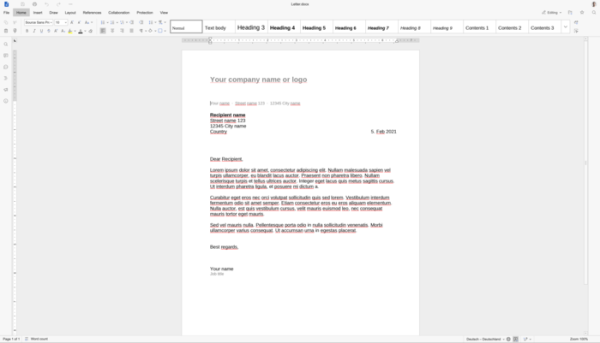
Several European companies and organizations, including Nextcloud, IONOS, Eurostack, XWiki, OpenProject, Soverin, Abilian, and BTactic, have presented an open collaborative document editing platform, Euro-Office, which is based on the codebase of the ONLYOFFICE office suite. The fork underwent rebranding, and modifications were made to the text of the AGPLv3 license, removing additional conditions related to the logo and trademarks. These changes have been perceived by ONLYOFFICE developers as a violation of the license, which they called for immediate correction.
Since 2021, the AGPLv3 license text under which the ONLYOFFICE code is distributed has included additional conditions clarifying the AGPL requirements regarding author attribution and the lack of trademark obligations. The additional conditions require retaining the original ONLYOFFICE logo in derivative products to maintain brand recognition. The license also mentions the absence of obligations regarding the granting of ONLYOFFICE trademark rights.
The creators of the Euro-Office fork removed additional requirements and contact information for Ascensio System from the license text, leaving only a note regarding the license for resources used in the graphical interface and a disclaimer of liability. This change is justified by reference to section 7 of the AGPLv3 license, which grants the right to remove additional restrictions imposed beyond the conditions set forth in sections 7(a)-7(f).
In particular, the requirement to retain the logo has been removed, as section 7(b) of the AGPL allows for the requirement of attribution, but the logo is a trademark and brand element not directly related to author attribution. The mention of the waiver of trademark rights has been removed as it does not affect the rights or obligations of the licensee (section 7(e) already states that AGPLv3 does not grant rights to trademarks). The contact address has been removed as it only carries informational value (AGPLv3 does not require the retention of contact details in the text).
Lawyers advising the ONLYOFFICE project consider it legally unjustified to claim that a derivative product can be distributed under a 'clean' AGPLv3 license without additional conditions imposed in accordance with Section 7. They believe that, according to established legal norms in the field of intellectual property, the right to create and distribute derivative works is formed exclusively from the rights granted by the license, and such rights are transferred undivided.
Creating a derivative product does not allow for the use of an independent licensing mode free from the conditions under which the original code was obtained; that is, the ONLYOFFICE fork must be distributed solely in accordance with all the terms of the license, including additional clauses. The interpretation of Section 7(b) of the AGPL and the distribution of 'credit to the author' for the logo is contentious in the current situation. The Free Software Foundation believes that, except for specific cases, the logo does not fall under the acceptable 'credit to the author' mentioned in Section 7(b) and legal notices.
Euro-Office is presented as an open, transparently developed, and independent platform for collaborative work with documents, spreadsheets, and presentations. The project is intended for use via the web and integration with third-party products, such as file sharing systems, wikis, and project management tools. It is noted that the fork was created as a forced measure due to the inability to connect to the development of ONLYOFFICE for the following reasons:
- The difficulty of transferring changes to the ONLYOFFICE platform codebase, whose developers do not review submitted changes, do not accept pull requests, and do not ensure the correctness and relevance of the build instructions.
- The company developing ONLYOFFICE periodically makes controversial decisions, such as disabling editing in the mobile app and removing the admin panel.
- Lack of transparency — commit messages often refer to internal bug tracking systems, delivered products include binary blobs and obfuscated code. Some comments in the code are in Russian, which complicates work with the code for international teams.
- The mobile application is not fully open and is tied to proprietary components.
- A significant portion of ONLYOFFICE developers are located in the Russian Federation, which complicates collaboration and undermines trust due to the political situation, especially when development processes are opaque and isolated.
Source: opennet.ru
