

Every transition to a newer mobile communication standard means not just an increase in data transfer speeds, but also helps make the communication more reliable and secure against unauthorized access. For this, vulnerabilities found in previous protocols are addressed, alongside the implementation of new security verification methods. In this regard, 5G protocol communication promises to be more reliable than that using the 4G (LTE) protocol, although this does not rule out the possibility of discovering vulnerabilities in '5G' in the future. Similarly, the years of using 4G did not free this protocol from the identification of many new vulnerabilities. A fresh example to confirm this thesis came from a study by South Korean security experts, who discovered 36 new dangerous vulnerabilities in the 4G protocol.
Specialists from the Korea Advanced Institute of Science and Technology (KAIST) applied the same method used for searching for problematic solutions in PC software to identify vulnerabilities in the LTE protocol (in the network), servers. This is known as the fuzz testing method, where the system is attacked (loaded) with a sequence of incorrect, unexpected, or random data. After the load, the system's response is analyzed, and scenarios for protection or further attacks are constructed. This work can be conducted in a semi-automated mode, trusting the data transmission and reception process, while attack scenarios and the analysis of the gathered data are developed manually. For example, KAIST specialists created the LTEFuzz utility to check the security of the LTE protocol and search for vulnerabilities, but they promise not to make it publicly available and to only provide it to equipment manufacturers and telecommunications operators.
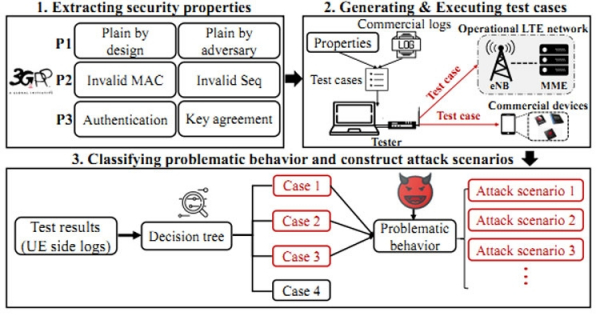
Using LTEFuzz, over 50 vulnerabilities were discovered, 36 of which were entirely new. The method revealed 15 already known vulnerabilities, confirming the validity of the chosen technology (if they are known, why were they not patched?). Testing was conducted in the networks of two unnamed operators and in collaboration with them, ensuring that regular users were not affected. A lot of interesting findings were uncovered. We were able to eavesdrop on subscribers, intercept data during base station-device exchanges, send fake SMS messages, block incoming calls, disconnect subscribers from the network, manage traffic, and much more. KAIST specialists notified the vendors and the 3GPP and GSMA organizations about all found vulnerabilities, including the 'gaps' in cellular base station hardware.
Source: 3dnews.ru
