

GitHub has published a report analyzing statistics for 2025. Key trends:
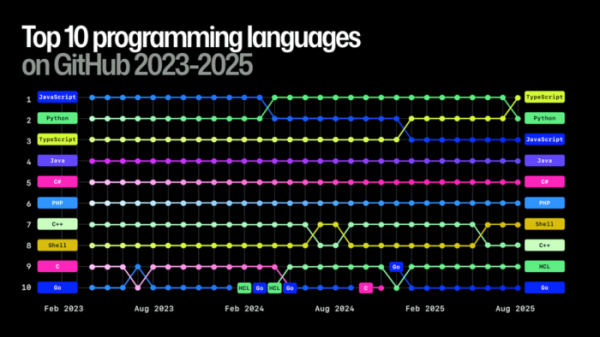
- The TypeScript language has surged to the top of the ranking of programming languages most frequently used by developers. Almost all major front-end development frameworks have switched to using TypeScript by default. Python and JavaScript have fallen to second and third place, respectively. Over the year, the number of developers using TypeScript increased by 1 million (+66%), Python – by 850,000 (+48%), and JavaScript – by 427,000 (+25%).

- In the ranking of the fastest-growing languages, the leaders are Luau (3,600 developers, +194%), Typst (3,600 developers, +108%), Astro (45,600 developers, +78%), Blade (91,100 developers, +67%), and TypeScript (2.6 million developers, +67%).
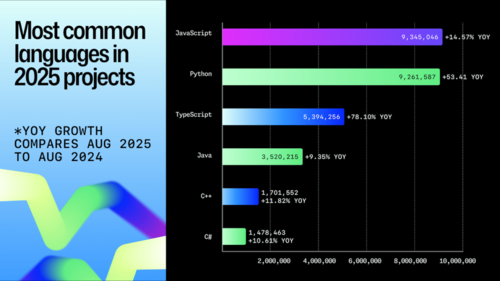
- In terms of popularity in new repositories, the leading languages are JavaScript (9.3 million, +14.57%), Python (9.2 million repositories, +53.41%), TypeScript (5.4 million, +78.10%), Java (3.5 million, +9.35%), C++ (1.7 million, +11.82%), and C# (1.5 million, +10.61%).

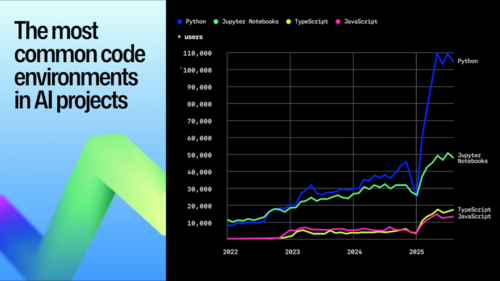
- When developing AI projects, the most popular languages are Python, Jupyter Notebooks, JavaScript, and TypeScript.
- The total number of projects on GitHub has reached 640 million, which is 121 million more than last year. The number of publicly available open-source repositories has reached 395 million, an increase of 72 million compared to last year (a growth of 19%). The number of private repositories has increased by 58 million (a growth of 33%).
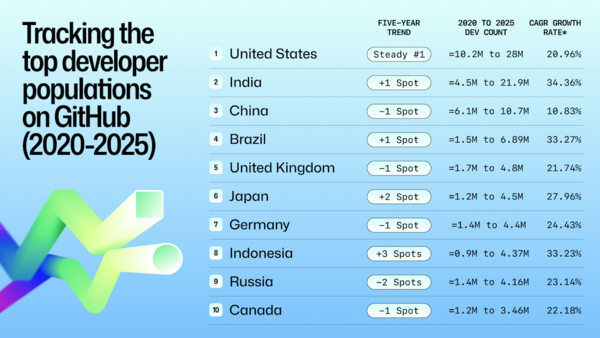
- The GitHub audience has grown by 36 million users over the year, reaching 180 million (last year, 30 million joined; the year before that, 20 million; three years ago, 20 million). The United States ranks first in the number of developers (28 million), followed by India (21.9 million), China (10.7 million), Brazil (6.89 million), and the United Kingdom (4.8 million). Compared to last year, Russia has dropped from sixth to ninth place, losing ground to Japan, Germany, and Indonesia. India saw the largest increase in the number of developers, with over 5 million new developers in a year (14% of all new accounts). It is forecasted that by 2030, India will take first place, pushing the U.S. to second.

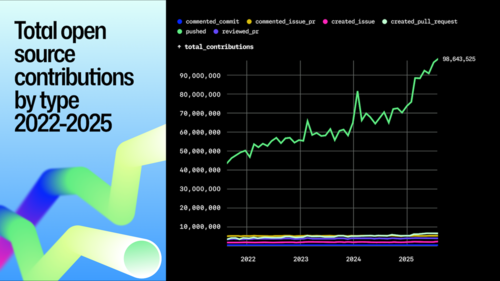
- The contribution to open and publicly available projects is estimated at 1.12 billion actions (commits, issues, pull requests, discussions, reviews, etc.), while private contributions amount to 4.97 billion (81.5%), with the share of private repositories being 37% and public ones 63%.
- Over the past year, more than 518 million pull requests were made (43.2 million per month), which is 23% more than last year. The number of commits is estimated at 986 million, which is 25.1% more compared to 2024. In August, a record was set for the number of commits in a month — about 100 million changes were accepted. The number of created issues compared to last year increased by 20.4%, while the number of comments on issues and pull requests remained unchanged (+0.35%), and the number of comments on commits decreased by 27%.
- The number of AI-related projects has reached 4.3 million. In 1.1 million publicly available repositories, one of the SDKs for working with large language models is used, with 693 thousand of these repositories created in the last 12 months (a growth of 178%). 80% of new developers used the AI assistant GitHub Copilot in the first week after registering on GitHub.
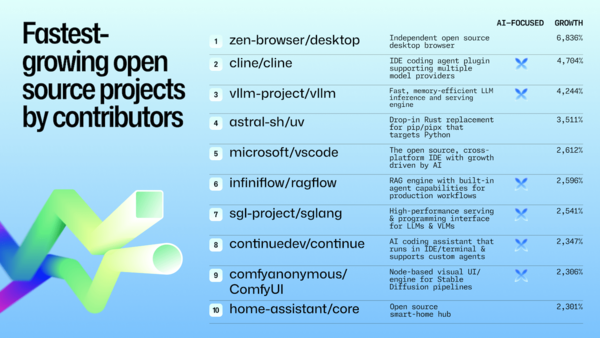
- The fastest-growing open projects have become Zen Browser, Cline, vllm, uv, and vscode.
- Leading the number of participants are the repositories vllm, vscode, codex, huggingface/transformers, godot, home-assistant, ollama, llama.cpp, verl, and expo.
- The repositories most popular with new users are:
- Overall resource consumption during the execution of GitHub Actions handlers increased by 30% compared to last year.
- The average time to fix critical vulnerabilities decreased by 30% compared to last year, and the average time to resolve vulnerabilities was reduced from 37 to 26 days.
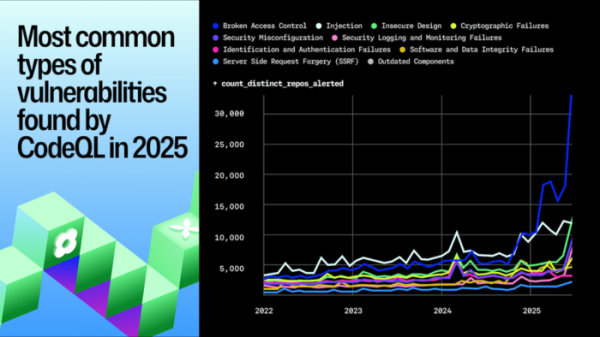
- The most commonly identified vulnerability has been access management issues. Over the year, such problems were identified in 151 thousand repositories, which is 172% more than last year.

Source: opennet.ru
