

Even during the announcement of the first GeForce RTX 20 series graphics cards, many believed that the large size of the Turing GPUs was due to the presence of additional blocks: RT cores and tensor cores. Now, one Reddit user has analyzed infrared images of the Turing TU106 and TU116 GPUs and concluded that the new computing blocks occupy less space than initially thought.
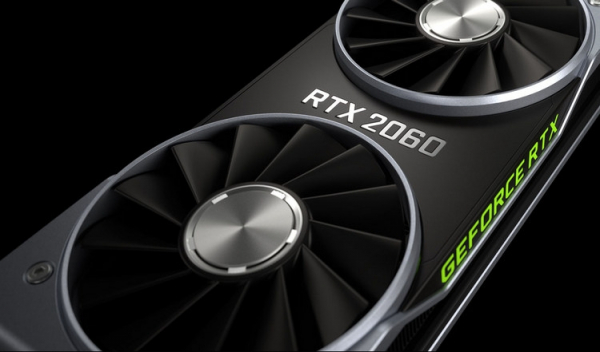
Firstly, let’s recall that the Turing TU106 graphics processor is NVIDIA's smallest and most compact chip, featuring specialized RT cores for ray tracing and tensor cores for accelerating artificial intelligence functions. In turn, its related graphics processor, the Turing TU116, lacks these special computing blocks, which is why they were chosen for comparison.
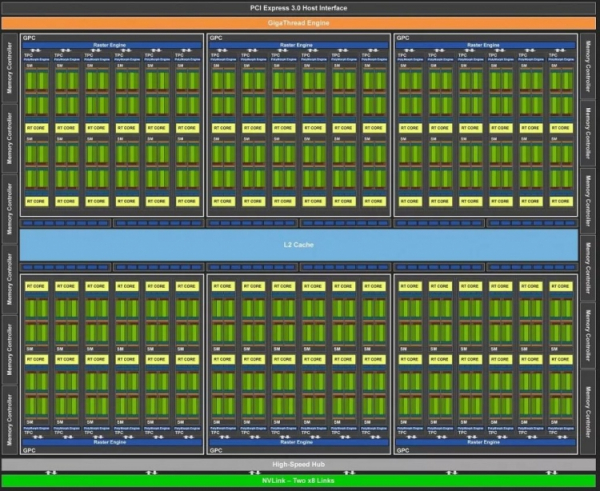

NVIDIA’s Turing graphics processors are divided into TPC blocks, which include a pair of Streaming Multiprocessors, housing all the computing cores. It turns out that the Turing TU106's TPC block area is just 1.95 mm² larger than that of the Turing TU116, which is a 22% increase. Of this area, 1.25 mm² is allocated for tensor cores, and only 0.7 mm² is for RT cores.
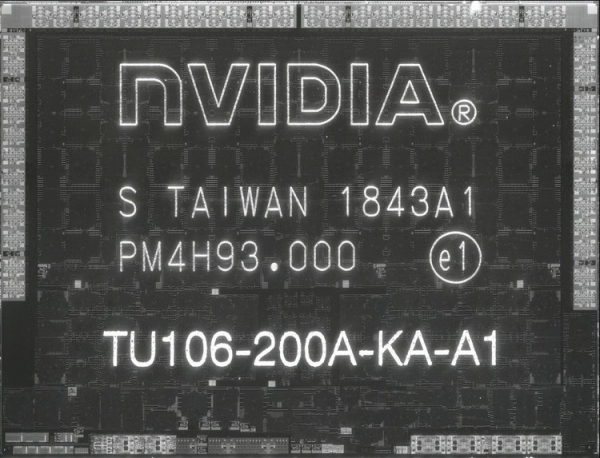

Thus, without the new tensor and RT cores, the flagship Turing TU102 graphics processor, which powers the GeForce RTX 2080 Ti, would occupy 684 mm² instead of 754 mm² (36 TPC). Similarly, the Turing TU104, which serves as the basis for the GeForce RTX 2080, could take up 498 mm² instead of 545 mm² (24 TPC). As seen, even without tensor and RT cores, the higher-end Turing graphics processors would still be quite large chips, significantly larger than the Pascal graphics processors.
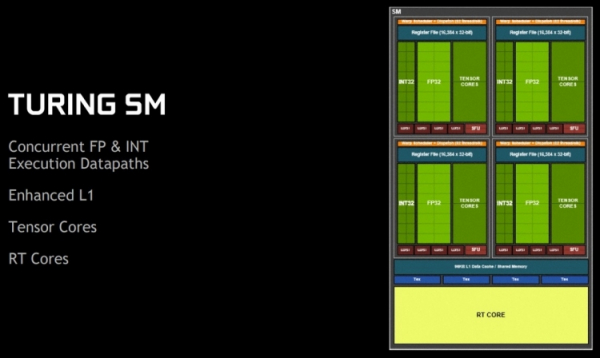
So what accounts for these considerable sizes? To start, the Turing graphics processors have increased cache memory. The shader sizes have also been enlarged, and the Turing chips feature larger instruction sets and expanded registers. All of this has significantly boosted not only the area but also the performance of Turing graphics processors. For instance, the GeForce RTX 2060 based on the TU106 provides performance nearly on par with the GeForce GTX 1080 based on the GP104. The latter, by the way, has 25% more CUDA cores, yet occupies 314 mm² compared to the new TU106’s 410 mm².
Source: 3dnews.ru
