

Recently, I noticed something. I used to not care, but now I know this — and I don't like it. In all these corporate training sessions, as well as starting from elementary school, we're told a lot of things where, as a rule, there isn't enough room for adventure, recklessness, and the triumph of the human spirit in its pure, sublimated form. Various films are made, both documentaries and feature films, but very few of them tell stories that are so extraordinary that they are hard to believe. And those that are made have low budgets and rarely attract many viewers. It’s believed that nobody is interested. And nobody needs to be reminded again. Who knows, someone might get inspired at the wrong time and… want to do the same. And then there are losses and constant frustration. An office worker sits in their stuffy little office, then comes home to a Soviet-style apartment on the outskirts of a residential area where they’re greeted by over-salted borscht for dinner. Meanwhile, perhaps somewhere in the world a drama is unfolding that will make history, and most will soon forget about it. But we don't know about that. Instead, we know some — and, of course, not all — of the stories of incredible adventures that happened to people in the past. I want to tell about some of them that impressed me the most. I won’t cover all that I know, and of course, I don’t know them all. The list is subjective; it includes only what, in my opinion, is particularly worthy of mention. So, here are 7 incredible stories. Not all of them ended well, but I promise there won't be a single one that could be called absurd.
7. The Bounty Mutiny
Britain undoubtedly owes its greatness to its navy and colonial policy. In the past, it launched expeditions for something useful for centuries, marking an entire era of great geographical discoveries. One such ordinary yet important expedition was to be a sea voyage for the breadfruit tree. The seedlings were to be taken from the island of Tahiti and then delivered to England's southern territories, where they would be cultivated and overcome In general, the state task was not completed, and the events became much more interesting than anticipated.
The Royal Navy allocated a new three-masted ship, Bounty, equipped with 14 guns just in case, which was entrusted to Captain William Bligh.
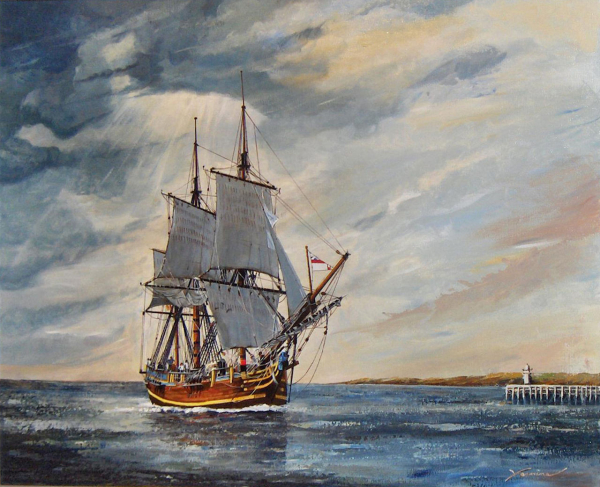
The crew was gathered forcibly— as is typical in the military fleet. The captain's assistant was a certain Fletcher Christian, a prominent figure in the coming events. On September 3, 1788, the dream team lifted anchor and set off towards Tahiti.
The grueling voyage lasted 250 days, fraught with hardships like scurvy and the harsh Captain Bligh, who, among other things, made the crew sing and dance to a violin every day to lift their spirits, successfully arrived at the destination. Bligh had been to Tahiti before and was received warmly by the natives. Taking advantage of his position, and to ensure reliability, he bribed local influential figures to obtain permission to set up camp on the island and collect breadfruit saplings, which thrived in these areas. For six months, the crew collected saplings and prepared for the journey home. The ship had suitable cargo capacity, so many saplings were harvested, which explains the prolonged stay on the island, as well as the crew's simple desire to relax.
Of course, the carefree life in the tropics was much better than sailing on a ship under 18th-century conditions. The crew members formed relationships with the local population, including romantic ones. Therefore, a few individuals escaped shortly before departure on April 4, 1789. The captain, with the help of the natives, found them and punished them. In short, due to the newly fallen hardships and the captain's strictness, the crew began to grumble. What especially outraged everyone was the fact that the captain was economizing on water for the crew in favor of watering the plants. It is hardly fair to blame Bligh for this: his task was to transport the trees, and he was fulfilling it. The consumption of human resources was merely a cost of the solution.
On April 28, 1789, the patience of most of the crew ran out. The rebellion was led by the first man after the captain — the very assistant Fletcher Christian. In the morning, the mutineers took the captain from his cabin, bound him in bed, and then brought him onto the deck where they held a trial chaired by Christian. To the credit of the mutineers, they did not create chaos and acted relatively gently: they placed Bligh and 18 men who refused to support the mutiny in a lifeboat, gave them some provisions, water, and a few rusty sabers, and set them adrift. Of navigational equipment, Bligh had only a sextant and a pocket watch. They landed on the island of Tofua, located 30 miles away. Fate was not kind to everyone — one man was killed by locals on the island, but the others managed to escape and, covering 6701 km (!!!), reached the island of Timor safe and sound after 47 days, which is an incredible adventure in itself. But this is not about them. The captain was later tried, but he was acquitted. This marks the beginning of the real adventure, while everything prior was merely a preface.
There were 24 people left aboard the ship: 20 conspirators and 4 loyal to the former captain who did not have enough room in the lifeboat (let me remind you, the mutineers were not reckless). Naturally, they did not dare to sail back to Tahiti, fearing punishment from their home country. So what to do? Correct… establish their own state with breadfruit and Tahitian women. But this was also easy to say. To start, the fighters against the system headed to the island of Tubua'i and tried to live there, but they did not get along with the natives, which forced them to return to Tahiti after 3 months. When asked what happened to the captain, the natives were told that he had met Cook, with whom he was friends. The irony was that Bligh had managed to inform the locals about Cook's death, so they had no more questions. Although in reality, the unfortunate captain lived for many more years and died in his bed of natural causes.
On Tahiti, Christian immediately began planning the next scenario of the mutiny to secure their success and avoid trial — representatives of the punitive squad were already dispatched on the ship 'Pandora' under the command of Edward Edwards. Eight Englishmen, along with Christian, decided to leave the friendly island on the 'Bounty' in search of a more peaceful place, while the others, believing in their innocence (as they saw it), chose to stay. Eventually, those who remained were indeed apprehended, and by the time of their arrest, two had already died by natural causes, four perished during the wreck of the 'Pandora', while four others — those who had not found room on the skiff — were acquitted, one was pardoned, and five were hanged — of which two for not resisting the mutiny, and three for participating in it. Meanwhile, the 'Bounty' sailed off with the more pragmatic citizens, who wisely took along twelve local women and six men loyal to them, wandering the vastness of the Pacific Ocean.
After some time, the ship reached an uninhabited island where the infamous breadfruit and bananas grew, there was fresh water, a beach, jungles — in short, everything one would expect on a deserted island. This was Pitcairn Island, which was relatively recently discovered in 1767 by navigator Philip Carteret. The fugitives were incredibly lucky on this island: its coordinates had been mistakenly plotted on the map by 350 kilometers, so the royal navy's search expedition could not locate them, even though they diligently searched every island. Thus, a new miniature state on Pitcairn Island was formed and continues to exist to this day. The 'Bounty' had to be burned to leave no traces and avoid the temptation to sail away. It is said that the ship's ballast stones can still be seen in the lagoon of the island.
The fate of the free settlers unfolded as follows. After several years of living freely, in 1793, a conflict erupted between the Tahitian men and the English, resulting in the former's disappearance, and Christian was also killed. The conflict was presumably caused by a shortage of women and the oppression of the Tahitians, whom the whites (who had, however, become no longer white) treated as slaves. Two more Englishmen soon died from alcoholism — they learned to distill alcohol from the roots of a local plant. One died from asthma. Three Tahitian women also perished. By 1800, approximately 10 years after the rebellion, only one participant remained alive, still capable of making good use of the results of his demarche. It was John Adams (also known as Alexander Smith). He was surrounded by 9 women and 10 minor children. The number of children then grew to 25: Adams did not waste time. Moreover, he established order in the community, guided the residents towards Christianity, and organized the upbringing of the youth. Eight years later, the 'state' encountered the passing American whaling ship 'Topaz.' The captain of this ship informed the world about the paradise island at the edge of the Pacific Ocean, to which the British government surprisingly reacted softly and pardoned Adams's crime upon the expiration of the statute of limitations. Adams died in 1829 at the age of 62, surrounded by many dearly loving children and women. The only settlement on the island is named after him — Adamstown.
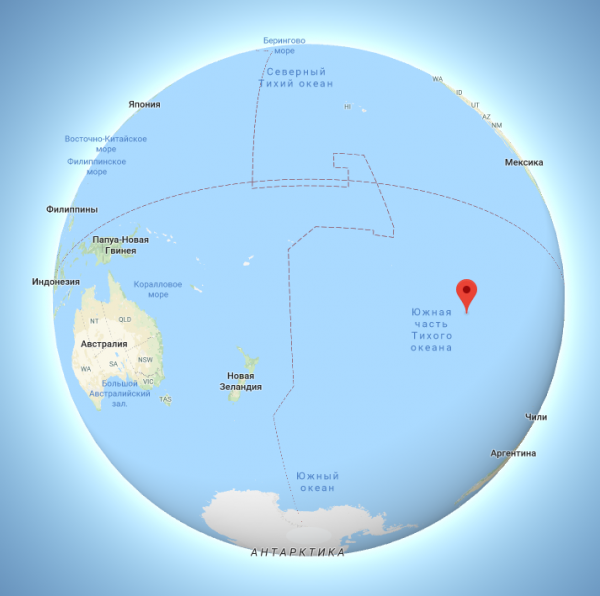
Today, around 100 people live in the Pitcairn Islands, which is quite a lot for an island covering 4.6 square kilometers. The population peaked at 233 in 1937, after which it declined due to emigration to New Zealand and Australia, but there were also newcomers who came to live on the island. Formally, Pitcairn is considered a British overseas territory. It has its own parliament, school, internet connection at 128 kbps, and even its own .pn domain, along with a pleasant phone code of +64. The economy's foundation is tourism, with a small portion coming from agriculture. Russian nationals require a British visa, but with local authorities' consent, they can be allowed entry without one for up to 2 weeks.
6. The Red Tent
I learned about this story from the movie of the same name. It's one of those rare cases when a movie is good. It is good for many reasons. First, it features a very beautiful (she is still alive, over 80 years old). Second, the film is in color (the title requires it), which was not a given for 1969, and it was produced with the cooperation of the USSR and Great Britain, which was also unusual and positively impacted the film. Third, the storytelling in the film is unparalleled. Just the final dialogue between the characters is worth it. Fourth, the film has historical significance, and this story deserves separate attention.
Before the space race and before World War II, there was a race in ballooning. Stratospheres of various shapes and sizes were built, and record heights were achieved. The USSR, of course, also . This was a matter of state importance; everyone wanted to be first and risked their lives for this just as much as during the era of space exploration. The media described the achievements in ballooning in detail, so you can easily find many articles on this topic online. One of those high-profile projects was the . The Italian (as is evident) airship arrived at Spitsbergen to launch on May 23, 1928, toward the North Pole.
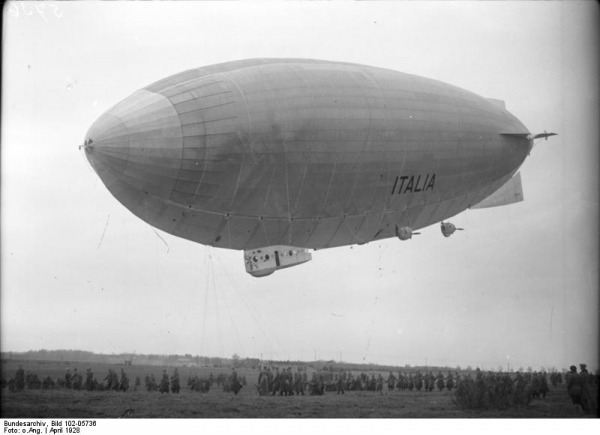
The goal was to reach the pole and return, while the tasks were scientific: to explore Franz Josef Land, the Northern Land, areas north of Greenland, and the Canadian Arctic Archipelago, to finally resolve the question of the existence of the hypothetical Crocker Land, which Robert Peary allegedly observed in 1906, as well as to conduct observations in atmospheric electricity, oceanography, and terrestrial magnetism. The hype around the endeavor is hard to overestimate. The Pope gave the crew a wooden cross meant to be planted at the pole.
The airship, under the command of , successfully reached the pole. Previously, he had already participated in something similar under the leadership of , but then, it seems, their relationship soured. The film mentions an interview Amundsen gave to journalists; here are some excerpts:
— What significance for science could General Nobile's expedition have if it is successful?
— It is of great importance, — replied Amundsen.
— Why aren't you leading the expedition?
— It's no longer for me. Besides, I wasn't invited.
— But Nobile is not an Arctic expert, is he?
— He takes them with him. Some of them I know. They can be relied upon. And Nobile himself is a magnificent dirigible builder. I realized this during our flight
to the North Pole on the dirigible he built, the ‘Norway’. But this time he not only built the dirigible but also leads the expedition.
— What are their chances of success?
— The chances are good. I know Nobile — he is an excellent commander.
Technically, the dirigible was a fabric semi-rigid airship filled with explosive hydrogen — a typical dirigible of that time. However, this was not what doomed it. On the way back, the vessel was blown off course due to the wind, so it spent more time in flight than planned. On the third day, in the morning, the dirigible was flying at an altitude of 200-300 meters and unexpectedly began to descend. The reasons cited were the weather conditions. The immediate cause is not reliably known, but it was likely icing. Another version considers a rupture of the envelope and subsequent hydrogen leakage. The crew's actions could not prevent the dirigible's descent, resulting in it crashing into the ice about 3 minutes later. The mechanic died on impact. The ship was carried by the wind about 50 meters, during which part of the crew, including Nobile, ended up on the surface along with some equipment. The other 6 people remained inside the gondola (along with the main cargo), which was carried away by the wind — their fate remains unknown, only a column of smoke was seen, but there were no flashes or explosion sounds, which does not suggest a hydrogen ignition.
On the ice in the Arctic Ocean, a group of 9 people found themselves led by Captain Nobile, who, however, was injured. Also present was Nobile's dog named Titina. The group was quite fortunate overall: there was food (including 71 kg of canned meat, 41 kg of chocolate) in the bags and containers that had fallen onto the ice, as well as a radio station, a pistol with ammunition, a sextant, chronometers, a sleeping bag, and a tent. However, the tent was only four-person. It was painted red for visibility using paint from marker balloons that also fell from the airship (this is the one referred to in the film).
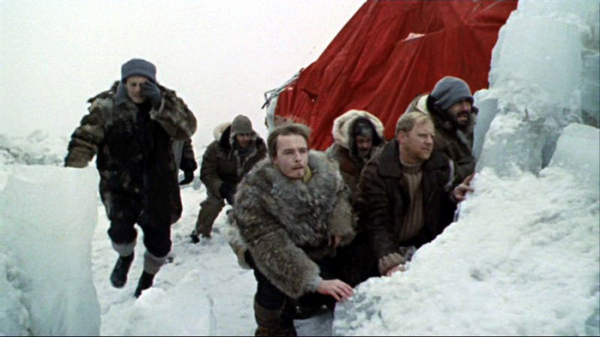
The radio operator (Biaggi) immediately began setting up the radio station and made attempts to contact the support ship of the expedition "Città di Milano." Several days were unsuccessful. As Nobile later claimed, the radio operators of "Città di Milano" were busy sending personal telegrams instead of trying to catch the expedition's transmitter signal. The steamboat went out to sea in search of the missing, but without the coordinates of the crash site, it had no serious chance of success. On May 29, the radio operator of "Città di Milano" heard Biaggi's signal but mistook it for the call sign of a station in Mogadishu and took no action. On the same day, one of the group members, Malmgren, shot a polar bear, and the meat was used for food. He, along with two others (Mariano and Zappi), separated the next day (Nobile was against it but allowed the separation) from the main group and independently headed towards the base. During the crossing, Malmgren perished, two survived, though one of them (navigator Adalberto Mariano) frostbit his foot. Meanwhile, nothing was known about the fate of the airship. In total, about a week passed during which Nobile's group waited to be discovered.
On June 3, luck struck again. from a remote area (the village of Voznesenie-Vokhma, North Dvina Province) picked up the signal from Biaggi's station on a homemade receiver. He sent a telegram to his friends in Moscow, and the next day the information was escalated to an official level. At (the very one that was actively involved in ballooning activities) a rescue headquarters was established, led by the Deputy People's Commissar for Military and Naval Affairs of the USSR, Iosif Unshlikht. On the same day, the distress signal was reported to the Italian government, but it was only after 4 days (on June 8) that the steamer 'Citta di Milano' finally made contact with Biaggi and received the exact coordinates.
In fact, this meant nothing yet. It was still necessary to reach the camp. The rescue operation involved various countries and communities. On June 17, two planes chartered by Italy flew over the camp but did not see it due to poor visibility. In the search, Amundsen also perished. He could not remain uninvolved and on June 18 took off on a French seaplane designated for him to look for the camp, after which he and his crew disappeared without a trace (later a float from his plane was found in the sea, then an empty fuel tank — presumably, the plane got lost, and it ran out of fuel). Only on June 20 was the camp located by plane, and 2 days later, cargo was delivered. On June 23, a light aircraft evacuated General Nobel from the camp — it was assumed that he would assist in coordinating the actions to rescue the remaining individuals. Later, this would be used against him, as the public accused the general of the airship crash. There is a dialogue in the film:
— I had 50 reasons to leave, and 50 to stay.
— No. 50 to stay and 51 to leave. You left. What was the 51st?
— I don't know.
— Remember what you were thinking then, at the moment of departure? You're sitting in the cockpit, the plane is in the air. Were you thinking of those who stayed on the ice floe?
— Yes.
— And of those who were taken by the airship?
— Yes.
— About Malmgren, Zappi, and Mariano? About 'Krasin'?
— Yes.
— About Romanya?
— About me?
— Yes.
— About your daughter?
— Yes.
— About the hot bath?
— Yes. My God! I was thinking of the hot bath in Kings Bay.
The Soviet icebreaker "Krasin" also participated in the rescue operations, delivering a small disassembled aircraft to the search area — it was then assembled on the ice. On July 10, its crew discovered a group, dropped food and clothing. The next day, the group of Malmgren was found. One of them was lying on the ice (it was presumed to be the deceased Malmgren, but it later turned out that these were likely his belongings, and Malmgren himself could not walk much earlier and therefore asked to be left behind). The pilot was unable to return to the icebreaker due to poor visibility, so he made an emergency landing, damaging the aircraft, and radioed that the crew was safe and requested to rescue the Italians first, and then them. "Krasin" picked up Mariano and Zappi on July 12. Zappi wore warm clothes belonging to Malmgren, and overall he was well-dressed and in good physical condition. In contrast, Mariano was half-naked and severely exhausted, having had a leg amputated. Zappi was accused, but there was no substantial evidence against him. That evening, the icebreaker picked up 5 people from the main camp, after which everyone was transferred on board the "Città di Milano". Nobile insisted on searching for the airship with six expedition members remaining in the envelope. However, Captain Samoylovich of the "Krasin" stated that he could not conduct searches due to a lack of coal and the absence of aircraft, so he removed the pilots and the plane from the ice on July 16 and was planning to head home. Captain Romagna of the "Città di Milano" cited an order from Rome to return to Italy immediately. However, the "Krasin" still participated in the search for the envelope, which ended in nothing (it arrived in Leningrad on October 4). On September 29, another search plane crashed, after which the rescue operation was halted.
In March 1929, the state commission recognized Nobile as the main culprit of the disaster. Immediately after that, Nobile resigned from the Italian Air Force, and in 1931 moved to the Soviet Union to lead the airship construction program. After the defeat of fascism in 1945, all charges against him were dropped. Nobile was restored to the rank of major general and died many years later at the age of 93.
The Nobile expedition was one of the most tragic and unusual expeditions of its kind. The broad range of assessments stems from the fact that too many people were put at risk to save the group, resulting in more fatalities than rescues during the search operation. At that time, it seems people viewed it differently. The very idea of flying to who knows where in an unwieldy airship is deserving of respect. It symbolizes the steampunk era. At the beginning of the twentieth century, humanity believed that almost anything was possible, and that there were no limits to technological progress, marked by a reckless adventurous spirit in testing the limits of technical solutions. Primitive? Who cares! In the pursuit of adventure, many lost their lives and endangered others unnecessarily, which makes this story the most ambiguous of all, although certainly very interesting. And the film is good too.
5. Kon-Tiki
The story of Kon-Tiki is primarily known thanks to the film (I admit, good adventure movies are made a bit more often than I initially thought). In fact, Kon-Tiki is not just the title of a film. It is the name of the raft on which the Norwegian explorer crossed the Pacific Ocean in 1947 (well, not entirely, but nonetheless). The raft is named after a Polynesian deity.
The point is that Thor developed a theory suggesting that people from South America, on primitive vessels presumably rafts, reached the islands of the Pacific Ocean and thus settled them. The raft was chosen because it is the most reliable among the simplest floating devices. Few believed in Thor (according to the film, so few that, in fact, no one did), and he decided to demonstrate the possibility of such a maritime journey while also testing his theory. For this, he assembled a somewhat questionable team for support. After all, who else would agree to such a thing? Thor was well acquainted with some, while others he knew less well. It's best to watch the film for more details on the team assembly. By the way, there is a book, and more than one, but I haven't read them.
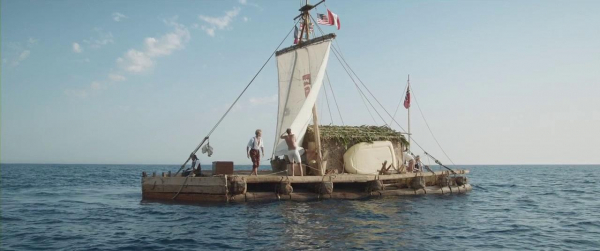
To begin with, Tur was, in general, an adventurous man, which his wife supported. Together, they lived for a time in their youth in semi-wild conditions on the island of Fatu Hiva. This small volcanic island, which Tur referred to as 'paradise' (though the climate and medical care turned out to be quite poor, and his wife developed a non-healing wound on her leg, which forced them to leave the island urgently). In other words, he was ready and able to dare something unusual.
The expedition participants did not know each other. Each had different personalities. Therefore, it would take a while for us to grow tired of the stories we would tell each other on the raft. No storm clouds or ominous pressure promising bad weather were as hazardous to us as our depressed moral state. After all, the six of us would be completely alone on the raft for many months, and under such conditions, a good joke would often be worth as much as a life jacket.
In general, I won't dwell too long on the journey; it's best to actually watch the film. It was awarded an Oscar for a reason. The story is quite unusual; I simply couldn't forget it, but I doubt I can add anything valuable. The voyage ended successfully. As Tur had anticipated, the ocean currents carried the raft toward the islands of Polynesia. They safely landed on one of the islands, conducting observations along the way and gathering scientific data. However, things didn't work out with his wife — she grew tired of her husband's adventures and left him. The guy lived a very active life and reached the age of 87.
4. Regarding emptiness
This event took place not long ago, in 1985. A pair of climbers was ascending the summit of Siula Grande (6344) in the Andes of South America. The mountains there are beautiful and unusual: despite the steep slopes, the snowy firn holds, which obviously made the ascent easier. They reached the summit. And then, following the classic pattern, the difficulties were supposed to begin. The descent is always more challenging and dangerous than the ascent. Everything was going smoothly, as is often the case in such situations. For instance, it was getting dark — which is quite natural. As usual, the weather was deteriorating, and fatigue was accumulating. The duo (Joe Simpson and Simon Yates) was traversing the area of the pre-summit ridge to take a more logical route. In short, everything was as it should be in a standard, albeit technically challenging, ascent: hard work, but nothing out of the ordinary.
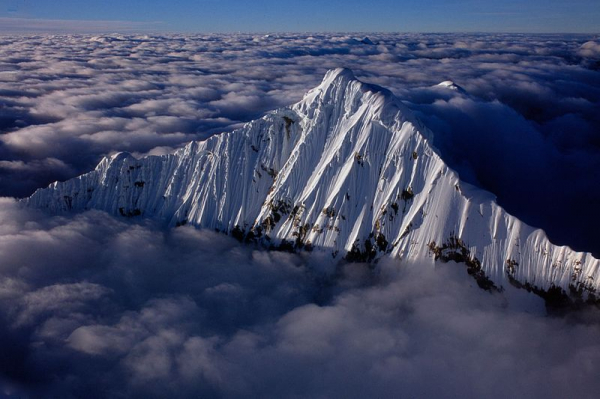
But then what happened was something that could very well occur: Joe fell. This was bad, but it still didn't pose a danger. The partners, of course, should have been ready for this, and they were. Simon held onto Joe. They would have continued, but Joe fell badly. His leg got wedged between the rocks, and his body, due to inertia, continued to move and broke his leg. Climbing as a pair can be ambiguous in itself, because everything goes well until something starts to go wrong. In such cases, the expedition can fragment into two solo climbs, and that's a whole different scenario (the same can be said about any group, for that matter). And they were not quite ready for it. To be precise, Joe was. He thought something like, 'Now Simon will say he's going for help, he will try to calm me down. I’ll understand him; he has to do that. And he will understand that I understood, we both will understand this. But there’s no other way.' Because conducting rescue operations at such altitudes only means increasing the number of people being rescued, and that's not really the purpose of these operations. However, Simon did not say that. He suggested descending right from there, right now, by the shortest route, taking advantage of the steepness of the slope. Even though the terrain was unfamiliar, the main thing was to quickly lose altitude and reach a flatter area, and from there, they'd sort it out.
Using descent devices, the partners began their descent. Joe played mostly the role of ballast: he was lowered on a rope by Simon. Joe descends, secures himself, then Simon passes one rope, removes it, and we repeat. One must acknowledge the relatively high effectiveness of the idea, as well as the good training of the participants. The descent was indeed going smoothly; there were no insurmountable difficulties on the terrain. A certain number of completed iterations allowed them to move noticeably downward. By this time, it was almost dark. But then Joe stumbled for the second time in a row — he again slipped during the next descent with the rope. During the fall, he landed on a snow bridge on his back, breaking through it, and continued to fall into the crevice. Meanwhile, Simon was trying to hold on, and, to his credit, he managed to do so. Until that moment, the situation was not exactly normal, but far from catastrophic: the descent was under control, injury was a natural risk for such activities, and while it was getting dark and the weather was deteriorating, that's usual in the mountains. But now Simon was awkwardly sitting on the slope, holding on to Joe, who had fallen beyond the edge, and nothing was known about him. Simon shouted but heard no response. He could not get up or descend, fearing he would not be able to hold Joe. He sat there for about two hours.
Meanwhile, Joe was hanging in the crevice. A standard rope is 50 meters long; I don't know how long theirs was, but it was probably about that length. That's not very long, but in foul weather, beyond the edge, in a chasm, it is quite possible that he really couldn't be heard. Simon began to freeze and, seeing no prospect for improvement, cut the rope. Joe fell another distance, and only then did his misfortune turn into unimaginable luck, which is the essence of the story. He landed on another snow bridge inside the crevice and accidentally managed to stay on it. Following that was a cut piece of rope.
Meanwhile, Simon descended into the bend and spotted the broken bridge and the crevice. It was so dark and bottomless that the thought of a living person in it was unimaginable. Simon 'buried' his friend and made his way back to the camp alone. This was held against him—he didn’t check, didn’t verify, didn’t offer help… However, this is comparable to hitting a pedestrian and seeing their head and torso fly in different directions in the mirror. You must stop, but is there any point in it? That's why Simon decided it wasn't worth it. Even if we assume Joe was still alive, he needed to be brought out of there. And people don’t live long in crevices. Plus, it’s impossible to work endlessly without food or rest at high altitude.
Joe was sitting on a small bridge in the middle of the crevice. Among other things, he had a backpack, a flashlight, a system, a descender, and a rope. He sat there for quite some time and concluded that there was no way to climb up. What happened to Simon was also unknown; perhaps he was not in a better position now. Joe could either continue to sit there or do something, and that something involved looking down below. He decided to do just that. He set up a base and slowly descended to the bottom of the crevice. The bottom turned out to be passable, and by then it had already brightened. Joe managed to find an exit from the crevice onto the glacier.
On the glacier, Joe also faced difficulties. This was just the beginning of his long journey. He moved on his belly, dragging his broken leg. It was challenging to find a path through the maze of crevices and ice chunks. He had to crawl, lifting the front part of his body with his arms, scanning the surroundings, choosing a landmark, and inching forward. On the other hand, the slope and the snow cover helped with the crawling. So by the time Joe, exhausted, reached the base of the glacier, he had two pieces of news waiting for him. The good news was that he finally managed to drink some water—murky sludge with bits of rock washed out from under the glacier. The bad news, of course, was that the terrain had become more gradual, even less smooth, and, most importantly, not as slippery. Now, it was much more difficult for him to drag his body.
For several days, Joe crawled to the camp. Simon was still there with another member of the group who did not go to the mountain. Night was falling, and it was destined to be the last; in the morning, they planned to pack up and leave. The usual evening rain was starting. By then, Joe was only a few hundred meters from the camp. They no longer awaited him; his clothes and belongings had been burned. Joe had no strength left to crawl on flat ground, and he began to scream—the only thing he still could do. Due to the rain, he was not heard. Then the people sitting in the tent thought they heard a cry, but who knows what the wind might bring? When sitting in a tent by the river, one can hear conversations that aren’t there. They decided it was Joe's spirit that had come. Yet Simon went out to check with a flashlight. And there he found Joe. Weak, hungry, soiled, but alive. He was quickly taken to the tent, where first aid was provided. He could no longer walk. Then there was a long recovery, numerous operations (it seems Joe had the means for this), and he was able to recover. He did not abandon the mountains, continued climbing challenging peaks, then he injured his leg (the other one) and face again, and even then, he continued practicing technical mountaineering. A tough guy. Overall, quite lucky. His miraculous rescue was not the only case. Once he found himself on what he thought was a saddle, he planted his ice axe, which sank in. Joe thought it was a depression and covered it with snow. It later turned out it was not a depression but a hole in a snow cornice.
Joe wrote a book about this climb, and in 2007, a detailed .
3. 127 Hours
I won't dwell on this too long; better… right, watch the film of the same name. But the tragedy's impact is staggering. In short, here’s the essence: a guy named was hiking in a canyon in North America (Utah). The hike ended when he fell into a crevice, dragging a large boulder with him that pinned his arm. Meanwhile, Aaron remained unharmed otherwise. The book "Between a Rock and a Hard Place," which he later wrote, became the basis for the film.
Aaron lived for several days at the bottom of the crevice, where sunlight only reached for a brief period. He tried to drink his urine. Then he decided to cut off his trapped arm because no one had come into that hole, and shouting turned out to be useless. The situation was worse because he had no real tools: he only had a dull utility folding knife. He had to break the bones of his forearm. There was a problem with severing the nerve. The film portrays all this well. After immense suffering, having freed himself from his arm, Aaron made it out of the canyon, where he encountered a couple walking by, who provided him with water and called for a rescue helicopter. This is where the story ends.
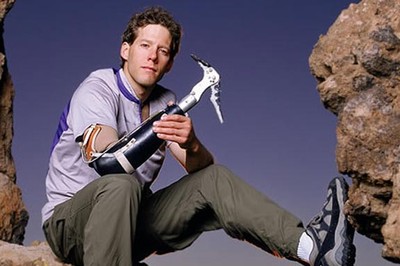
The incident is undoubtedly impressive. The rock was later lifted and its weight evaluated — according to various sources, it ranges from 300 to 400 kg. Of course, lifting it alone would have been impossible. Aaron made a harsh but correct decision. Judging by the smile in the photo and the media hype, the fact that he had become disabled did not upset him much. He even got married later. As seen in the photo, he attached a prosthetic resembling an ice axe to his arm for better climbing convenience.
2. Death Will Wait for Me
This is not so much a story as it is a tale and the title of a book by Grigory Fedoseev, in which he described his life in the Siberian wilderness of the mid-20th century. Originally from Kuban (now the birthplace is located in the territory of the Kabardino-Balkar Republic), a pass in the Abishira-Akhuba range near the village of Arkhyz (~3000, n/k, grassy-scree) is named after him. In Wikipedia, Grigory is briefly described as 'a Soviet writer, engineer-surveyor.' Overall, this is accurate; he gained notoriety due to his writings and books that were later published. To be honest, he is not a bad writer, but he is also not Leo Tolstoy. The book leaves a controversial impression in literary terms, but it undoubtedly has high documentary value. It describes the most interesting segment of his life. Published in 1962, but the events occurred earlier, between 1948 and 1954.
I highly recommend this book for reading. Here, I will briefly outline the main plot. By that time, Grigory Fedoseyev had become the head of the expedition in the Sea of Okhotsk region, where he commanded several teams of surveyors and cartographers and personally participated in the work. It was a harsh, wild area in the no less harsh USSR. In terms of equipment, by modern standards, the expedition had very little. There was a plane, some equipment, supplies, and a military-style logistics system. At the same time, life conditions within the expedition were marked by poverty, much like nearly everywhere in the Soviet Union. People built rafts and shelters for themselves using axes, ate flatbreads made of flour, and hunted game. They then carried bags of cement and metal up the mountain to establish a geodetic point. Then another, and yet another. Yes, these are the very trigonometrical points that were used for peaceful purposes in mapping the area and for military purposes to calibrate compasses based on those previously created maps. There are many such points scattered across the entire country. Now they are in a semi-ruined state because GPS and satellite imagery exist, and the idea of a full-scale war involving massive artillery strikes thankfully remained an unrealized Soviet doctrine. But every time I came across the remnants of a trigonometrical point on some knoll, I wondered how they had built it here. Fedoseyev shares how.
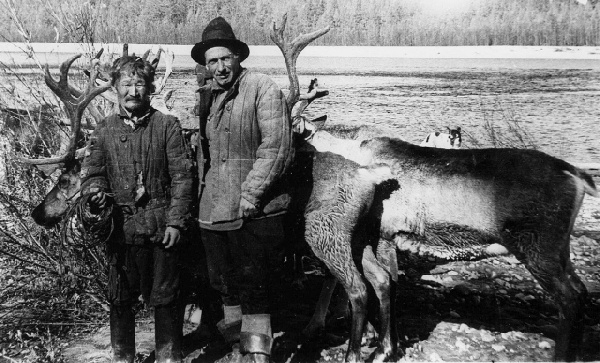
In addition to constructing trigonometrical points and mapping (measuring distances, heights, etc.), the missions of those expeditions included studying the geology and wildlife of Siberia. Grigory also describes the lifestyle and appearance of the local inhabitants, the Evenks. He shares a wealth of information about everything he saw. Thanks to the work of his team, we now have maps of Siberia, which were subsequently used to construct roads and oil pipelines. The scale of his work is hard to overstate. But why was I so impressed by the book and placed it in second place? It turns out that the man was remarkably resilient and durable. If I were in his position, I would have died within a month. Yet he lived a normal life for his time (69 years).
The climax of the book is the autumn rafting down the Mae River. Locals used to say that a log wouldn't make it to the mouth without turning into splinters. And so, Fedoseev, along with two companions, decided to blaze a trail. The rafting turned out to be successful, but during the process, the trio crossed the line of reason. The dugout canoe fell apart almost immediately. They then constructed a raft. It regularly capsized; they would catch it, lose it, and build a new one. It was damp and cold in the river canyon, and frost was approaching. At some point, the situation completely spiraled out of control. There was no raft, no belongings, one companion was paralyzed and near death, and the other had vanished who knows where. Grigory holds his dying companion, positioned on a rock in the middle of the river. It begins to rain, the water rises, and they are about to be swept off the rock. Nevertheless, everyone survived, not by a miracle, but through their own strength. And the book's title is not even about that. In short, if you're interested, it's better to read the original source.
Regarding the personality of Fedoseev and the events he described, my opinion is ambiguous. The book is positioned as artistic. The author does not hide this but does not clarify what exactly, merely stating that he intentionally compressed time for the sake of the storyline and asks for forgiveness for this. Indeed, it is a minor inaccuracy. But what is disconcerting is that everything is just too predictable. He, like an immortal Rimbaud, tackles adversities one after another, where each subsequent one is more serious and requires unprecedented efforts. One danger—he was lucky. The next—he escaped. The third—he was helped by a companion. The tenth—it's all the same. While each is worthy of, if not a book, at least a story, the hero should have died at the very beginning. I hope the exaggerations were minimal. Grigory Fedoseev was, after all, a Soviet person in the good sense of the word (unlike the 60s generation that wasted all the polymers), when it was fashionable to behave decently. On the other hand, even if the author exaggerated, if even a tenth of what is described was true, it is already worthy of mention among the three incredible stories, and the title of the book accurately reflects its essence.
1. Crystal Horizon
There are brave climbers and there are old climbers. But there are no brave old climbers, unless, of course, it's Reinhold Messner. This individual, at 74, being the world's leading climber, still lives in his castle, occasionally takes on some height, and in his spare time builds models of the mountains he has visited in his garden. "If he has been on a great mountain — he should bring back large stones from it," as it was in "The Little Prince" — Messner is clearly quite the troll. He is known for many things, but most notably for being the first to solo summit Everest. He detailed the climb and everything that accompanied and preceded it in his book "Crystal Horizon." He is also a good writer. However, his character is rather unpleasant. He openly states that he wanted to be first, and his ascent of Everest somewhat resembles the launch of the first Earth satellite. During the expedition, he psychologically tormented his girlfriend Nena, who accompanied him the whole way, which is explicitly stated in the book (there seems to have been love, but there are no details about it in the book or popular sources). Finally, Messner is an engaged character, and he made the ascent under relatively modern conditions, with appropriate equipment, and his level of preparation was fully adequate. He even flew in a depressurized airplane at 9000 meters to acclimatize. Yes, the event required tremendous effort, physically draining him. But in reality, that's a lie. Messner later stated, after K2, that Everest was just a warm-up.
To better understand the essence of Messner and his ascents, let’s recall the very beginning of his journey. After leaving the camp where Nena stayed behind to wait for him, just a few hundred meters away, he fell into a crevice. The incident happened at an unfortunate time and threatened the worst. Messner then remembered God and asked to pull him out, promising that if such a thing happened, he would give up climbing altogether. And he would completely cease all ascents (but only on eight-thousanders) in the future. After struggling, Messner got out of the crevice and continued on his way, thinking: "what a silly idea might come to mind." Nena later wrote (by the way, she used to guide in the mountains):
The tirelessness of this man is beyond words... The phenomenon of Reinhold is that he is always wired, even though his nerves are perfectly fine.
However, enough about Messner. I believe I have explained enough why his outstanding achievement does not qualify as one of the most incredible. There have already been many films made about him, numerous books written, and every second notable journalist has interviewed him. This is not about him.
Thinking of Messner, one cannot overlook climber No. 2, Anatoly Bukreev, or as he is also known, the 'Russian Messner.' By the way, they were friends (there are joint ). Yes, it's about him, including a low-quality film 'Everest' that I do not recommend watching, but I do recommend reading the book that carefully examines , including the transcripts of the interrogations of the participants. Unfortunately, Anatoly did not become the second Messner and, being a brave climber, died in an avalanche under Annapurna. He should be mentioned, but we won’t talk about him either. Because the most interesting thing is the historically first ascent.
The first documented ascent was made by a team led by Edmund Hillary from Britain. There is a lot known about it as well. And there is no need to repeat — yes, this history is not about Hillary. It was a well-planned state-level expedition that went smoothly without extraordinary incidents. So why all this? Let's return to Messner. Let me remind you, this remarkable man was also a snob, and he was obsessed with the idea of being the first. Taking it extremely seriously, he began his preparations by studying the 'current state of affairs', poring over sources for any information about anyone who had ever been on Everest. All this is in a book that, in terms of thoroughness, can claim to be a scientific work. Thanks to Messner, his fame, and meticulousness, we now know about the almost forgotten, yet no less extraordinary ascent of Everest, which took place long before Messner and Hillary. Messner dug deep and uncovered data about a man named Maurice Wilson. That is the story I intend to prioritize.
(also a Brit like Hillary), was born and raised in England, fought in World War I, where he was injured and demobilized. During the war, he started to have health problems (cough, pain in his arm). In his attempts to heal, Wilson found no success with traditional medicine and turned to God, who, he claimed, helped him cope with his ailments. By chance, in a café, Maurice learned from a newspaper about another expedition planned for Everest in 1924 (which ended unsuccessfully) and decided that he must reach the summit. Prayer and faith in God would help in this challenging endeavor (Maurice was surely aware of this).
However, one could not simply take a trip to Everest. At that time, there wasn't such involvement as there is now, but there was another extreme. Ascents were considered a state matter, or, if you will, political, and took place in a militarized style with clear delegation, supply transports, back-end operations, and summit assaults by specially trained units. This largely explains the underdevelopment of climbing gear at that time. To join an expedition, you had to be a member. It didn’t matter what, just respected. The more you were a member, the better. Maurice was not one of them. Therefore, the British official he approached for support stated that he would not aid just anyone in such a sensitive state matter and, moreover, would do everything to prevent the planned expedition. Theoretically, there was also another way, for instance, as in Nazi Germany in honor of the Führer, or, to not look far, like in the Soviet Union: it was completely unclear why this particular idiot would go up the mountain at the time when one had to forge a labor feat, but if this endeavor could be timed to coincide with Lenin's birthday, Victory Day, or at least some congress date, then no questions were raised — people were allowed time off work, the state provided preferences and was happy to help with money, food, transportation, and basically anything. But Maurice was in England, where no suitable occasion could be found.
In addition, a couple more problems emerged. There was the question of how to reach Everest. Maurice chose the air route. It was 1933, and civil aviation was still underdeveloped. To do this properly, Wilson decided to handle it himself. He bought a second-hand plane (financial concerns were not an issue for him). and, writing "Ever Wrest" on its side, began preparing for the flight. Maurice, however, did not know how to fly. So he needed to learn. Maurice enrolled in a flight school, where during one of his first practical lessons, he successfully crashed the training plane, receiving a scolding from an irate instructor who told him he would never learn to fly and should quit his training. But Maurice did not give up. He started flying his plane and managed to master the controls, albeit not perfectly. In the summer, he crashed and had to repair the plane, which finally drew attention to him and led to an official ban on his flight to Tibet. The other problem was equally serious. Maurice knew as little about mountains as he did about planes. He began training to improve his fitness on low hills in England, for which he was criticized by friends who rightly believed he should have hiked in the Alps instead.
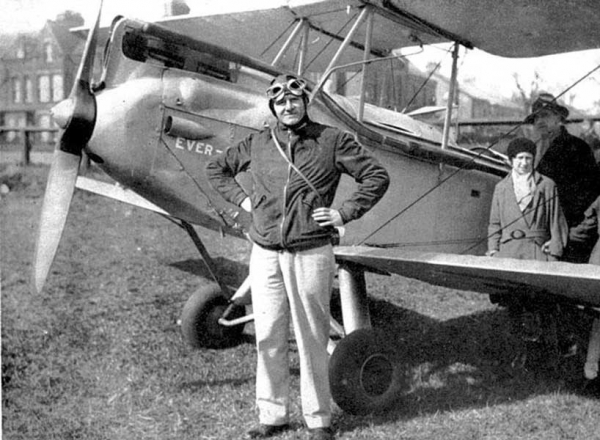
The aircraft's maximum range was about 1000 kilometers. Therefore, the journey from London to Tibet would consist of many stops. Wilson tore up the telegram from the Ministry of Air Transport stating that his flight was prohibited, and on May 21, 1933, he began his journey. First Germany (Freiburg), then, on the second attempt (the first attempt to cross the Alps had failed), Italy (Rome). Next was the Mediterranean Sea, where Maurice faced zero visibility on the way to Tunisia. Then Egypt, Iraq. In Bahrain, the pilot encountered a setup: his home government, through the consulate, petitioned for a flight ban, resulting in him being denied refueling and advised to leave, with the promise of arrest if he did not comply. The conversation took place in the police station. There, a map hung on the wall. It should be noted that Wilson did not have good maps (during the preparations he had even to use a school atlas), so while listening to the police officer and nodding, Wilson took advantage of the situation and carefully studied that map. The plane was refueled with the promise of flying towards Baghdad, after which Maurice was let go.
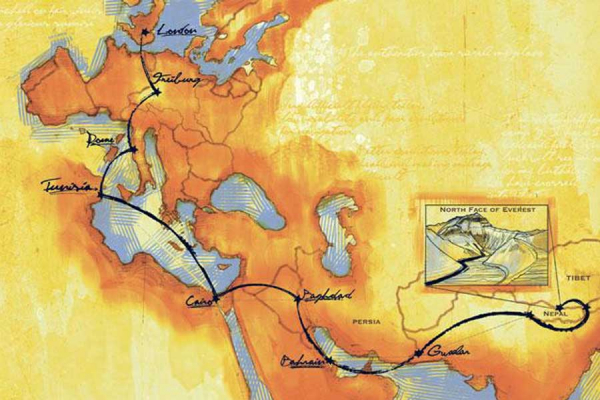
After flying to Baghdad, Maurice turned towards India. He intended to cover 1,200 kilometers — an immense distance for an outmoded aircraft. However, whether it was favorable winds, exceptional Arab fuel, or the plane was designed with a range reserve, Maurice successfully reached the westernmost airfield in India at Gwadar in 9 hours. A few days later, he made some simple flights across India towards Nepal. Considering that India was under British influence at that time, it’s surprising that the plane was not detained until now, justifying it by stating that flights by foreigners over Nepal were prohibited, and given the pilot's stubbornness, anything could happen. There remained 300 kilometers to the border with Nepal, which Wilson covered overland, from where he called Kathmandu to request permission to travel through Nepal and to attempt the ascent. The official on the other end preferred to remain indifferent to the needs of the novice climber, and permission was denied. Maurice also tried to obtain permission from the Tibetan side (i.e., from the north, where Messner had come from, as at that time Tibet had already become China, whereas the southern Khumbu icefall en route from Nepal was considered impassable, which is no longer the case), but he was refused there as well. Meanwhile, the rainy season began, followed by winter, which Maurice spent in Darjeeling, watched by the police. Maurice managed to lull the authorities' vigilance by claiming he had given up on the ascent, now portraying himself as an ordinary tourist. However, he did not stop gathering information and preparing in every possible way. Money was running out. He contacted three Sherpas (Tewang, Rinzing, and Tsering, who had worked on the British 1933 expedition last year), who agreed to accompany him and helped find a horse, packing the gear into bags made from wheat sacks. On March 21, 1934, Wilson and the Sherpas set out on foot from the town. The Sherpas dressed as Buddhist monks, while Maurice disguised himself as a Tibetan lama (in the hotel he stated he had gone to hunt tigers). They traveled at night. Throughout the journey, only one old man uncovered the ruse, who, upon realizing that a lama had stopped near his house, wanted to sneak into his tent, but he kept silent. In 10 days, they managed to reach Tibet and cross the border.
Now, before Wilson, the endless ridges of the Tibetan plateau opened from the Kongra La pass. The path lay over passes at an altitude of 4000-5000 meters. On April 12, Wilson saw Everest for the first time. Surely the landscapes that Messner admired inspired Wilson as well. On April 14, he reached the Rongbuk Monastery at the foot of Everest's northern slope with the Sherpas. The monks welcomed him warmly and allowed him to stay, and upon learning of his visit's purpose, offered to use the equipment stored in the monastery from the British expedition. Waking up the next morning, he heard the monks chanting and thought they were praying for him. Maurice immediately set out to cross the Rongbuk Glacier, aiming to reach the height of 8848 meters on April 21 – his birthday – which is the summit of the world. The monastery itself is located at an altitude of around 4500 meters. There remained just over 4 kilometers. A small distance, if this were some Alps or the Caucasus, but Maurice likely knew little about high-altitude ascents. Moreover, he first had to overcome the glacier.
Since everything he had read about this area was written by climbers who tended to downplay the difficulties, he found himself in a challenging situation. A convoluted maze of ice towers, crevasses, and rock blocks appeared before him. With astonishing perseverance, following in the footsteps of his compatriots, Wilson managed to cover almost 2 kilometers. Which, of course, is too little, but quite respectable for a start. He lost his way several times and discovered the previous expeditions' Camp 2 at around 6000 meters. At 6250 meters, he was met with a heavy snowfall, forcing him to wait out the bad weather in his tent on the glacier for two days. There, alone and far from the summit, he celebrated his 36th birthday. At night, the storm ceased, and Wilson descended to the monastery over 16 hours through fresh snow, where he told the Sherpas about his adventures and ate hot soup for the first time in 10 days, after which he fell asleep and slept for 38 hours.
The attempt to summit abruptly took a heavy toll on Wilson's health. His war wounds flared up, his eyes became inflamed, and his vision deteriorated due to snow blindness. He was physically exhausted. He fasted and prayed for 18 days. By May 12, he declared himself ready for another attempt and asked the sherpas to go with him. The sherpas refused for various reasons, but seeing Wilson's obsession, they agreed to accompany him to the third camp. Before leaving, Maurice wrote a letter asking the authorities to forgive the sherpas for breaking the climbing ban. Apparently, he already understood that he was going to stay here forever.
Since the sherpas knew the route, the group relatively quickly (in 3 days) ascended to 6500 meters, where they unearthed discarded expedition gear and remnants of food. Above the camp lies the northern saddle at an altitude of 7000 meters (where the next camp is usually set up). Maurice and the sherpas spent several days at the 6500 camp waiting out the bad weather, after which, on May 21, Maurice made an unsuccessful ascent attempt that took four days. He crawled across a crevasse on a bridge, reached a 12-meter ice wall, and was forced to turn back. This likely happened because Wilson inexplicably refused to walk along the handrails set by the expedition. On the evening of May 24, Wilson, half-alive, sliding and falling, descended from the glacier and collapsed into the arms of the sherpas, admitting that he could not summit Everest. The sherpas urged him to descend to the monastery immediately, but Wilson wanted to make another attempt on May 29, asking them to wait for him for 10 days. In reality, the sherpas thought this idea was madness and went down, and they never saw Wilson again.
Everything that followed is known from Maurice's diary. But first, it is necessary to clarify something. For the third week now, having recovered from a recent illness, Maurice was at an altitude of just under 7000 meters. This is considerable in itself and raises some questions. These questions were first seriously addressed by a citizen of France named Nicolas Jeje. Being not only a mountaineer but also a doctor, in 1979 he undertook an experiment in which he spent 2 months at an altitude of 6768 meters, living in solitude and observing his body's condition (he even had an ECG recording device). Specifically, Jeje wanted to answer the question of whether long-term human existence at such altitudes was possible without oxygen. After all, no one thinks of living in the glacier zone, and climbers rarely stay at altitudes above a few days. Now we know that above 8000 meters begins the death zone, where it is fundamentally dangerous to walk without oxygen (in fact, Jeje wanted to refute this as well), but regarding the range of 6000-8000 meters (less than that is not interesting), the traditional opinion holds that a healthy and acclimatized person is generally not in danger. Nicolas came to the same conclusion. After descending from 60 days at that altitude, he noted that he felt great. But that was untrue. Doctors conducted an examination and determined that Nicolas was on the brink of not only physical but also nervous exhaustion, had stopped adequately perceiving reality, and likely could not have endured another 2 months at an altitude above 6000 meters. Nicolas was a trained athlete; what can be said about Maurice? Time was working against him.
In fact, there's not much time left. The next day, May 30, Maurice noted: "A magnificent day. Forward!". Thus, we know that the weather was at least good that morning. Clear visibility at altitude always lifts spirits. Dying at the foot of the north saddle in his tent, Maurice was likely happy. His body was found the following year by Eric Shipton. The tent was torn, the clothes as well, and for some reason, one of his boots was missing from one foot. We now only know the details of this story from the diary and the accounts of the Sherpas. His presence, like that of Maurice himself, formally casts doubt on Messner's solo ascent. However, common sense and a conservative assessment are unlikely to provide serious grounds for this. If Maurice did go up and died on the descent, why did he not ascend to the north saddle earlier when he wasn't so exhausted? Let's assume he managed to reach 7000 (Wikipedia states he got to 7400, but that is clearly incorrect). Further along, closer to the summit, he would encounter Hillary's Step, which is technically even more challenging. Speculation about the possible achievement of the goal is based on the statement of Tibetan climber Gombu, who allegedly saw an old tent at an altitude of 8500 in 1960. This altitude is higher than any of the camps left by British expeditions, and thus, if the tent truly existed, it could only have belonged to Wilson. His words are not supported by those of other participants in the ascent, and furthermore, establishing a camp at such a height without oxygen is highly questionable. Gombu likely confused something.
But to talk about failure would be completely inappropriate in this case. Maurice demonstrated a number of qualities, each of which, and all together even more so, testify to quite the opposite, indicating significant success. First of all, he showed abilities to master aviation technology in a short time and proved himself not only as a pilot, having flown across half the globe without prior experience, but also as an engineer, reinforcing the aircraft's landing gear and integrating an additional fuel tank, and these solutions worked. Secondly, he demonstrated diplomatic skills by avoiding the premature arrest of the aircraft and securing fuel, and later finding sherpas who, it must be said, were with him almost until the end. Thirdly, in addition to all this, Maurice faced significant difficulties throughout the journey, under the pressure of overpowering circumstances. Even the supreme lama assisted him, impressed by his persistence, and the first climber on the planet dedicated a paragraph to Wilson in his, let's not deceive ourselves, ambitious book. Finally, the ascent to 6500 meters for the first time, without proper equipment, without skills, partially solo, is also worth noting. It is more challenging and higher than well-known peaks like Mont Blanc, Elbrus, or Kilimanjaro and is comparable to the highest peaks in the Andes. Throughout his journey, Maurice did nothing wrong and put no one in danger. He had no family, no rescue operations were conducted, and he didn't beg for money. At most, his only charge could be the uncoordinated use of abandoned equipment left by previous expeditions in camps and the unused drops left there, but such a practice is generally acceptable even today (as long as it doesn’t cause direct harm to other groups). Through the chaos of coincidences, he was led to his necessity of reaching the summit. He may not have reached the geographical peak, but Maurice Wilson evidently reached his own summit.
God Mode
One might wonder what could be more extraordinary than the relentless, maddening Maurice, who dedicated himself entirely to his dream, not just in words, but in action. I thought nothing could surpass this. Messner also questioned whether he had reached a level of madness comparable to Maurice's, or if he wasn't there yet. However, there's another case that illustrates how a person can not only explore the limits of their capabilities but also look beyond them. The peculiarity of this case, in addition to its extreme improbability, is the violation of legality. In the event of failure, the protagonist would face 10 years in prison, and this act is still discussed almost 50 years later. Despite the fact that no lawlessness occurred or was planned. Initially, I intended to write a separate article, but later decided to include it in the main piece and highlighted it in a separate paragraph. This story, in terms of madness, far surpasses not only Maurice Wilson but also everything previously mentioned combined. Such a thing simply could not happen. Yet it did, and unlike many other spontaneous adventures, it was meticulously planned and flawlessly executed, without unnecessary words or emotions, without witnesses, without direct harm to anyone, without a single shot fired, but with the effect of a bomb explosion.
It all revolves around Stanislav Kurilov. He was born in Vladikavkaz in 1936 (then still Ordzhonikidze), and his family later moved to Semipalatinsk. He served in the Soviet Army in the chemical troops. After that, he graduated from a maritime school and then enrolled in the oceanographic institute in Leningrad. This marked the beginning of a long story spanning many years, concluding in such an extraordinary way. Like Maurice, Slava Kurilov was consumed by a dream. It was a dream of the sea. He worked as a diver, an instructor, and wanted to see the world's oceans with coral reefs, wildlife, and uninhabited islands he had read about in books as a child. However, back then, one couldn't just buy a ticket to Sharm El Sheikh or Male. A travel visa was required. Securing one wasn't easy. Everything foreign attracted an unhealthy interest. For example, one of the memories goes:
On the 'Bataisk', there were three hundred of us — oceanography students and cadets from maritime academies. We, the students, were not trusted the most, fearing all sorts of troubles. In the Bosphorus Strait, the vessel had to make a short stop to take on board a local pilot who would guide the 'Bataisk' through the narrow strait.
In the morning, all the students and cadets rushed to the deck to catch a glimpse of Istanbul's minarets from a distance. The first officer immediately got flustered and started shooing everyone away from the rails. (By the way, he was the only one on the ship who had nothing to do with the sea and knew nothing about maritime affairs. It was said that at his previous job as a commissioner at the maritime academy, he struggled for a long time to get used to the word 'enter', continuing to habitually say 'introduce' when calling cadets for a conversation.) I was sitting over the navigation bridge and could see everything happening on the deck. When the curious were driven away from the left side, they immediately ran to the right. The first officer rushed after them to drive them away from there as well. Clearly, they did not want to go below. I saw how the crowd of at least three hundred people ran back and forth from side to side several times. The 'Bataisk' began to slowly list from side to side, as in a good sea swell. The Turkish pilot, puzzled and concerned, turned to the captain for explanations. By that time, a crowd of locals had gathered on both shores of the narrow Bosphorus, watching in astonishment as the Soviet vessel rocked sharply on the mirror-smooth surface of the strait, as if in a strong storm, with several hundred faces appearing and disappearing over its rails simultaneously.
It ended with the furious captain ordering the immediate removal of the first officer from the deck and locking him in his cabin, which two burly cadets promptly carried out. And we were still able to see Istanbul — from both sides of the ship.
When Slava was preparing to participate in the expedition , who was just starting his career as a researcher, received a denial. "Comrade Kurilov — we consider a visit to capitalist states to be unwise" — such a visa was marked on Kurilov's application. But Slava didn't lose heart and simply kept working. He traveled as much as he could. He toured the Union and visited Baikal in winter. Gradually, he became interested in religion and especially in yoga. In this regard, he was also similar to Wilson, as he believed that training the spirit, prayer, and meditation would expand possibilities and achieve the impossible. Maurice, however, did not succeed, but Slava did more than that. Of course, one could not just engage in yoga casually. Literature was banned and circulated hand to hand (like literature on karate, for example), which created significant difficulties for Kurilov during the pre-internet era.
Slava's interest in religion and yoga was quite pragmatic and specific. He learned that, according to stories, experienced yogis have hallucinations. He diligently meditated, asking God to send him at least a small, the simplest hallucination (which he couldn't achieve, only once managing something similar) to feel what it was like. He was also very intrigued by the statement of Dr. Bombar Alen, who in 1952 the ocean in an inflatable boat: "Victims of legendary shipwrecks, who died prematurely, I know: it was not the sea that killed you, it was not hunger, it was not thirst! Rocking on the waves under the plaintive cries of seagulls, you died of fear." Kurilov spent days in meditation, and in total, periods could last a week or a month. During this time, he fell out of work and family life. His wife didn't nag him. She didn't ask him to hammer a nail or take out the trash. Of course, there could be no talk of sex. Slava's woman silently endured all this, for which he later thanked her and asked for forgiveness for the broken life. Most likely, she understood that her husband was unhappy and preferred not to disturb him.
Thanks to yoga exercises, Slava became very well trained psychologically. Here’s what he wrote regarding the refusal to participate in Cousteau's expedition:
What a remarkable state it is when there is no more fear. I wanted to go out into the square and laugh out loud in front of the whole world. I was ready for the most insane actions.
The opportunity for such actions came unexpectedly. Slava read in a newspaper, just like Maurice (another coincidence!), an article about an upcoming cruise on the liner 'Soviet Union' from Vladivostok to the equator and back. The tour was called 'From Winter to Summer.' The ship did not plan to dock at ports and limited its sailing to international waters, so a visa was not required, and there was no strict selection process, giving Slava the chance to participate. He decided that the cruise would be beneficial in any case. At the very least, it would serve as training, and after that, he would see how it goes. By the way, here is the ship:
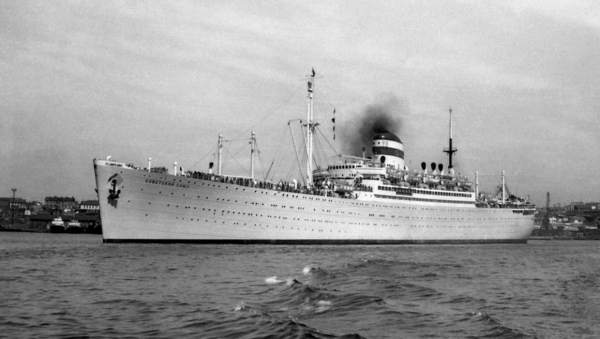
Its name is somewhat of a troll. The vessel is German, military, originally named 'Hansa' and served as transport for the Nazi army. In March 1945, 'Hansa' was blown up by a mine and sank, lying on the bottom for 4 years. After the division of the German fleet, the ship was handed over to the USSR, was raised and repaired, and was ready by 1955 under the new name 'Soviet Union.' The vessel operated passenger lines and charter services of a cruise nature. It was precisely such a journey that Kurilov bought a ticket for (the ticket clerk, surprisingly, was not left unpunished afterward).
So, Slava left his family without saying anything provocative to his wife and arrived in Vladivostok. Here he is on a ship with another 1200 idle passengers. The way Kurilov describes what’s happening is quite amusing. He notes that his compatriots, having escaped their gray dwellings and aware of the briefness of the vacation, behave as if they’re living their last day. There weren't many entertainments on the ship, and they quickly became boring, so passengers invented their own activities as best as they could. Resort romances quickly blossomed, leading to regular sounds of moaning from behind cabin walls. To elevate the culture and provide a bit more amusement for the vacationers, the captain decided to hold fire drills. 'What does a Russian do when he hears a fire alarm?' Slava asks. And immediately answers: 'Right, he keeps drinking.' Undoubtedly, he possesses both humor and writing skills in abundance. To better understand Kurilov and simply enjoy the reading, I recommend a couple of his stories: 'I Serve the Soviet Union' and 'Night and Sea.' And especially 'The City of Childhood' about Semipalatinsk. They are short.
While walking around the ship, Slava happened to visit the navigator in the cabin. He filled him in on the details of the route. Among other things, it passed by the Philippines. The nearest point is Siargao Island, located in the far east of the Philippines. Later, a map appeared on the ship, which visually depicted the area. Here’s a sample map marking the island and the approximate location of the ship:
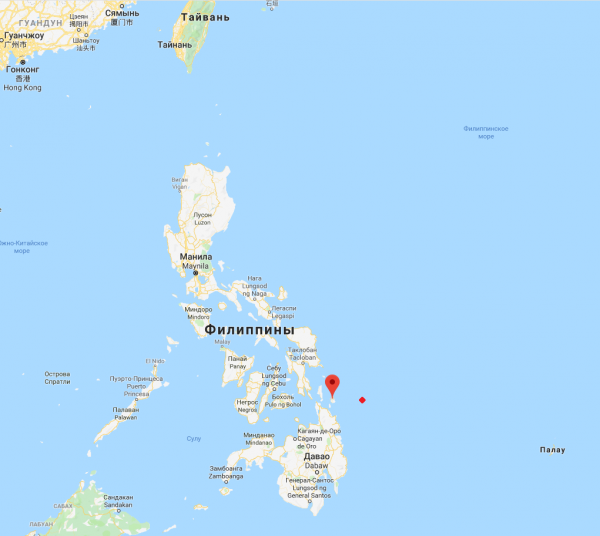
The future route, however, was not disclosed. According to Kurilov's calculations, if the ship does not change course, by the upcoming night it will be situated just opposite Siargao Island, about 30 kilometers away.
Waiting for nightfall, Slava descended to the wing of the bridge and asked the watch sailor about the shore lights. He replied that no lights were visible, which was, in fact, obvious. A thunderstorm was beginning. The sea was covered with 8-meter waves. Kurilov was elated: the weather worked in his favor. He went to the restaurant closer to the end of dinner. The deck was swaying, and the free chairs were sliding back and forth. After dinner, he returned to his cabin and came out with a small bag and a towel. Walking down the corridor, which felt like a rope over an abyss to him, he stepped out onto the deck.
"Young man!" a voice called from behind. Kurilov was taken aback. "How do I get to the radio room?". Slava explained the way, the man listened and left. Slava took a breath. He then walked across the lit part of the deck, past dancing couples. "I said goodbye to my homeland, Russia, earlier, in the harbor of Vladivostok," he thought. He stepped out to the stern and approached the bulwark, peering over it. The waterline was not visible, only the sea. The fact is, the ship's design has protruding sides, and the surface of the water was hidden behind the curve. It was about 15 meters down (the height of a five-story Khrushchyovka). At the stern, three sailors sat on a folding bed. Slava left there and strolled a bit more, then, returning, he was pleased to find that two sailors had gone somewhere, and the third was making up his bed, turned away from him. Then Kurilov did something worthy of a Hollywood movie, but apparently it wasn’t sensational enough for such a film to materialize. Because he didn't take the sailor hostage and hijack the ship. No NATO submarine surfaced from the high waves, and no American helicopters flew in from the Angeles airbase (let me remind you, the Philippines is a pro-American state). Slava Kurilov leaned with one hand on the bulwark, hurled his body overboard, and pushed off hard. The sailor noticed nothing.
The jump was good. He entered the water feet first. The water twisted his body, but Slava managed to hold the bag against his stomach. He surfaced. Now he was an arm's length away from the hull of the ship, which was traveling at high speed. There was no bomb in the bag, as one might think. He wasn’t planning to blow up the ship and was not a suicide bomber. And yet, he froze in fear of death—the huge propeller spun nearby.
I can almost physically feel the movement of its blades — they mercilessly slice through the water right next to me. Some inexorable force pulls me closer and closer. I make desperate efforts to swim away — and I get stuck in the thick mass of stagnant water, tightly bound to the propeller. It seems to me that the liner has suddenly stopped — just moments ago it was cruising at eighteen knots! Terrifying vibrations of hellish noise, the rumble and hum of the hull pass through my body, slowly and relentlessly trying to push me into the black abyss. I feel as if I’m crawling into this sound… The propeller spins above my head, and I can distinctly feel its rhythm amidst the monstrous din. The propeller seems alive to me — it has a malevolent smiling face, and I am firmly held by its invisible hands. Suddenly, something throws me aside, and I’m hurtling into the gaping void. I got caught in a strong current of water to the right of the propeller, and I was flung away.
The stern searchlights flashed. It seemed they had noticed him — they shone for so long — but then it went completely dark. In the bag were a scarf, fins, a mask with a snorkel, and webbed gloves. Slava put them on and tossed the bag along with the unnecessary towel. The time was 20:15 ship's time (later he also had to throw away his watch as it had stopped). In the area of the Philippines, the water was relatively warm. You could spend a good amount of time in such water. The ship moved away and soon disappeared from sight. Only from the height of the ninth wave could its lights be discerned on the horizon. Even if they had already noticed the person was missing, no one would send a rescue boat into such a storm.
And then silence enveloped me. The sensation was sudden and struck me profoundly. It felt as if I had crossed to the other side of reality. I still didn't fully understand what had happened. The dark ocean waves, prickly spray, and glowing crests around me seemed like some sort of hallucination or dream — if only I opened my eyes, everything would disappear, and I would find myself back on the ship, with friends, amidst noise, bright light, and merriment. With great effort, I tried to pull myself back to my old world, but nothing changed; the stormy ocean surrounded me still. This new reality defied perception. But time passed, and I was engulfed by the crests of the waves, needing to be careful not to lose my breath. And I finally realized that I was completely alone in the ocean. There was no help to be found. And I had almost no chance of reaching the shore alive. At that moment, my mind wryly noted, "At least you are finally free! Isn't this what you longed for so passionately?!"
Kurilov did not see the shore. He couldn't see it because the ship had deviated from its intended course, presumably due to the storm, and was actually not 30, as Sava had thought, but about 100 kilometers from the shore. At that moment, he was most afraid that a search would begin, so he poked his head above the water, trying to spot the ship. It was still moving away. About half an hour passed like that. Kurilov started swimming west. At first, he could navigate by the lights of the departing ship, but then they disappeared, the storm subsided, and the sky uniformly filled with clouds, rain began to fall, making it impossible to determine his position. Fear rolled in again, one that he thought he couldn't endure for even half an hour, but Sava fought it off. By his estimation, it wasn't even midnight yet. Sava had envisioned the tropics quite differently. However, the storm began to calm down. Jupiter appeared. Then the stars. Sava knew a bit about the sky. The waves lessened; it became easier to maintain direction.
With the dawn, Slava began to try to see the shore. Ahead, to the west, there were only piles of cumulus clouds. Fear crept in for the third time. It became clear: either the calculations were wrong, the ship had significantly changed course, or the currents had swept it far off during the night. But this fear quickly gave way to another. Now, during the day, the liner could return and easily spot him. He needed to reach the maritime border of the Philippines as quickly as possible. At one moment, an unidentified vessel indeed appeared on the horizon — most likely, it was the 'Soviet Union,' but it was not getting any closer. By noon, it became noticeable that rain clouds were gathering in the west around a single point, while in other areas they appeared and disappeared. Later, faint outlines of a mountain emerged.
It was an island. Now it was visible from any position. This was good news. The bad news was that the sun was now directly overhead, and the clouds had dissipated. Once, for lack of judgment, I had drifted in the Sulu Sea, watching fish for about two hours. Then, I lay in my room for three days. Slava, however, had an orange T-shirt (he read that this color repels sharks, but then later read the opposite), but his face and arms were burnt. The second night had arrived. On the island, the lights of villages were already discernible. The sea calmed down. In the mask, the phosphorescent underwater world was visible. Every movement caused fiery splashes — this was bioluminescent plankton. Hallucinations began: sounds could be heard that could not possibly exist on Earth. A severe burn, and a swarm of Portuguese man o' war drifted by, which, if encountered, could cause paralysis. By dawn, the island looked like a large rock, shrouded in mist at its base.
Slava continued to swim. By this time, he was already very tired. His legs began to give out, and he started to feel cold. He had been swimming for almost two days! A fishing boat appeared on the horizon, heading straight towards him. Slava felt a surge of joy because he was already in coastal waters, and it could only be a Philippine vessel, which meant he had been spotted and would soon be rescued. He even stopped paddling. The boat passed by without noticing him. Evening fell. The palm trees could already be seen. Large birds were catching fish. And then the island current swept Slava away with it. There are currents around every island, and they are quite strong and dangerous. Every year, they carry trusting tourists who have swum too far out to sea. If you're lucky, the current might bring you to another island, but often it just pulls you out to sea. Fighting it is pointless. Kurilov, being a professional swimmer, couldn't overcome it either. His muscles were exhausted, and he hung in the water. He was horrified to notice that the island was drifting to the north and getting smaller. Fear washed over him for the fourth time. The sunset had burned out, and the third night at sea began. His muscles were no longer working. Visions started appearing. Slava thought about death. He wondered if it was worth prolonging his agony for a few more hours or if he should just discard his gear and quickly gulp down water? Then he fell asleep. His body still automatically kept him afloat, while his mind conjured images of some other life, which Kurilov later described as a divine presence. Meanwhile, the current that had carried him from the island brought him back closer to shore, but already from the opposite side. Slava woke up to the roar of the surf and realized he was on a reef. All around him were enormous waves, as they seemed from below, crashing onto the corals. There should be a calm lagoon behind the reef, but it was nowhere to be found. For a while, Slava struggled against the waves, thinking that each new one would be his last, but eventually, he learned to ride the crests that carried him to the shore. Suddenly, he found himself standing waist-deep in the water.
The next wave swept him away, and he lost his footing; the bottom was no longer within reach. The turbulence subsided. Slava realized he was in a lagoon. He tried to swim back to the reef to rest, but the waves wouldn’t let him climb back. So, he made the decision to swim straight ahead despite the noise of the surf. Beyond would be the shore — that was clear. The swim through the lagoon continued for about an hour, and the bottom was still deep enough. It was already possible to take off the mask, look around, and bandage his scraped knees from the reef with a cloth. Then he continued swimming towards the lights. As the crowns of palms appeared against the black sky, strength left his body once again. Dreams began anew. After one more effort, Slava felt the bottom with his feet. Now he could walk in the water up to his chest. Then to his waist. Slava reached the white coral sand, which is so often shown in ads, and leaned back against a palm tree, sitting down. Hallucinations soon enveloped him — Slava had finally achieved all of his desires at once. Then he fell asleep.
He woke up from insect bites. In search of a more pleasant spot in the coastal thicket, he stumbled upon an unfinished dugout, where he slept a bit longer. He wasn’t hungry. He was thirsty, but not as someone dying of thirst would be. Underfoot, he found a coconut, which Slava struggled to break open, but found no liquid — the nut was ripe. For some reason, Kurilov felt like he would be living on this island like Robinson and had already begun to dream about how he would build a hut from bamboo. Then he remembered that the island was inhabited. “I’ll have to look for an uninhabited one nearby tomorrow,” he thought. Movement was heard from the side, and then people appeared. They were extremely surprised by Kurilov’s presence in their area, who was still glowing with plankton like a Christmas tree. To add to the uniqueness of the situation, there was a cemetery nearby, and the locals thought they had seen a ghost. It was a family returning from evening fishing. The children approached first. They touched him and said something about “American.” Then they concluded that Slava must have survived a shipwreck and began to ask him for details. Upon learning that nothing of the sort had happened, that he jumped from the ship himself and swam here, they asked a question he had no clear answer to: “Why?”
Locals escorted him to the village and welcomed him into their home. Hallucinations started again; the ground felt like it was slipping away beneath him. They gave him some hot drink, and Slava drank an entire kettle of tea. He still couldn't eat due to his inflamed mouth. The locals were most curious about how he hadn't been eaten by sharks. Slava showed them the amulet around his neck—this answer satisfied them completely. It turned out that a white man (the Filipinos were dark-skinned) had never appeared from the ocean in the entire history of the island. Then they brought in a police officer. He asked Slava to write down the details on a piece of paper and left. They put Slava Kurilov to sleep. The next morning, the whole village came to greet him. Then he saw a jeep and armed guards. The military took him to prison, without allowing him to enjoy the paradise (as Slava imagined it) of the island.
In prison, they didn't really know what to do with him. He was not a criminal, except for the illegal border crossing. He was sent with the others to do hard labor digging trenches. This went on for a month and a half. It’s worth mentioning that even in a Filipino prison, Kurilov preferred it to his homeland. Surrounding him were the tropics that he longed for. The prison warden, sensing Slava's distinction from the other thugs, occasionally took him to the city in the evenings after work, where they would go to bars. Once, after a bar visit, he invited Slava to his home. Kurilov recalled that moment with admiration for the local women. Meeting them at 5 a.m., drunk at home, his wife not only said nothing against it but, on the contrary, welcomed him warmly and began to prepare breakfast. After a few months, he was released.
For all interested parties and organizations. This document certifies that Mr. Stanislav Vasilyevich Kurilov, 38 years old, Russian, was sent to this commission by the military authorities, and after an investigation, it was found that he was discovered by local fishermen on the shore of General Luna, Siargao Island, Surigao, on December 15, 1974, after he jumped from a Soviet vessel on December 13, 1974. Mr. Kurilov does not possess any tourist documents or any other identification documents. He claims to have been born in Vladikavkaz (Caucasus) on July 17, 1936. Mr. Kurilov has expressed a desire to seek asylum in any Western country, preferably Canada, where, according to him, his sister resides, and has reported that he has already sent a letter to the Canadian embassy in Manila requesting permission to reside in Canada. This commission has no objections to his deportation from the country for the stated purpose. This certificate was issued on June 2, 1975, in Manila, Philippines.
It was his sister from Canada who was initially an obstacle, and then the key to Kurilov's freedom. This is because she was the reason he was not allowed to leave the country, as she had married an Indian and emigrated to Canada. In Canada, he found work as a laborer and spent some time there, later working for companies involved in marine research. His story captured the attention of Israelis, who planned to make a film and invited him to Israel for this purpose, providing an advance of $1,000. However, the film was never made (instead, a home movie was created in 2012 based on the memories of his new wife, Elena, whom he found there). In 1986, he moved to Israel permanently, where he died two years later during diving operations, getting entangled in fishing nets at the age of 61. Much of the information about Kurilov's story comes from his writings and , published at the initiative of his new wife. The homemade film even aired on national television.
Source: habr.com
