

The Tor Project and the VPN provider Mullvad have jointly introduced the Mullvad Browser, a web browser focused on user privacy protection. Technically, the Mullvad Browser is based on the Firefox engine and incorporates nearly all changes from the Tor Browser, differing mainly in that it does not use the Tor network and sends requests directly (a Tor Browser variant without Tor). It is expected that the Mullvad Browser may appeal to users who do not want to operate through the Tor network but wish to access privacy-enhancing mechanisms available in the Tor Browser, such as tracking visit blocking and user identification protection. The Mullvad Browser is not tied to Mullvad. VPN It can be used by anyone interested. The browser's code is distributed under the MPL 2.0 license, with development ongoing in the Tor project repository.
To provide additional protection in the Mullvad Browser, as in the Tor Browser, the "HTTPS Only" setting is enabled to encrypt traffic on all websites where possible. To mitigate threats from JavaScript-based attacks and block ads, NoScript and Ublock Origin extensions are included. DNS-over-HTTP is used for name resolution. server Ready-made builds are available for Linux, Windows, and macOS.
By default, a private browsing mode is applied, which deletes cookies and browsing history after the session ends. There are three security modes available: Standard, Safer (JavaScript enabled only for HTTPS; audio and video tag support disabled), and Safest (no JavaScript). DuckDuckgo is used as the search engine. The browser includes a Mullvad extension for displaying information about the IP address and connection to Mullvad VPN (using Mullvad VPN is not mandatory).
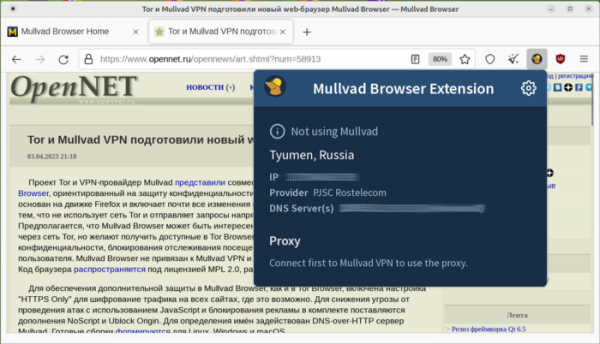
To prevent user tracking and to avoid unique visitor fingerprinting, APIs such as WebGL, WebGL2, Social, SpeechSynthesis, Touch, WebSpeech, Gamepad, Sensors, Performance, AudioContext, HTMLMediaElement, Mediastream, Canvas, SharedWorker, Permissions, MediaDevices.enumerateDevices, and screen.orientation are either disabled or restricted, along with telemetry sending features, Pocket, Reader View, HTTP Alternative-Services, and MozTCPSocket. Only a portion of installed font data is sent. To block identification by window size, a letterboxing mechanism is used, adding margins around web page content. The password manager has been removed.
Differences from Tor Browser: it does not use the Tor network, lacks support for multiple languages, support for WebRTC and Web Audio API has been restored, uBlock Origin and Mullvad Browser Extension have been integrated, Drag & Drop protection has been disabled, warning notifications during downloads have been removed, NoScript's protection against information leaks between tabs, which could be used to identify users, has been disabled.
Source: opennet.ru
