

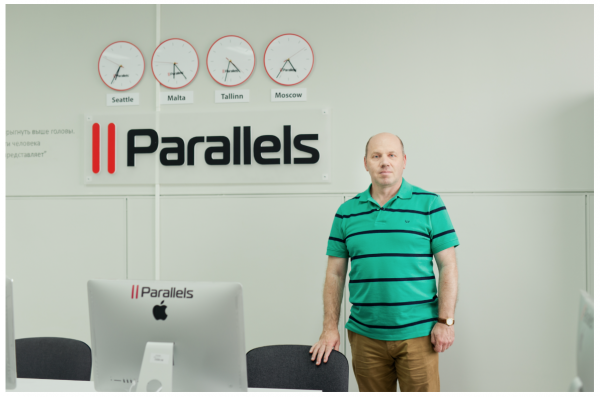
The Director of Academic Programs at Parallels, Anton Dyakin, shared his thoughts on how the increase in the retirement age is connected to further education and what skills are essential to learn in the coming years. Here is a first-person account.
By the will of fate, I have lived a third, perhaps even a fourth, complete professional life. The first was military service, which culminated in my commission as an officer in the reserves and a military pension at a young age. Then came a period of self-discovery, career guidance, and building a career almost from scratch in new fields for me. I taught in schools, tried my hand in business, but ultimately found my long-term place at the Higher School of Economics, where I created and developed the School of Oriental Studies. My first degree is in translation with specialisation in Japanese and English. Immersing myself in this quite specific field, I progressed from senior lecturer to deputy dean of the Faculty of World Economy and World Politics. Having achieved certain goals, I realised it was time to move forward. After some searching for directions to apply my skills and abilities, I ended up at Parallels. In fact, my responsibilities here mirror what I did at the university, albeit with my own nuances: finding and selecting the most talented students, organising the educational process for gifted individuals from leading technical universities, and participating in training high-class specialists – future engineers for their smooth and effective integration into the highly professional international team of our global company. This is not only in Russia but also across the EU.
On pension reform and aging
It has always been said that "it's better to be rich and healthy than poor and sick." We can add another word to this – "young." Indeed, when you are young and enthusiastic, your energy can even warm the North Pole. The doors are open, and horizons stretch 360 degrees. But is it solely about youth? In reality, it’s about the absence of stereotypes and "blinders" blocking the intake of new information. When you’re young and don’t know how to do things right, you simply try, face setbacks, but gain invaluable experience along the way. As people age, many lose that enthusiasm which propels them forward and upward.
What has changed in the 21st century? Everything is true now, but the average life expectancy has increased. Despite all the upheavals, even in Russia, we are living longer. Have you read "Crime and Punishment" by Fyodor Dostoevsky? In that book, the innocent victim, an old moneylender, was only 42 years old.
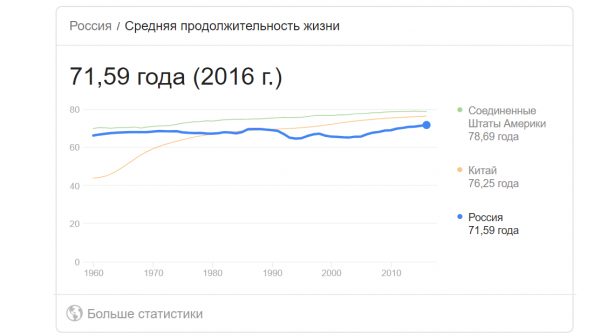
Gradually, the very model of aging is changing. We are able to maintain physical health much longer, and most importantly, the "mobility" of our minds. In the past, after a vibrant and intense professional period, a brief phase of decline was expected at a relatively young age by today's standards. But now, the retirement age has noticeably increased. This has already prompted authorities to initiate a pension reform that proposes a later retirement age. Given the general acceleration of life’s pace, we are inevitably forced to adapt to changes, learn, acquire, and quickly consolidate new skills and abilities. Otherwise, the quality of life may unpredictably decline at the most unexpected moment. This applies to all spheres and layers of the population. Even elderly people have to learn how to order a taxi via a mobile app or make a doctor’s appointment online through the local clinic’s website.
What is more significant is that the working period is becoming longer. Additionally, the demands for knowledge and skills are changing rapidly. There is no longer an opportunity to master a craft once and remain unchanged until the end of one's days. This is especially true for those in intellectual labor. Every year, dozens, if not hundreds, of new projects emerge, creating new jobs and altering people's lives and routines. They also require new skills and abilities from those realizing them. At the heart of all changes is the pursuit of comfort and the fulfillment of needs, which has become a prerequisite for success. Today, it is evident that those who are educated, flexible, professional, and capable of identifying and responding to these needs come out ahead. Sitting idly by, chewing on bread, like Ilya Muromets 'until the age of thirty-three,' and then unexpectedly achieving success is no longer possible.

How I Changed and What I Learned
On one hand, my entire professional career is tied to personal organization and the ability to work with people. The ability to build relationships at all levels and under any circumstances is fundamental, an essential overlay on professional skills. This has always been obvious. However, the demands placed upon me are constantly changing. In the army, regulations, unquestioning obedience, and feeling like a part of a big team serve as the foundation, while in business, only you are expected to deliver specific results within a set timeframe. Even when working in a team, you bear personal responsibility for everything you do.
For example, in a service environment, hierarchy and orders from senior personnel determine the course of action; however, in everyday life, you rely only on human relationships and the motivations of colleagues and subordinates or interacting employees. You must independently assess the strengths and resources needed to achieve your goals and construct optimal algorithms. It's important to understand how to engage and motivate the right person for the often challenging tasks, someone who won't simply follow orders like in the army but can move mountains when they have motivation, respect for the authority of their leader, and can build the right professional relationships that will lead to the desired outcome.
Upon joining Parallels, I had to significantly enhance my communication skills, which complemented my in-depth knowledge of the specifics of university academic processes and intra-university communications. Sometimes, colleagues are surprised by the almost secretive methods we use to achieve our planned objectives.

In reality, there are no secrets—everything is determined by people, which means you need to be able to build communication with them, be goal-oriented, persistent, active, and sometimes even swift in fulfilling promises, while being respectable with partners and keeping your word. Everything starts with finding the right professional for each specific project and building a business relationship with them. This approach works if you are professional, organized, and understand the ways to achieve your goals. My partners are extraordinary individuals with excellent education and high intelligence. They can instantly recognize who they are dealing with and quickly make decisions about whether to start a collaboration. Fortunately, their decisions are usually positive for me.
Now, let's talk about what I had to learn. Given that before joining Parallels, I had little understanding of the specifics of a programmer's work, I needed to grasp the fundamental concepts of the profession, significantly broaden my knowledge of essential programming languages, learn the professional jargon, and try to catch the key trends in IT development and related fields. Furthermore, since I primarily work with young people, I need to understand their value system. Working at the university with students, engaging on social media, participating in thematic conferences, and joining communities provided me with the knowledge and allowed me to develop the necessary skills.
By the way, don't think that life gives you useless lessons. Any experience is valuable.
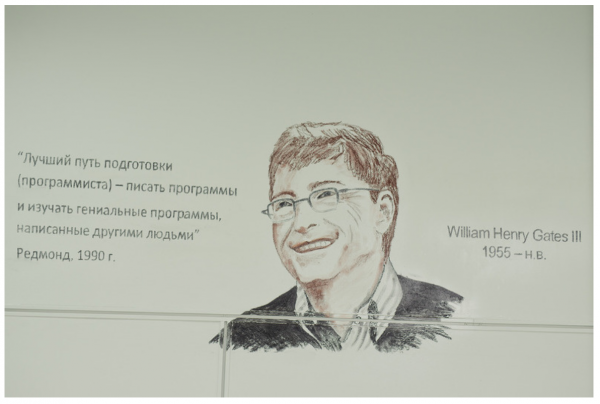
For instance, I finished art school in my childhood. Since then, my works have not been displayed at exhibitions or art fairs. However, when we at Parallels had to think about decorating a thematic educational space at Bauman Moscow State Technical University, my artistic skills came in handy. As a result, on the walls of our educational laboratory, images of outstanding figures in science and technology were brought to life by my hands. Now, not only students but also guests of the university come to this room for excursions, to work with the magnificent new Macintosh technology, and to see its decoration.
What should we learn?
Today, one can read millions of articles about the inevitability of the rapid development of artificial intelligence and, consequently, mass unemployment. It is possible that this will indeed happen. However, when it comes to human relationships, machines will always find it challenging, and that means this is the niche for applying human capabilities.
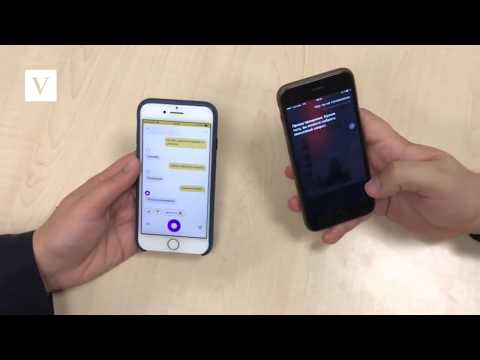
What does this say? It indicates that people in creative professions and experts in human relations will continue to be in demand in the future, especially those who combine high-quality technical training with humanities knowledge. Even tech professionals increasingly need to develop those so-called soft skills. These meta-professional skills, not directly tied to job responsibilities but essential for successful teamwork, are a must-have. Incidentally, emotional intelligence is not just another whim or a passing trend. The ability to recognize emotions, understand intentions, motivations, and desires of others and oneself, as well as the capacity to manage one's emotions and those of others to solve practical problems, is becoming ever more valuable. A creative approach to problem-solving in various fields and finding effective out-of-the-box solutions, which requires a wealth of knowledge, skills, and a broad perspective, are the traits of a successful person of the future.
Such abilities are not innate to everyone, but they can and should be learned. Perhaps not everyone is ready to speak in front of an audience, and as a 'hardcore' developer, some may seek to grow their professionalism within their workspace. However, even such geeks should understand that while machines will likely learn to code better than humans in the foreseeable future, building relationships among people will remain a challenge for a long time.

Everything that focuses on human development, diversifies their lives, adds color, allows for creative potential to be realized, and brings joy to life—be it pleasure from taste, communication, or engaging activities—is already in demand and will continue to be as long as humanity exists in its current form.
For now, programmers and developers are in charge, as more and more of humanity is 'relocating' to the virtual space, where and through which they obtain all that has been mentioned above.
Source: habr.com
