

Compared to European countries, where distributed generation accounts for nearly 30% of total production today, in Russia, estimates suggest that the share of distributed energy is no more than 5-10%. Let's discuss whether there are chances for Russian to catch up with global trends, and for consumers—motivation to move towards independent energy supply.
Beyond the numbers. Find the differences
The differences between the distributed electricity generation system in Russia and Europe today go beyond mere numbers—essentially, these are completely different models both in terms of structure and economics. The development of distributed generation in our country had motives that were somewhat different from those that became the primary driving force behind similar processes in Europe, which sought to compensate for the lack of traditional fuel sources by involving alternative energy sources (including secondary energy resources) in the energy balance. In Russia, however, the issue of reducing energy resource acquisition costs for consumers under planned economy conditions and centralized tariff formation was significantly less relevant for a long time. Therefore, discussions about self-generation primarily arose in cases where an enterprise was a particularly large energy consumer and faced difficulties in connecting to networks due to its remote location.
In the realm of distributed energy, self-generation facilities had a fairly high capacity — from 10 to 500 MW (and even higher) — depending on production needs and aimed at supplying nearby communities with electricity and heat. Since the transmission of heat over distances always involves significant losses, there was active construction of water heating boilers for the needs of enterprises and cities. Additionally, self-energy sources — whether they were combined heat and power plants or boilers — were built using gas, fuel oil, or coal, while renewable energy technologies, except for hydroelectric power plants, and secondary energy resources were applied only in isolated cases. Currently, the picture is changing: small-scale electricity generation facilities are gradually emerging, and alternative energy sources are being incorporated into the energy balance, albeit to a lesser extent.
In the West, much is being done to develop small-scale generation, and recently the concept of a virtual power plant has gained widespread acceptance. This system integrates a large number of players in the electricity generation market — producers (from small generators in private households to cogeneration plants) and consumers (from residential buildings to large industrial enterprises). The virtual power plant regulates energy consumption, smoothing out peaks and redistributing loads in real-time, utilizing all available system capacity for this purpose. However, such an evolution is impossible without market stimulation for distributed generation from the government and without corresponding changes in legislation.
In Russia, under the conditions of intense competition and the monopoly of centralized electricity supply, the realization of excess electricity production into the external network remains a challenging task from the standpoint of organization and cost, despite being solvable. Therefore, at present, the chances of becoming a full-fledged market participant for large suppliers in the distributed energy sector are very slim.
Nonetheless, the development of self-generation is undoubtedly trending today. The main factor driving its growth is the reliability of energy supply. Dependence on generating and network companies increases the risks for producers. Most large generation facilities in Russia were built during the Soviet era, and their considerable age is becoming evident. For industrial consumers, a power supply interruption due to an accident poses the risk of production stoppage and obvious losses. If the desire to reduce risks is accompanied by economic motives (primarily determined by the tariff policy of the regional supplier) and investment opportunities, then self-generation pays off 100%, and more and more industrial enterprises today are ready (or are considering the possibility) to go down this path.
Therefore, the prospects for distributed electricity generation "for personal needs" are quite high in Russia.
Self-Generation. Who Benefits from It
The economics of each project is strictly individual and determined by many factors. If one tries to generalize as much as possible, then in regions with a higher concentration of generating capacities and industrial enterprises, higher electricity and heating tariffs, self-electricity generation presents a realistic chance to significantly reduce costs for purchasing energy resources.
This also applies to remote and sparsely populated regions with poorly developed or non-existent electricity network infrastructure, where electricity tariffs are undoubtedly the highest.
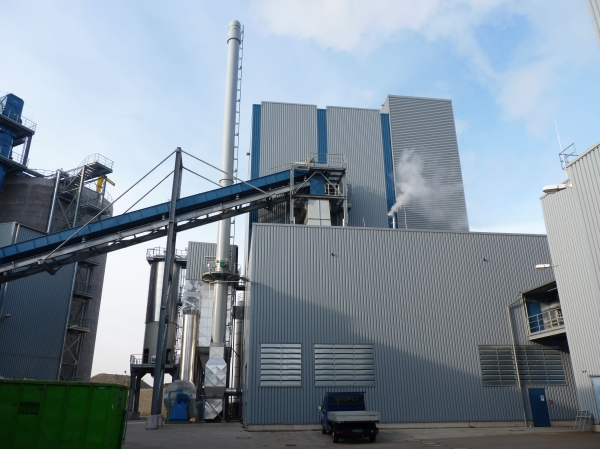
In regions with fewer electricity consumers and suppliers, where a significant share of the generated electricity comes from hydroelectric power plants, tariffs are noticeably lower, and the economics of such projects in industry are not always favorable. However, for enterprises in certain sectors that can use alternative fuels, such as production waste, self-generation can be an excellent solution. For example, in the image below – a CHP plant using waste from a woodworking enterprise.
When we talk about generation for communal needs, public buildings, and commercial and social infrastructure, until recently, the economy of such projects was largely determined by the level of development of the energy infrastructure in the region and, no less importantly, the cost of technological connection for electricity consumers. With the development of trigeneration technologies, such limitations have effectively ceased to be decisive, and the waste or generated heat during the summer period can now be used for air conditioning needs, significantly increasing the efficiency of energy centers.
Trigeneration: electricity, heating, and cooling for the facility
Trigeneration is a fairly independent direction in the development of small-scale energy. It is characterized by individualism, as it focuses on satisfying the energy resource needs of a specific facility.
The very first project with the concept of trigeneration was developed in 1998 through the joint efforts of the U.S. Department of Energy, the ORNL national laboratory, and producer BROAD (absorption bromine-lithium chillers) and was implemented in the U.S. in 2001. Trigeneration is based on the use of absorption chillers, which use heat as the primary energy source and allow for the production of cooling and heating depending on the facility's needs. The use of conventional boilers, as in cogeneration, is not a mandatory condition in such a scheme.
In addition to traditional heating and electricity, trigeneration provides the production of cooling in absorption chillers (in the form of chilled water) for technological needs or air conditioning. The process of generating electricity inevitably occurs with significant losses of thermal energy (for example, from the exhaust gases of generator units).
Involving this heat in the process of obtaining cooling, on the one hand, minimizes losses, increasing the overall efficiency of the cycle, and on the other hand, allows for a reduction in the facility's electricity consumption compared to traditional cooling generation technologies using vapor-compression chillers.
The ability to operate on various heat sources (hot water, steam, exhaust gases from generator units, boilers, and furnaces, as well as fuels like natural gas, diesel fuel, etc.) allows the use of CHP systems in a wide range of facilities, utilizing the resources available to the enterprise.
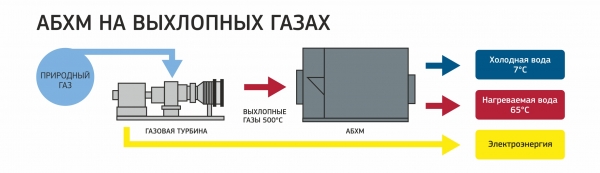
Thus, reclaimed heat can be used in industry:
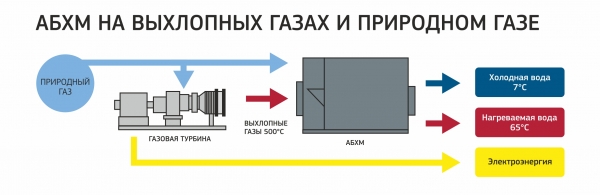
In urban infrastructure, commercial, and public buildings, various combinations of heat sources can be feasible:
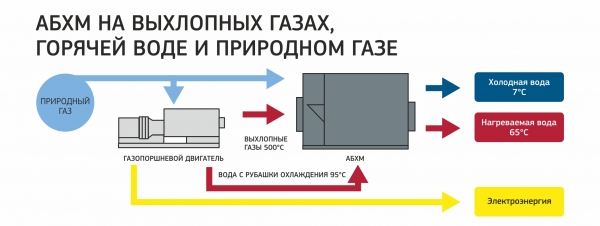
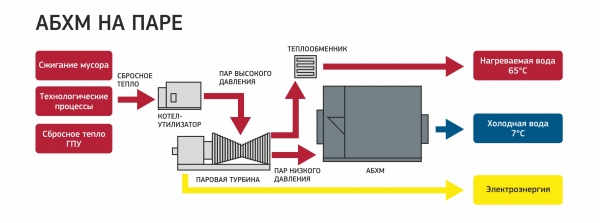
A trigeneration energy center can be designed and built based on electricity needs or can rely on the cooling demands of the facility, depending on what is the determining criterion for the consumer. In the first case, the utilization of by-product heat in CHP systems may not be complete, while in the second case there may be restrictions on the self-generated electricity (supplemented by purchasing electricity from an external grid).
Where Trigeneration is Beneficial
The range of application for the technology is quite broad: trigeneration can fit well into the concept of any public space (for example, a large shopping center or an airport building) as well as into the energy infrastructure of an industrial facility. The feasibility of implementing such projects and their performance heavily depends on local factors, both economic and climatic, and for industrial enterprises, also on the cost of the produced goods.
The first and most important criterion is the need for cooling. Its most common application today is the air conditioning of public buildings. These can include business centers, administrative buildings, hospital and hotel complexes, sports facilities, shopping and entertainment centers, water parks, museums and exhibition pavilions, airport buildings — in short, all locations where many people gather and where a central air conditioning system is required to create a comfortable microclimate.
The use of trigeneration is most justified for facilities ranging from 20,000 to 30,000 square meters (medium-sized business centers) up to gigantic structures of several hundred thousand square meters or more (shopping and entertainment complexes, and airports).
However, such facilities must demand not only cooling and electricity but also heating. Moreover, heating is not just about warming spaces in winter; it also involves providing hot water year-round for GVS needs. The more the capabilities of the trigeneration energy center are utilized, the higher its efficiency.
All over the world, there are numerous examples of trigeneration application in the hospitality sector, the construction and modernization of airports, educational institutions, business and administrative complexes, data centers, and there are also many examples in industries such as textiles, metallurgy, food processing, chemicals, pulp and paper, and machine engineering.
As an example, I will mention one of the facilities for which the company “” developed the concept of a trigeneration energy center.
With an electricity demand of about 4 MW at an industrial facility (generated by two gas piston units (GPU)), cooling needs are at the level of 2.1 MW.
Cooling is generated by a single absorption lithium bromide chiller, which operates on the exhaust gases from the GPU. In this case, one GPU fully covers 100% of the heating needs of the absorption chiller. Thus, even when only one GPU is operating, the plant is always ensured to have the necessary cooling. Furthermore, when both gas piston units are offline, the absorption chiller retains the ability to generate heat and cooling because it has a backup heat source—natural gas.
Trigeneration Energy Center
Depending on the needs of the consumer, their category, and the requirements for backup, the trigeneration scheme (illustrated in the figure below) can be quite complex and may include energy and hot water boilers, waste heat boilers, steam or gas turbines, complete water treatment, etc.
For relatively small facilities, a gas turbine or a piston unit (running on gas or diesel) with a comparatively low electric capacity (1-6 MW) typically serves as the main generating unit. They produce electricity and exhaust heat or hot water, which is utilized in the CCHP. This is the minimal and sufficient set of main equipment.
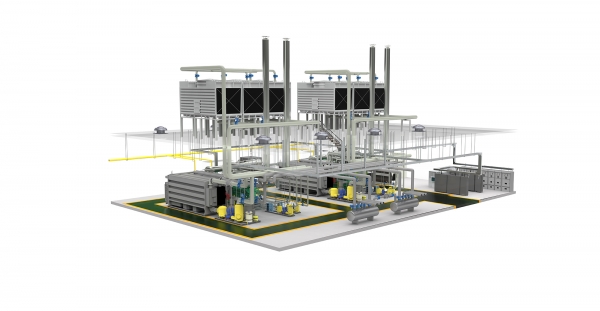
Yes, auxiliary systems are essential here: a cooling tower, pumps, a reagent treatment station for stabilizing circulating water, an automation system, and an electrical setup that allows the generated electricity to be used for internal needs.
In most cases, the trigeneration center is a standalone building, or containerized blocks, or a combination of these solutions, as the requirements for placing electric and heat-generating equipment differ somewhat.
Electric generating equipment is sufficiently standardized, unlike the CCHP, although it is technically more complex. Manufacturing time can range from 6 to 12 months or even longer.
The average manufacturing time for CCHP is 3-6 months (depending on cooling output, the number and types of heating sources).
Generally, the manufacturing of auxiliary equipment will not exceed the same timelines, so the overall duration for the implementation of a trigeneration energy center project averages 1.5 years.
Result
Firstly, the trigeneration center will reduce the number of energy suppliers to one – the gas supplier. By eliminating the purchase of electricity and heat, one can primarily eliminate any risks associated with interruptions in energy supply.
Utilizing relatively inexpensive 'excess energy' from heat reduces the cost of produced electricity and heat compared to purchasing them. Year-round loading of generating capacities for heat (for heating in winter, for cooling and technological needs in summer) ensures maximum efficiency. Of course, as with other projects, the key condition is the development of the correct concept and its techno-economic justification.
Among the additional advantages is eco-friendliness. By using exhaust gases to generate useful energy, we reduce emissions into the atmosphere. Furthermore, unlike traditional cooling technologies that use ammonia and freons as refrigerants, ABHM uses water as a refrigerant, which also minimizes the environmental impact.
Source: habr.com
