

The creation and development of devices for non-volatile storage of digital data has been ongoing for several decades. A significant breakthrough occurred just under 20 years ago with NAND memory, although its development began around 20 years earlier. Today, nearly half a century into extensive research, production, and continuous efforts to improve NAND, this type of memory is nearing the limits of its development potential. It is essential to lay the groundwork for transitioning to a different type of memory with better energy, speed, and other characteristics. In the long term, this memory could be a new type of ferroelectric memory.
Ferroelectrics (the term used in foreign literature) are dielectrics that possess a memory of the applied electric field or, in other words, are characterized by the residual polarization of charges. Memory based on ferroelectrics is not something new. The challenge has been to reduce the scale of ferroelectric cells to the nanoscale level.
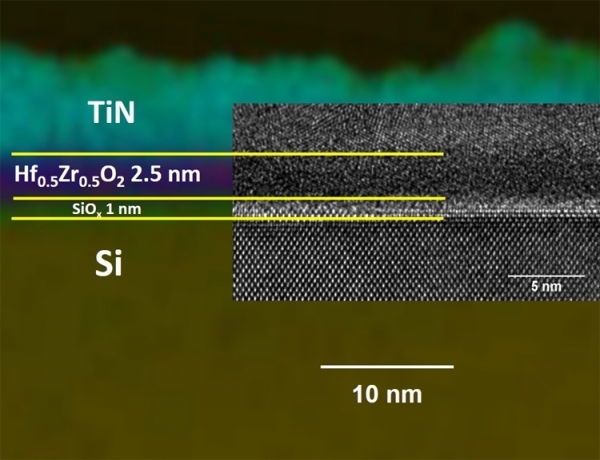
Three years ago, scientists at MIPT developed a technology for manufacturing thin-film materials for ferroelectric memory based on hafnium oxide (HfO2). This is not a unique material either. This dielectric has been used for several decades in the production of transistors with metal gates in processors and other digital logic. Based on the alloyed polycrystalline films of hafnium and zirconium oxides with a thickness of 2.5 nm proposed at MIPT, transitions with ferroelectric properties were successfully created.
In order for ferroelectric capacitors (as they are now called at MIPT) to be used as memory cells, it is necessary to achieve the maximum possible polarization, for which a detailed study of the physical processes in the nanoscale layer is required. In particular, it is essential to gain an understanding of the distribution of electrical potential within the layer when voltage is applied. Until recently, scientists could only rely on mathematical models to describe this phenomenon, and only now has a method been realized that allows peering inside the material during the phenomenon.
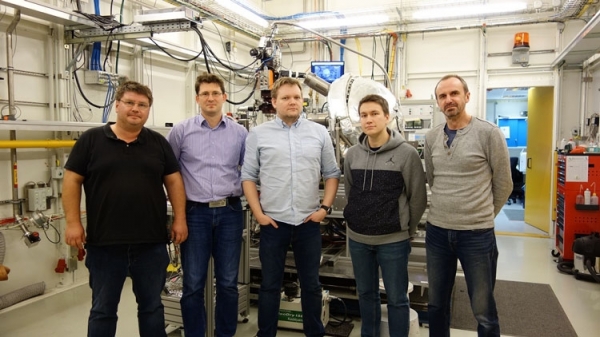
The proposed method, which relies on high-energy X-ray photoelectron spectroscopy, could only be implemented at a specialized facility (synchrotron accelerators). One such facility is located in Hamburg (Germany). All experiments with the "ferroelectric capacitors" manufactured at MIPT based on hafnium oxide were conducted in Germany. An article on the work carried out has been published in .
"The ferroelectric capacitors created in our laboratory, if applied for the industrial production of non-volatile memory cells, can provide 10 billion rewrite cycles — one hundred thousand times more than what modern computer flash drives allow," claims Andrei Zenkevich, one of the authors of the work and head of the laboratory of functional materials and devices for nanoelectronics at MIPT. This is another step toward new memory, although there are still many steps to take.
Source: 3dnews.ru
