

Today, many IT companies face the challenge of finding employees in their region. An increasing number of job opportunities in the labor market are associated with the possibility of remote work.
Full-time remote work implies that the employer and employee are bound by clear labor obligations: a contract or employment agreement; most often, a defined work schedule, stable salary, vacation, and other features that are typically present for those who spend their workday in an office.
The advantages of permanent remote work for anyone deciding to leave the office are significant. The ability to work for large foreign companies without relocating to another geographic region, along with stability compared to freelancing, is probably the main attraction for our compatriots. High competition is the primary challenge that applicants face when searching for jobs in the international labor market.
What should one be prepared for, and how to increase the chances of success – let’s explore next.
Do you speak English?
Most companies offering remote job vacancies are quite lenient regarding your not-so-perfect English, but it’s important to understand that a lack of grammar and spelling knowledge can play a negative role and be decisive in selecting a candidate for the position. Even with a high level of technical knowledge, a low proficiency in a foreign language significantly reduces your overall professionalism, communication, and understanding of the details.
Usually, an Intermediate (B1, average) level is sufficient, but not lower. If your English level does not reach intermediate, you will have to postpone your job search until it becomes adequate.
GitHub and LinkedIn profiles
Having a developer profile on GitHub is a significant plus for an applicant. Some companies require having a GitHub profile as mandatory since it allows employers to assess a developer's skills and reputation and confirm their professional activity.
This does not mean that a GitHub profile is mandatory, but it will certainly be a significant advantage for any company.
An up-to-date LinkedIn profile is crucial for a hiring manager, as it can serve as a validation of your experience and skills.
There is an unspoken rule that if a recruiter cannot determine your main specialization within the first 15 seconds of viewing your LinkedIn profile, they will move on to the next candidate. Despite the arbitrary nature of this approach, it holds true. Therefore, before sending out your resume, pay attention to your online profile to ensure that potential employers do not overlook any of your professional talents.
How to format a resume?
Your resume should undoubtedly align with the goal it states. For the employer's convenience, it is not necessary to include work experience unrelated to the position; thus, a separate resume should be created for each job, as this will help highlight the skills and capabilities you possess.
There are no strict formatting rules for a resume, but certain guidelines should be adhered to. For instance, a resume longer than two pages is not a benefit. First, state the position (objective) of the resume, your skills and knowledge in your professional field, followed by language proficiency and so-called soft skills (personal qualities).
Work experience includes the organization's name, position, and duration of employment, and you can omit detailed responsibilities. Education is usually the last section of the resume.
If you encounter difficulties with your resume, you can always refer to resources online that provide a wealth of information on how to properly format it in English (englex.ru/how-to-write-a-cv), as well as a comprehensive list of IT skills (simplicable.com/new/it-skills) and technical skills for your resume (thebalancecareers.com/technical-skills-list-2063775).
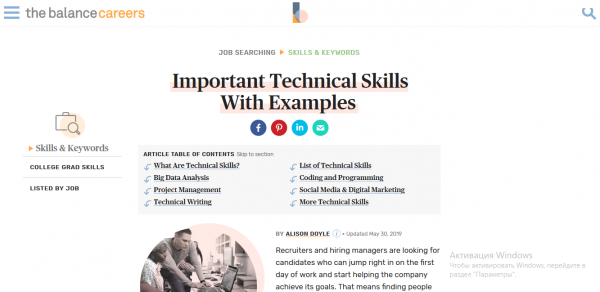
It should be noted that if you are sending your resume for review, having a cover letter is a plus. Just like your resume, the cover letter should be tailored for each position.
Job search online
If you have already faced the challenge of finding a full-time remote job, you might say that finding a suitable vacancy is not as easy as it seems. Despite the increasing number of offers for permanent remote work in IT, there are still not enough opportunities for all who are interested.
Often, our compatriots complain that, in most cases, European employers look for candidates within Europe, while in the U.S., one needs a work permit and, most often, to reside there permanently.
Moreover, the most popular job offers you will come across on international resources like remote.co will be for JavaScript, Ruby, and PHP developers, with competition from applicants in Africa and India being nearly insurmountable. A quick glance at job listings reveals that 90% of the offers are for senior-level specialists, and middle, let alone junior, candidates may have no chance of receiving job offers.
But not everything is as grim as it seems at first glance.
For example, the English-language resource can assist job seekers from anywhere in the world with junior/middle specialization, juniors seeking training, and even entry-level positions. A clear advantage of this site is that it offers vacancies not only for developers but also for engineers and administrators.
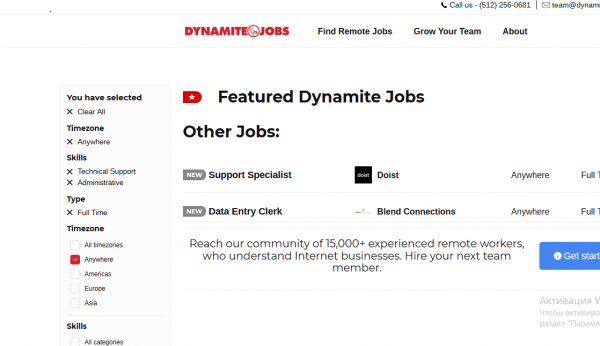
The resource can help job seekers from Poland, Czech Republic, Ukraine, Moldova, and Belarus. The site features convenient filters for language knowledge, skills, job type, region, and location. There are options available for junior-level candidates. Registration is required, with login available through Facebook or LinkedIn.
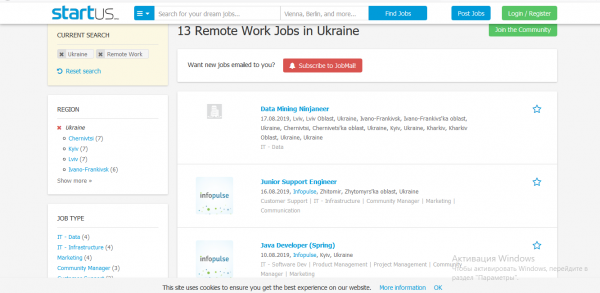
The resource can be considered a database for seekers of permanent remote work. The job offers are divided into those tied to the geographical location of the applicant and those for which the candidate's location does not matter. The vacancies are categorized by specialization. There are offers available for beginners.
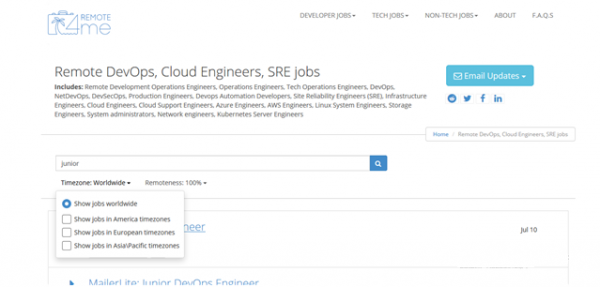
It's worth noting that the mentioned resources are free, which will undoubtedly be a benefit for newcomers.
Remote-job communities in social networks.
Online communities and social media groups focused on full-time remote jobs can be a great support for beginners.
For example, Facebook groups , and others welcome job seekers and employers among their followers. These groups post job vacancies, news related to remote work, Q&A discussions, and more.
In summary, those who seek will always find, and having additional information is never a bad thing. I hope this material will help beginners eager to start their full-time remote careers to kick off their productive work outside of the office in the near future.
Source: habr.com
