

The Matrix is a film by the Wachowski sisters, rich in meanings: philosophical, religious, and cultural, and sometimes it is seen as a reflection of There is another interpretation — teamwork. In a team, there is a seasoned team lead and a young specialist who needs to be quickly trained, integrated, and sent off to complete a task. Yes, there are specifics with leather coats and sunglasses indoors, but otherwise, it’s a movie about collaboration and knowledge.

Using The Matrix as an example, I will explain why managing knowledge within a team is essential, how to integrate it into the workflow, what is meant by 'competence' and 'competency models', how to assess expertise, and how to transfer experience. I will also discuss cases such as losing a valuable employee, wanting to earn more, and managing knowledge during development.
Team leads are often concerned about various issues. How to build a super team faster and more effectively? It seems there are budgets and projects available, but the people are either unavailable or they learn slowly. How to not lose valuable knowledge? Sometimes people leave, or management comes in and says: 'We need to cut 10% of the staff. But we cannot afford any disruptions!' Will there be an afterparty? All these questions are addressed by one discipline — knowledge management.
Knowledge management is the key to answers.
You surely have experience growing a team or letting people go, but you may lack experience organizing parties after conferences. You might wonder what the similarity is. It lies in the mindfulness of actions.
I approached the issue of working with people more thoughtfully after hearing HR say:
— You need senior developers, but how about we hire juniors, and you will grow the seniors yourself?
How much time will it take to turn a junior into a senior? 2 years, 5 years, 25? And how long to develop a conference website? ? Наверное, не больше пары-тройки месяцев. Получается, что мы, разработчики, умеем оценивать фичи: владеем практикой декомпозиции программных систем. А как декомпозировать людей, не знаем.
People can also be decomposed.Each of us can be digitized and broken down into 'atoms' of knowledge, skills, and competencies. This can be easily illustrated with a story from The Matrix — a film that is already 20 years old.
Welcome to the Matrix.
For those who haven't watched or have forgotten, here's a brief non-canonical summary of the plot. Meet the characters.
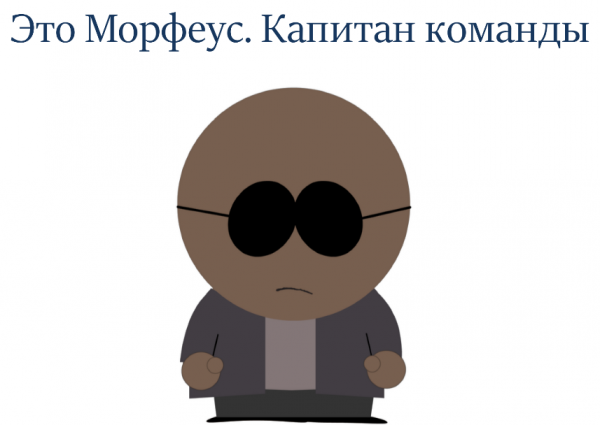
The main character is Morpheus. This guy mastered various martial arts and offered people pills.
A strange woman, the Pythia, has cookies, and she is an oracle. But right now in Russia, there is a trend for import substitution, so she is a seer. The Pythia was famous for answering questions with ambiguous phrases.

Two bouncers and team members — Neo and Trinity.

Once, Morpheus got caught with pills and was taken to the headquarters by an agent named Smith, codename 'Elf'. Trinity and Neo set out to rescue Morpheus from custody. They didn't know how to do it, so they decided to ask a smart person. They went to the Pythia:
N: — How can we get Morpheus out?
P: — What do you have for that, what are your skills?
To solve the problem, certain skills or competencies are needed — the ability to solve a specific class of tasks. What competencies does the team need to achieve its goals?
Competence
Each of us possesses a considerable number of competencies, each of which is a combination of three components.
Competence is knowledge, skills, and character.
The first two components are our abilities or Hard Skills. We know something and can do something — one knows how to get from St. Petersburg to Moscow, another knows why manhole covers are round. There are also practical skills, like fast typing or using a clicker. Each of us has character traits — these are Soft Skills. All together — these are competencies. Neo and Trinity have their own competencies: Neo could fly, while Trinity was an excellent shot.
A set of competencies allows for more meaningful, competent, and successful actions.
Competency Model
Let's examine, using developers as an example, what the competency model consists of.
Practices and tools. To program, one needs to know at least one programming language, the principles of building complex systems, and how to test. We are also skilled in using various development tools — version control systems, IDEs, and are familiar with management practices — Scrum or Kanban.
Personnel and working with them. These are competencies related to team formation and collaboration, feedback, and employee motivation.
Subject area. This encompasses knowledge and skills in a specific subject area. Each person has their own, whether large or small: fintech, retail, blockchain, education, etc.
Returning to 'The Matrix'. All the competencies present in Neo and Trinity's team answer three simple questions: What we do, how we do it and Who does it. When Pythia shared this with Neo and Trinity, they reasonably remarked: “Great story, but we have no idea how to build our competency model.”
How to build a competency model
If you want to build a competency model to use in your activities, start by understanding what you do.
Create the model from processes. Step by step, decompose which skills, abilities, and knowledge are needed to complete each stage of your work.
What is needed for successful process completion
The competencies required by Neo and Trinity to rescue Morpheus included shooting skills, stunts, jumping, and beating up guards with various objects. Then they needed to determine where to go — the skill of orientation in the building and using the elevator. Lastly, piloting a helicopter, shooting from a machine gun, and using a rope came in handy. Step by step, Neo and Trinity identified the necessary skills and built the competency model.
Every activity can be broken down into the knowledge and skills needed to solve a specific task.
But is a model alone sufficient for knowledge management? Of course not. A list of necessary skills is a useless topic by itself. Even in a resume.
To understand how to manage knowledge better, you need to understand the level of that knowledge in your team.
Knowledge level assessment
To decide who will do what during the rescue operation, Neo and Trinity need to understand who is best skilled in which competencies.
Any system will do for assessment. Measure in pink elephants if you like, as long as the system is consistent. If you assess one group of employees in snakes and another in parrots, it will be difficult to compare them to each other. Even with a coefficient of x38.
Come up with a unified assessment system.
The simplest grading system we’re familiar with from school is scores from 0 to 5. Zero means a complete zero — what else could it mean? A five indicates that a person can teach something. For example, I can teach how to build competency models — I score a five. Between these values lie different stages: attended conferences, read a book, practices often.
There may be other assessment systems. You can easily choose a simpler one.
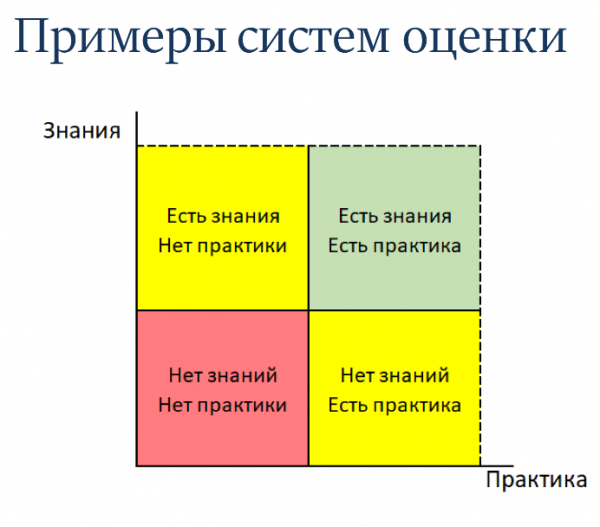
There are only 4 options here, it's hard to get confused.
- No knowledge, no practice. — this is not our person, they are unlikely to share their knowledge.
- There is knowledge and practice. — they might share their knowledge. Let's take them!
- Two intermediate points — we need to think about where to apply the person.
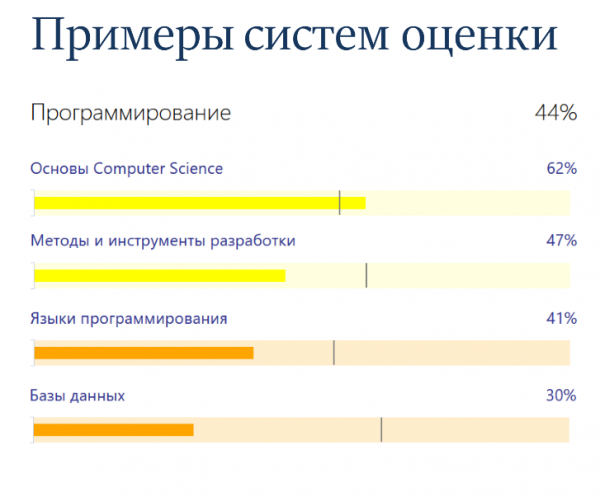
It can be complicated. Measure depth and width, as we do in Cloveri.
Have we decided on the scale? But how to assess the level of competencies that you or your team possess?
Common assessment methods.
Self-assessment.. The simplest method was devised by Neo. He said, "I know kung fu!" and many believed — after all, if he said it, he must know — he is the chosen one.
The self-assessment method works, but there are nuances. You can ask an employee to evaluate how proficient they are in a certain skill. But as soon as this assessment has monetary implications — the level of knowledge somehow increases. Poof! And everyone is an expert. Therefore, as soon as money is involved in the assessment, immediately keep self-assessment away.
The second nuance — the Dunning-Kruger effect..
Incompetent people do not understand their incompetence due to their incompetence.
Interviews with experts. We are invited to companies to assess the level of employees so that further development plans can be made. Employees fill out self-questionnaires about their , we look at them: "Great, another expert, let's talk to them." But during the conversation, the person quickly stops looking like an expert. Most often, this happens with juniors, sometimes with mids. Only at a certain level of the specialist’s development can self-assessment be trusted.
When Neo said he knew kung fu, Morpheus suggested checking whose kung fu is better in practice. It quickly became clear — Neo was only talking a big game or showing real skill.
Practice is the most challenging method. Determining the level of proficiency through practical cases is more complex and time-consuming than interviews. For example, I participated in the "Leaders of Russia" contest and overall we were assessed for 5 days to determine the level across 10 competencies.
Developing practical cases is expensive, so often only the first two methods are used: self-assessment and interviews with experts.These may be external experts or members of your own team. After all, every team member is an expert in something.
Competency Matrix
So, when Neo and Trinity were preparing to save Morpheus, they first figured out what competencies were needed to carry out the work process. Then they evaluated each other and decided that Neo would do the shooting. Trinity would help him at first, but later would pilot the helicopter, since Neo isn’t very good with helicopters.
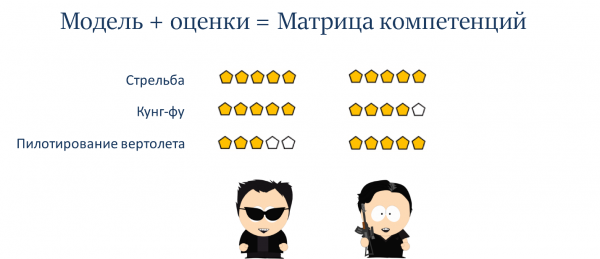
The model along with the evaluations gives us the competency matrix.
Thus, effective knowledge management led Neo and Trinity to victory, and they saved Morpheus.
How to manage using models
The story of the little people in glasses and leather pants is interesting, but what does it have to do with development? Let’s move on to real-life applications of the competency model built from your processes.
Selection
Everyone who approaches HR for a new employee hears the question: "So, who do you need?" For a quick answer, we take the job description of the previous person and go looking for someone like them. Is it right to do so? No.
The manager's task is to reduce the number of bottlenecks in the team.The fewer competencies that are held by only one person, the better for the team. Fewer bottlenecks = greater team throughput = work gets done faster. So when looking for a person, use the competency matrix.
The main criterion for selection is what essential skills your team will gain from this person.
This will increase your team’s throughput.
The main question that needs to be answered when creating a new vacancy is: "Who actually do we need?" The obvious answer is not always the correct one. When we say that we have performance issues in the system, do we necessarily need to hire an architect to solve them? No, sometimes it’s enough to buy and set up some 'hardware.' And that requires a completely different set of skills.
Adaptation
How to quickly adapt specialists who have recently joined the team and are still on probation? It’s great when there’s a knowledge base, and even better when it’s up to date. But there is a nuance. It is related to the fact that people learn in three ways.
- Through theory — reading books, articles on Habr, attending conferences.
- Through observationInitially, we are social animals — the first monkey took a stick, hit the second one with it, and the third organized a course on 'Seven Effective Ways to Handle a Stick.' Therefore, observing someone is a customary way of learning.
- Through practice. Scientists working on cognitive systems say that the first method is good, the second is great, but the most effective one is through practice. Without practice, adaptation occurs more slowly.
Practice? Should we throw a person straight into battle? But alone, they might not cope.
That’s why we usually provide them with a mentor. Sometimes this doesn’t work:
— I've got a ton of my own tasks, and now you've added this burden. You're the team lead; you get paid for this, handle it yourself!
That’s why the approach we implement in building a team development plan is many different mentors for various skills.An expert in prototyping helps a frontend developer with creating prototypes, while an expert in testing teaches how to write tests or at least shows what they usually do, with which tools and checklists.
Microlearning and mentorship from a large number of specialists work better than having just one mentor.
It works better also because most problems in companies are related to communication. If you train a person to communicate and share information a lot from the start, then perhaps there won’t be communication issues in the company. Therefore, the more people involved in a person's adaptation, the better.
Development
— Where to find time for training? There’s no time to work!
When you use competency models, it’s easier for you to understand how to learn right in the process of work. What practical task to give so that the person gains knowledge.
Many of you know about the Eisenhower matrix, which indicates what can be delegated and what should be done personally. Here’s its analogy for knowledge management.
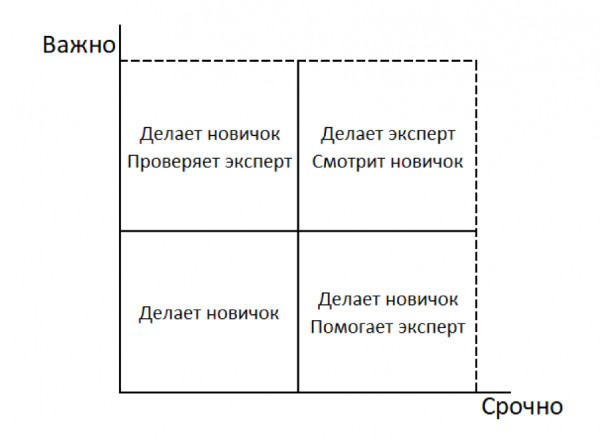
When you want to constantly cultivate knowledge within the team, do it at least sometimes in pairs — have people work on the same task simultaneously.Even if it’s urgent and important, let the newcomer tackle it alongside the expert — at least have them record why the expert solves this task in that way, and let them ask what is unclear — why the server was rebooted this time, but not last time.
In every square of the matrix, there is always a task for a second person. A newcomer can almost always do everything independently, but sometimes they need supervision, and sometimes active assistance.
This is a way to teach people when there is no time for training, but only time for work. Engage employees in what they are capable of at the moment, and develop them in the process.
Career
Every team lead eventually has an employee approach them and ask:"How can I earn more?" And you have to quickly come up with what the employee needs to do in order to get a raise three months later.
With a competence matrix, you have the answers at your fingertips. Remember that the team needs to be duplicated, spreading knowledge among different people as much as possible. If you understand where the problem lies in the team, then, of course, the first task for the person asking is to improve in that area.
Once you adopt a competency-based approach, a more meaningful direction for employee development begins. The competence matrix always provides the answer to the question of how to earn more.
To earn more, develop the competencies needed by the team.
But be careful. A common mistake we observe when consulting companies is setting a direction without inquiring about the person's desire to go there. Is there motivation? Do they want to advance in load testing or focus on test automation?
An important aspect when we talk about personal development is understanding their motivation: what they want to learn, what interests them. If a person is not interested, knowledge will not stick. Our brain is structured to be very resistant to change. Change is costly, painful, and requires energy. The brain wants to survive, so it tries to escape new knowledge by any means. Going for lunch, taking a smoke break. Or playing. Or scrolling through social media. Yes, doing what we usually do when we need to learn something.
If there is no motivation, teaching is useless. Therefore, it is better to teach a little bit at a time, but on topics that are interesting. When the brain finds something interesting, it is willing to share energy for new knowledge.
Departure
What to do with the knowledge of departing employees? There are cases when a person leaves a company. Often, after they sign their resignation and slam the door, it turns out they were working on something important that was forgotten. This is a problem.
When you have a competency matrix, you understand where the bottlenecks are, who your sole person is that can shoot or pilot a helicopter. As a team lead, you need to address problems before they arise.: if you have only one person who can fly a helicopter, teach someone else how to do it.
Duplicate people before they leave or get hit by a bus. Most importantly, don't forget to duplicate yourself as well. A good team lead is one who can leave while the team continues to work.
And finally.
What we don't understand scares us. What scares us, we tend to avoid doing.
There are tools that allow for more meaningful management in an organization. One of them is the management model based on digitization of processes and people for more purposeful actions by managers. Based on this model, we hire, develop, and manage people more effectively, creating products and services.
Apply competency models, be more intentional managers.
If you are interested in the topic of this article and feel the need for structured knowledge management in the company, I invite you on April 26 to the first conference in Russia about knowledge management in IT. We have gathered a lot of important topics: onboarding newcomers, working with knowledge bases, engaging employees in knowledge sharing, and much more. Come for practical solutions to everyday challenges.
Source: habr.com
