

The codec introduced in 2018 was supported by key players in the streaming market. Hardware providers confirmed support for the new codec, and devices with AV1 hardware decoding are expected to emerge by the end of the year. Against this backdrop, patent trolls have intensified their financial demands.
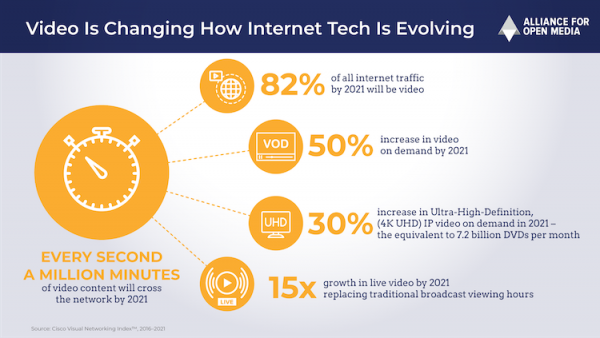
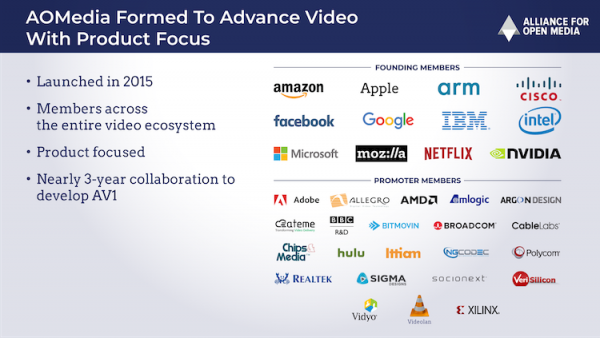
Video Codec developed with open source since 2015 by engineers from several companies, including Amazon, BBC, Netflix, Hulu, and others who created the Alliance for Open Media (AOMedia). The new technology is primarily designed for streaming video in ultra-high resolutions (4K and above), with an expanded color palette and various HDR technologies. Among the main features of the AOMedia codec is compression algorithm compared to existing methods, predictable computational hardware requirements, as well as maximum flexibility and scalability.
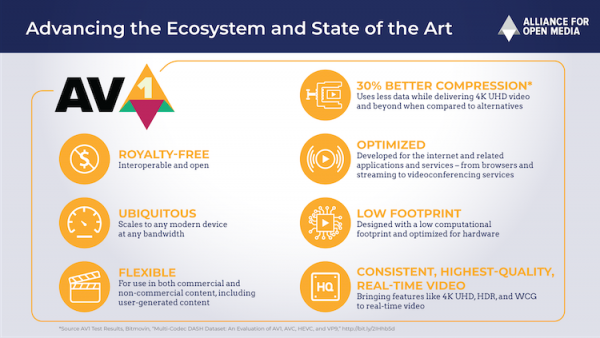
For these companies with their own streaming services, efficient codecs are as vital as air. Firstly, AV1 reduces the bandwidth requirements of the Internet connection at both the data center (DC) level and among providers and end-users. Secondly, the use of Amazon Studios' 65mm film and IMAX MSM 9802 cameras (which are very difficult to rent) and RED Monstro for the film) shows that the company is preparing for the post-4K era, when current codecs will not seem as effective.
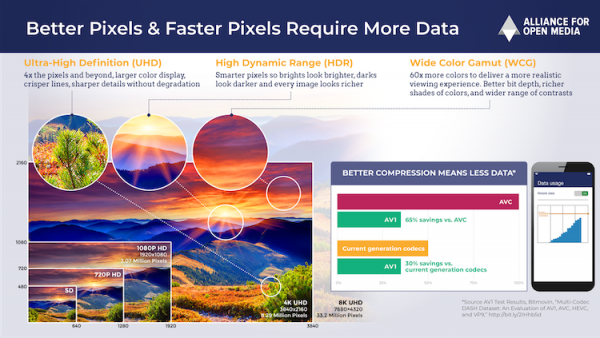
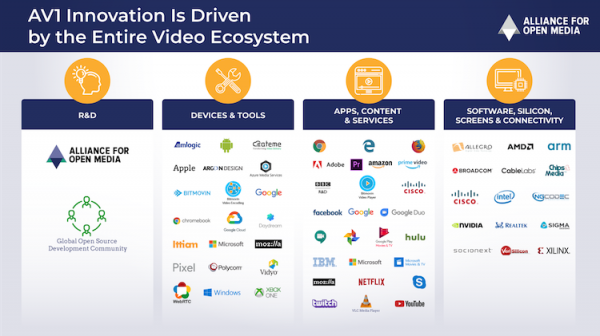
As for software decoders, they are currently by a whole range of companies, including Cisco, Google, Netflix, Microsoft, and Mozilla. However, software decoding generally always results in increased power consumption and very limited use. Therefore, it is interesting to see the support for hardware decoding.
Chips & Media became one of the first to introduce an AV1 hardware decoder in October last year. The video processor represents licensed intellectual property (synthesizable at the RTL level) that can be embedded in a system-on-chip (SoC) using ARM AMBA 3 APB and ARM AMBA3 AXI internal buses. This decoder supports AV1 codec level 5.1, a maximum bitrate of 50 Mbps, color depth of 8 or 10 bits, as well as color sub-sampling of 4:2:0. A single-core Wave 510A configuration running at 450 MHz can be used for decoding 4K streams at 60 Hz (4Kp60), while a dual-core configuration can decode 4Kp120 or 8Kp60 streams.
In addition to Chips & Media, several other companies offer licensed video processors with AV1 support. For example, support both AV1 and other popular formats, including H.264, H.265 (HEVC), VP9, and JPEG. They also support color sub-sampling of 4:2:0 and 4:2:2 for consumer and professional applications. Allegro has stated that these solutions have been licensed by tier-one equipment suppliers and will be used in end devices to be released by the end of the year.
In addition to licensed video processors, a number of developers have announced ready-made systems-on-chip with AV1 support for televisions, set-top boxes, players, and other similar devices. Among others, Amlogic stands out, supporting resolutions up to 8Kp60, Broadcom supporting 4Kp60, Realtek (4Kp60) and (8Kp60). Additionally, the third-generation LG α9 SoC used in the company's 8K televisions from 2020 also supports AV1. Furthermore, MediaTek has announced the Dimensity 1000 mobile system-on-chip with hardware AV1 decoding.
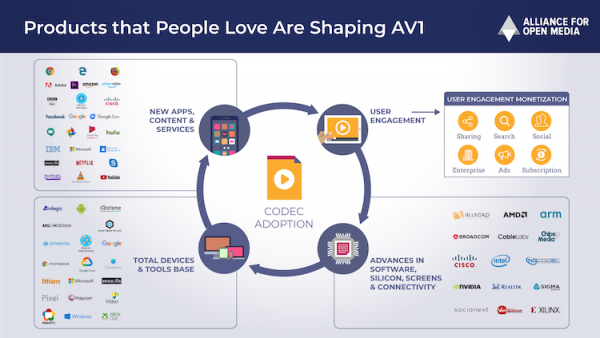
As can be seen, the support for hardware decoding of AV1 streams from the developers of licensed video processors and chips is currently quite modest. However, given the backing of the new codec by a range of technology companies (Apple, Amazon, AMD, ARM, Broadcom, Facebook, Google, Hulu, Intel, IBM, Microsoft, Netflix, NVIDIA, Realtek, Sigma, and many others), hardware support for AV1 is expected in the coming years.
Formally, the AV1 video codec does not require payment of licensing fees for the use of patents owned by members of the Alliance for Open Media (AOMedia). Although the process of including a specific patent in AV1 requires the conclusion of two experts that it does not infringe anyone's rights, patent trolls who claim violations by everyone always emerge.
Thus, the Luxembourg-based company Sisvel has amassed a pool of 3,000 patents from dozens of companies that describe technologies similar to those used in AV1 and VP9. Starting in March of this year, Sisvel is offering to license these patents for €0.32 for devices with a display (TVs, smartphones, PCs, and others) and €0.11 for devices without a display (chips, players, motherboards, and more). Although Sisvel does not plan to charge licensing fees for content, it appears that software is treated the same as hardware, meaning that software developers will have to pay this company.
Although Sisvel has not yet initiated legal proceedings against hardware and software developers (and will not do so until the technology becomes widely adopted), it is quite evident that such intentions exist. However, AOMedia is there to protect participants in the AV1 ecosystem, although it does not clarify how exactly.
The creators of AV1 are counting on its widespread adoption across all platforms, so it is expected that it will be supported not only by major chip manufacturers, software developers, and service providers, but also by leading consumer electronics manufacturers.

Nevertheless, not everything is so cloudless for AV1. First, since most players, TVs, and set-top boxes do not support this codec, the transition across the industry will be relatively slow. Additionally, it is worth remembering that developers are preparing codec AV2 for the post-8K era. Secondly, the demands of patent trolls will clearly dampen interest in this technology among certain companies.
Source: 3dnews.ru
