

The recent disclosure of yet another Intel processor vulnerability, known as MDS (or Zombieload), has fueled renewed debates about the performance degradation users will have to endure when adopting the proposed hardware fixes. Intel has published their own , which demonstrated an extremely small impact of the fixes on performance even when disabling Hyper-Threading. However, not everyone agrees with this stance. The site Phoronix conducted its own independent Linux testing and found that applying fixes for the recently discovered suite of processor vulnerabilities results in an average performance drop of 16% for Intel processors without disabling Hyper-Threading and 25% with it disabled. In contrast, the performance of AMD processors based on the Zen+ architecture, as shown in these tests, only decreases by 3%.

From the tests presented in the study, it can be concluded that the performance degradation of Intel processors varies significantly from application to application and can easily exceed a factor of 1.5 when Hyper-Threading is disabled. This is precisely the point made by Apple when citing its cost of mitigating Zombieload — up to 40%. Apple, like Google, states that making systems based on Intel processors completely safe can only be achieved this way. If Hyper-Threading is not disabled, the performance drop can also be quite noticeable: in the worst case, it can reach double the size.
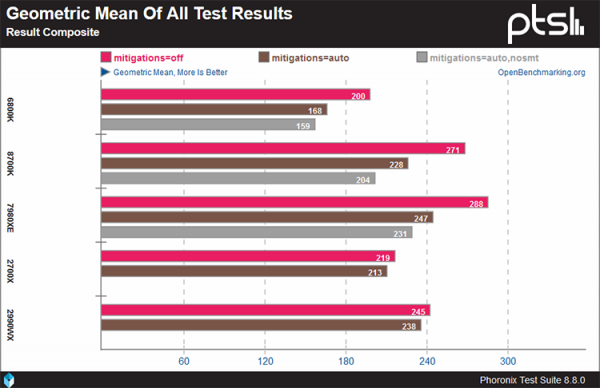
It should be clarified that the Phoronix tests were aimed at assessing the impact of the entire set of patches against all recent vulnerabilities — Spectre, Meltdown, L1TF, and MDS. This means that in this case, we are discussing the maximum performance difference that Intel processor owners will experience after applying all patches at once. This also explains the performance decrease observed in AMD processors. Although MDS does not affect them, AMD chips are susceptible to certain types of Spectre vulnerabilities, which also require software fixes. However, no drastic measures such as disabling Hyper-Threading are necessary for them.
The serious decline in performance of Intel processors after applying patches could prove to be a fatal factor for the company's position in the server market. While AMD is gearing up to raise the performance bar with its new 7nm EPYC (Rome) processors, Intel chips are confidently moving in the opposite direction. At the same time, it is impossible to forego fixing vulnerabilities in server solutions — they present the main danger there. Thus, AMD has the opportunity to soon become a supplier of higher-performing server solutions, which will have a significant impact on its position in the server market, where the company aims to capture a 10% share within the next year.
Consumers using desktop systems can fairly choose to forego patches, at least until potentially dangerous exploitation scenarios of vulnerabilities are identified. However, according to Phoronix tests, if initially, the Core i7-8700K is on average 24% faster than the Ryzen 7 2700X, after applying fixes, the advantage shrinks to 7%. If one follows the most conservative recommendations and additionally disables Hyper-Threading, the older AMD processor will be 4% faster than the Core i7-8700K.
Source: 3dnews.ru
