

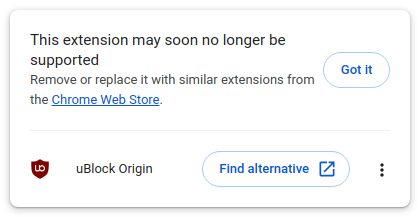
Raymond Hill, the creator of the content-blocking system uBlock Origin, discussed the situation regarding the project's upcoming cessation of the second version of the Chrome manifest, which defines the capabilities and resources available for extensions built using the WebExtensions API. Users of uBlock Origin and other extensions that do not support the third version of the manifest have started to receive warnings on the Chrome 127 extensions page ("chrome://extensions/") about the impending discontinuation of support for the extension and the need to seek alternatives. The complete discontinuation of support for the second version of the Chrome manifest is planned to be completed by the end of the year.
The uBlock Origin project has developed a new extension called uBlock Origin Lite (uBOL), which is a version of uBlock Origin adapted to the declarative API proposed in the third version of the manifest, providing access to the built-in browser engine for content filtering. The new API trails behind the webRequest API in its capabilities, which has been put into read-only mode in the third version of the manifest. Due to the limitations of the new API, which processes blocking rules on its own and does not allow the use of custom filtering algorithms, only part of the uBlock Origin functionality is implemented in uBlock Origin Lite.
The uBlock Origin Lite and uBlock Origin projects are too different from each other to replace one extension with the other in the Chrome Web Store catalog and ensure an automatic transition from uBlock Origin to uBlock Origin Lite on systems without support for the second version of the manifest. Users are invited to make their own decision on whether to switch to uBlock Origin Lite or choose another ad-blocking extension as a replacement. At the same time, despite the discontinuation of support for the second version of the manifest in Chrome, the developers do not intend to halt the development of the old uBlock Origin, as full webRequest API support remains in Firefox and some other browsers.
One of the most notable differences between uBlock Origin Lite and uBlock Origin is the lack of support for cosmetic filters to replace content on the page ("##"), script injections on sites ("##+js"), request redirection filters ("redirect="), CSP header filters (Content Security Policy), and filters for removing query parameters ("removeparam="). To enable these features, the extension requires explicit permissions to modify and read site data.
Among the features that could not be transferred to uBlock Origin Lite are dynamic content and URL filters, HTTP header filters, tools for disabling scripts, fonts, and large multimedia elements tied to specific sites, many filter options (strict1p, strict3p, domain, redirect-rule, removeparam), and DNS manipulation protection to bypass blocking.
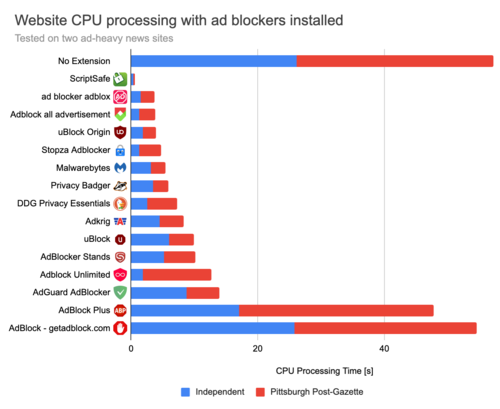
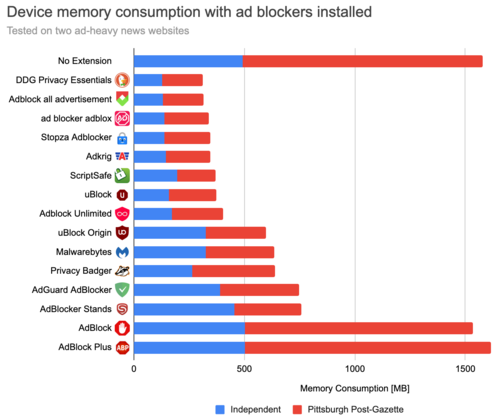
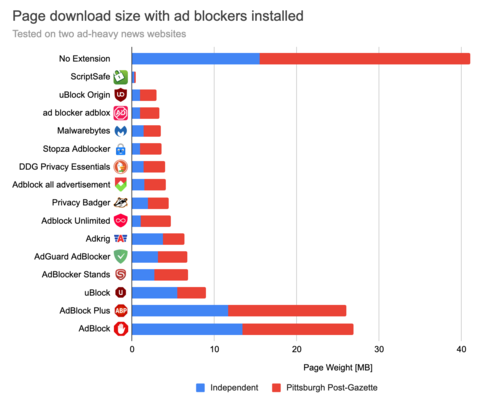
Overall, uBlock Origin Lite is seen as less effective when dealing with sites that use methods to combat ad blockers or that apply scripts to minimize disruptions, as many filters for such sites cannot be converted into rules for the declarativeNetRequest API. In terms of performance, uBlock Origin Lite consumes slightly less CPU and memory resources than uBlock Origin, but results in slightly more data loading when opening pages (in the graphs below, "ad blocker adblox" is the renamed uBlock Origin Lite).
Source: opennet.ru
