

Christian Schaller, head of the Fedora Desktop Team and the desktop systems development group at Red Hat, discussed some features that are planned to be added in the next release of Fedora Workstation:
- The toolkit Instructlab is planned to be included, allowing for the quick installation of the large language model Granite, open-sourced by IBM under the Apache 2.0 license, which encompasses 7 billion parameters and can consider up to 4,000 tokens when generating text. Besides working with the ready-made model,
Instructlab provides tools for augmenting the model with additional knowledge and implementing new skills that may be required for addressing specific tasks.Furthermore, Fedora plans to enhance capabilities that can be utilized with other models; for example, work is underway to add support for the ROCm stack for hardware acceleration on AMD GPUs in the PyTorch library package. More distant plans include ensuring out-of-the-box hardware acceleration capabilities in the PyTorch packaged for systems with AMD, NVIDIA, and Intel GPUs.
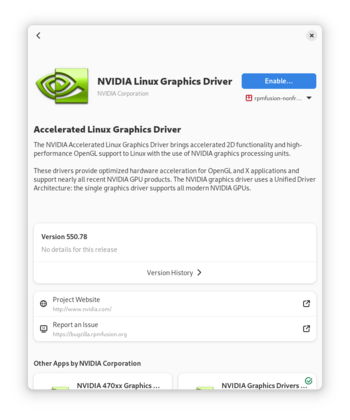
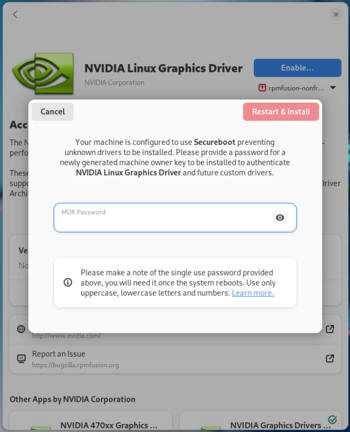
- To simplify the use of NVIDIA GPUs for graphics and machine learning, there are plans to upgrade the quick installation feature for proprietary NVIDIA drivers in GNOME Software. In a recent Fedora release, the option for installing such drivers was removed because, in the default configuration that sets up secure boot, installation was complicated by the need to manually add a digital signature for the loaded drivers using utilities from the mokutils package. In Fedora 41, the ability to install
proprietary NVIDIA drivers in GNOME Software is planned to be reinstated, along with a graphical interface for creating and saving a digital signature for the NVIDIA kernel module in MOK (Machine Owner Key).

- Work is underway to integrate support for NVIDIA drivers into the Toolbx toolkit, which allows launching additional isolated environments for installing experimental packages without affecting the main system or for creating environments based on other distributions. This change will enable the use of the official NVIDIA Container Device Interface (CDI) module to fully support NVIDIA driver capabilities and CUDA in Toolbx-based containers, for instance, to run containers with machine learning system components in Toolbx.
- Fedora 41 plans to add the open-source Nova driver, written in Rust, which supports NVIDIA GPUs. In this, the initialization and management operations for the GPU are handled in firmware and executed by a separate microcontroller (GSP - GPU System Processor). To support the Vulkan graphics API on top of the Nova driver, the NVK module will be utilized, while the Zink module will implement OpenGL calls through translation to the Vulkan API.
- Efforts are being made to add support for High Dynamic Range (HDR) in the Mutter compositor and GNOME Shell, as well as to include changes that allow standard (SDR) and extended (HDR) brightness dynamic ranges to be used side by side. A final version of the Wayland protocol extension defining HDR-related capabilities is also planned for publication.
- Changes have been prepared for the implementation of the Wayland protocol 'DRM leasing', which can be used for output to virtual reality headsets or video walls.
- To address output violations and freezes on NVIDIA GPU systems when using Wayland, Fedora 41 plans to include support for Explicit Sync technology in the kernel and GNOME, allowing the Wayland protocol-based compositor to be informed of the frame's readiness for display. This can be used to reduce latencies and eliminate the appearance of artifacts in graphic output.
Source: opennet.ru
