

The beta version of Firefox 67 includes code to block JavaScript inserts that perform cryptocurrency mining or track users using covert identification methods ("browser fingerprinting"). Blocking is carried out based on additional categories (fingerprinting and cryptomining) in the Disconnect.me list, which includes hosts caught using miners and code for covert identification.
Cryptocurrency mining code, which leads to a significant increase in CPU load on the user's system, is typically injected into websites as a result of hacks or used on dubious sites as a monetization method. Covert identification involves storing identifiers in areas not intended for permanent information storage ("Supercookies"), as well as generating identifiers based on indirect data such as screen resolution, supported MIME types, specific parameters in headers (HTTP/2 and HTTPS), analysis of installed plugins and fonts, availability of certain Web APIs, specific rendering features from graphics cards using WebGL and Canvas, CSS manipulations, and analysis of mouse and keyboard behavior.
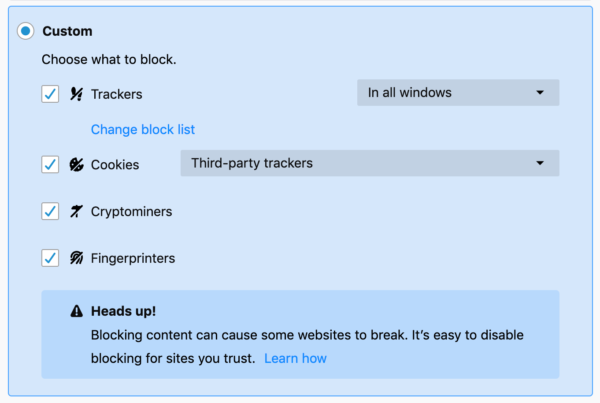
By default, the new blocking modes are disabled, and new options "Cryptominers" and "fingerprinters" have been added to privacy-related settings to activate them. After some time, these modes are planned to be enabled by default for a small test group of users, after which they will be activated for everyone in a future release.
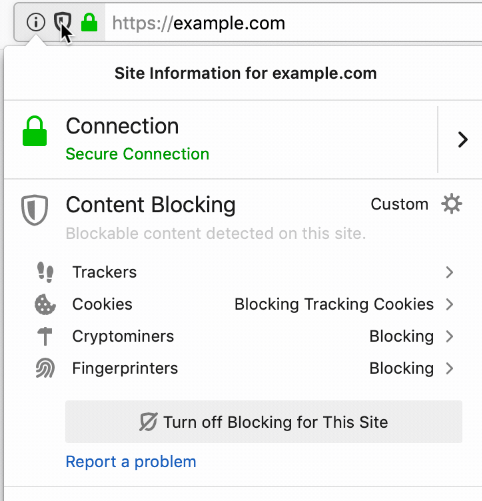
You can track the activity of the blocker through
the site's context menu, which is displayed when clicking on the shield icon in the address bar. The menu also includes a link
for quickly sending a report to developers about any issues that arise.
Other recent developments related to Firefox include:
- A program of recommended extensions has been announced, which will offer a list of extensions that meet Mozilla's security, usability, and convenience standards this summer. Extensions from the list will be promoted through contextual recommendations in various Mozilla products and on project websites. To be accepted into the list, an extension must effectively and efficiently address relevant tasks that interest a broad audience, be actively developed by the author, and undergo thorough security review with each update.
- The possibility of including the Servo WebRender compositing system, written in Rust and offloading rendering operations to the GPU, in Linux builds of Firefox is being considered. When using WebRender instead of the Gecko engine's built-in compositing system, which processes data using the CPU, shaders executed in the GPU are used for the final rendering of page elements, resulting in significantly increased rendering speed and reduced CPU load. In Linux, WebRender is initially proposed for Intel graphics cards with Mesa drivers 18.2.8 and newer. WebRender can be manually activated on systems with other graphics cards via the "gfx.webrender.all.qualified" variable in about:config or by launching Firefox with the environment variable MOZ_WEBRENDER=1 set.
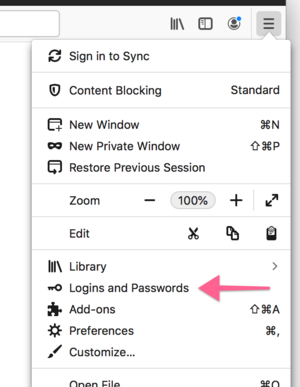
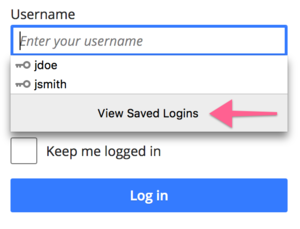
- In the beta version of Firefox 67, a quick access option to saved passwords for the site has been added to the main menu and the form filling dialog.


- A button has been added to the settings to reload all tabs after changing the rules for handling cookies from third-party resources.
- Restrictions have been added on the intensity of authentication dialog displays by websites.
- A new implementation of code for synchronizing bookmarks, rewritten in Rust (enabled via services.sync.bookmarks.buffer.enabled in about:config), has been added to the nightly builds.
Source: opennet.ru
