

Linux kernel developers have officially approved a policy for the use of artificial intelligence (AI) after months of intense debate. Linus Torvalds and industry partners have reached an agreement that allows the use of AI assistants but imposes strict disclosure rules and places full responsibility for any errors on human developers.
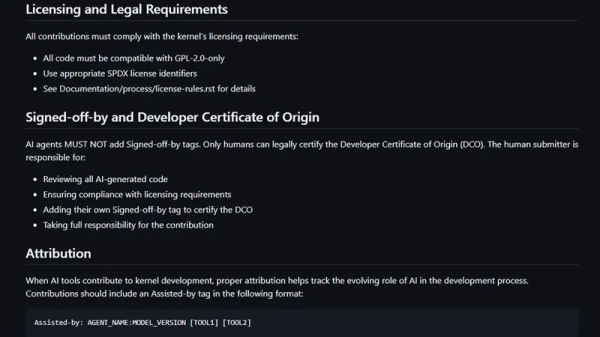
The new rules prohibit the use of the legally binding 'Signed-off-by' tag for code generated by AI systems, replacing it with a new 'Assisted-by' tag to ensure transparency in the origin of modifications. This decision, as noted, Tom’s Hardware, was a response to the growing tension in the community caused by a flood of low-quality code and the hidden use of neural networks. Now every bug or vulnerability in such code will be legally attributed to a specific person who published the changes. This will eliminate the possibility of shifting blame onto algorithms and will allow for the integration of modern tools into the workflow without violating the principles of the Developer Certificate of Origin (DCO).
Debates over AI integration peaked in January when representatives from Intel and Oracle publicly clashed over the regulation of neural networks in the project. Meanwhile, Torvalds sharply criticized ideas for a total ban, calling it pointless, and insisted that AI is merely a tool, like any other software. He emphasized that malicious actors will not read documentation anyway, making it more effective to control outcomes through the accountability of specific individuals rather than attempting to ban technologies on developers' local machines.
Prior to adopting a unified policy, major open source projects showcased varying approaches to the issue, even extending to outright bans. For instance, the distributions Gentoo and NetBSD previously blocked the acceptance of AI-generated code, arguing that the training data for models often contains code under restrictive licenses, which renders the result legally untenable. Experts from Red Hat, on the other hand, warned that using such tools could unintentionally violate GNU GPL licenses and undermine the entire DCO system, as developers cannot guarantee the provenance of each line of code.
In addition to legal risks, the community faced the problem of a massive influx of low-quality edits, dubbed AI slop. Creators of popular projects like cURL and tldraw were forced to shut down bounty programs or automatically reject external submissions due to spam containing AI hallucination code. In the case of the Linux kernel, the situation was exacerbated by a high-profile incident with maintainer Sasha Levin, an Nvidia engineer, who integrated a patch for kernel 6.15 that was entirely written by an AI model without proper notification. The code was functional; however, it contained a performance regression despite being reviewed and tested.
The issue of distrust stemming from the covert use of AI affected not only systems programming but also other areas, such as the Doom modding community. Specifically, GZDoom project leader Christoph Oelckers faced a mass exodus of project participants after he used AI patches without disclosing this information and refused to compromise with critics. As a result, most contributors left the original project and created the UZDoom fork, demonstrating the importance of openness and honesty to the community.
Source:
Source: 3dnews.ru
