

Google has summarized the results of implementing AutoFDO (Auto-Feedback-Directed Optimization) optimization when building the Linux kernel for the Android platform. AutoFDO utilizes profiling results with information about the frequency of execution of various code segments to enhance the performance of frequently executed operations. The AutoFDO optimization was employed in the Linux kernel 6.12 build for Android 16 and 6.6 for Android 15, and it will also be included in the kernel build 6.18 for Android 17. Performance profiles for AutoFDO were created based on running 100 popular applications from the C-Suite (Android App Compatibility Test Suite) set and simulating user interactions with these applications.
Previously, AutoFDO optimization was already used in Android when building system libraries and executable files in user space, and on average, it enhanced application launch speed by 4% and reduced loading time by 1%. However, until recently, AutoFDO optimization had not been applied to the Linux kernel, which, according to Google statistics, spends 40% of CPU time on.
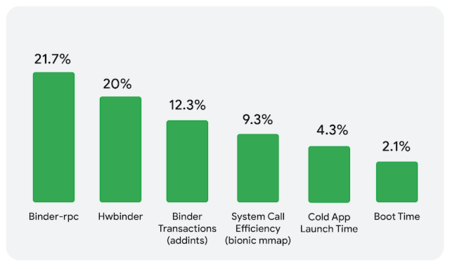
In the conducted tests, enabling AutoFDO for the kernel led to a 2.1% reduction in loading time, a 4.3% improvement in the first launch speed of programs, a 9.3% increase in the efficiency of system calls, and a reduction in the execution time of mmap transactions of Binder by 12.3%, HwBinder by 20%, and Binder RPC by 21.7%.
Source: opennet.ru
