

I have a friend from Grenoble, the son of Russian emigrants. After finishing school (collège + lycée), he moved to Bordeaux and got a job at the port. A year later, he transitioned to a flower shop as an SMM specialist. Another year passed, and he completed a short course to become something like an assistant to the manager. After two years of work, at the age of 23, he joined the SAP company in an entry-level position, earned a university degree, and has now become an engineer in corporate systems. When asked if he was afraid of taking such a 'gap' in his education, he replied that he was more afraid of leaving university at 22 without knowing who he is or what he wants. Sound familiar? If you are a parent or relative of a student, or if you are a student yourself, this is for you. Nevertheless, it’s also a good reason for nostalgia for everyone else.
Prologue - the origin of this article
On Habr, fragmented articles about education, the necessity of a diploma, graduate school, and other aspects of studying have appeared multiple times. It's no coincidence that there are hubs dedicated to the educational process, career, studying abroad, etc. The topic is indeed serious, especially in the context of a significantly changed job market and the demands on professionals. We decided to summarize our experiences, requested assistance from a specialist who has dedicated 8 years to education and has 25 years under their belt, including school 🙂 and 10 years in the IT sector. We have prepared 5 articles that will be published in our blog.
The cycle 'Live for a Century - Learn for a Century'
Part 1. School and Career Guidance
Part 2. University
Part 3. Continuing Education
Part 4. Education Within Work
Part 5. Self-Education
Share your experiences in the comments—perhaps, thanks to the efforts of the RUVDS team and Habr readers, someone's first of September will be a little more conscious, correct, and fruitful.
School: the old song about the main thing
Groups
On average, the school system in the country is a rather interesting element of education, especially now. It has become a crossroads of completely different worlds:
- teachers of the old formation, mostly in a very solid age, largely unwilling to accept new realities and forms of education, unwilling to listen to students;
- young and somewhat indifferent teachers from the 90s, who, with rare exceptions, entered pedagogy out of despair and an inability to enroll in another university (due to the level of preparation or lack of money);
- parents spanning ages from the 70s to the 90s, meaning from people of the Soviet era to the reckless representatives of the so-called 'lost generation';
- Children aged 15-17 (we will primarily discuss them) are digital natives, automated and computerized, introverted and virtual, with their own thinking and unique organization of psyche and memory.
All four groups are at war with each other and with other groups, creating much misunderstanding within such communities, with the invisible hand of the main and authoritative educator — the internet. And you know what I’ll tell you? It’s not bad at all; it just requires a specific approach. I’ll also say that the generational conflict is as eternal as the laziness of schoolchildren; only the scenery changes.
What problems do schoolchildren face?
- Knowledge is completely detached from practice. The school curriculum does not provide information connected with practice. That's why you often hear questions about whether a programmer needs mathematics or which programming language to choose to avoid math questions. Meanwhile, in algebra, one could touch upon issues related to neural networks, machine learning, and game development (imagine how cool it is to learn that your favorite gaming characters move according to the laws of physics, and each trajectory is described by a mathematical formula). Merging theory and practice within subjects could increase student interest, overcome boredom in the classroom, and assist in initial career orientation (which takes place in grades 6-9). It's not necessary to demand a costly material base; the desire, a board, and chalk/marker would suffice.
- The real level of knowledge does not correspond to the grades in diaries and certificates. The eternal problem of rote memorization, encouragement, and demotivation through grades, along with competition, leads schoolchildren to chase after a coveted number, while parents and teachers encourage this race. It’s not surprising that in their first year of university, top students slide down to threes in higher mathematics, while average students maintain a steady four — they understand the subject rather than just memorizing information, which quickly escapes after the exams.
- Free access to information, in reality, it's a significant problem. There's no need to memorize, search, or analyze — you just open Wikipedia or Google and it’s all there, information right in front of you. This is detrimental because it truly diminishes the memory function, failing to establish a proper educational foundation. That very foundation teaches how to grasp a problem, find the missing piece of the puzzle, and only then utilize a reference or the internet. Simply put, by constantly Googling, a student doesn’t learn to understand exactly what they need to search for. Meanwhile, this initial educational foundation lays the groundwork for their future career, serving as a platform for analytical and synthetic skills.
- Unnecessary knowledge in school exists. Perhaps the teacher reading this post will want to find and tear the author apart, but the better the school, the more, forgive me, unnecessary stuff is crammed into the curriculum. Among the nonsense I've come across: 4 years of Latin, 7 years of foreign literature (with specialization), 4 years (!) of Life Safety Basics, 2 years of philosophy, as well as various language-related subjects, Greek, physical education theory, history of mathematics, etc. Undoubtedly, general erudition, school championships like 'What? Where? When?' and the ability to engage in conversation are invaluable and indeed quite pleasant and useful, but in such volumes, the hours of these subjects rob the student's brain of focus on subjects that are crucial for them and the crucial part of general education (just look at contemporary spelling, even on Habrahabr!). There's a solution: make such subjects elective and ungraded.
- A complex pace of education — a question that has existed since the dawn of schools and whose solution is very difficult to find. In one class, even in a 'strong' or 'weak' group, students have different paces of learning the material, solving tasks, and varying speeds of 'getting into the groove.' Ultimately, one has to either resort to equality and lose potentially strong students or ignore the weak ones and make them even weaker. I had a student who could solve mathematical statistics problems brilliantly but did so very slowly because he searched for the best way to solve them and optimized his approach. In the end, out of five problems, he could only solve three. What would you suggest I grade him? Exactly. Meanwhile, a small workaround can be found: giving stronger students more tasks to solve independently, allowing them to mentor and teach their classmates under teacher supervision—this significantly increases responsibility, reduces fear of making mistakes, and allows students to demonstrate the basics of teamwork.
- The problem of socialization — a painful and serious issue that brings along a dozen others. The virtual communication environment, gaming interactions, social networks, and messengers take away from children (yes, they are children under 18, and unfortunately, even afterwards, they are still children) the ability to communicate and interact socially. There are no problem-solving skills, teamwork, or relationships within a group of people—just a peer social network with simple conversations. And here the school's task is to show how awesome the 'person-person' system can be: organizing team games, facilitating communications.
How to choose a profession?
In most schools in Russia (the situation is better in Moscow), career guidance for students mainly involves essays on the topic of future professions and somewhat inadequate career assessment tests, some of which merely aim to define students' inclinations towards certain fields. Specialties like bioinformatics, medical informatics, etc. — that is, in-demand and promising areas for versatile and advanced students — are not discussed. Schoolchildren themselves remain primarily children, romantics, and dreamers. Today they want to heal people or serve in emergency services, tomorrow to be entrepreneurs, and a week later — programmers or engineers building the cars of the future. It's important to listen and think about the reasons behind their choices — whether it’s the charm of Dr. House, the charisma of Elon Musk, or a genuine need and calling for the young person.
How to evaluate a profession?
Prospectiveness — this is perhaps the most challenging metric. What seems promising right now can turn into the most saturated field by the time they finish school and university (hello to the lawyers and economists from the 2000-2002 enrollment years!) or may disappear entirely. Therefore, it’s essential to make it clear to your child and realize yourself that there must be a foundational base around which they can repeatedly change their specialization. For example, a software engineer proficient in C/C++ can easily transition into the world of neural network development, industrial development, science, etc., whereas a practitioner (applied informatics) may find themselves outside the stack they trained on in five years. Again, an economist specializing in 'Financial Management' is much more promising in terms of horizontal moves than one specializing in 'Banking' or 'Real Estate Appraisal.'. To assess the prospects, explore the list of future professions, look at programming language ratings (if we’re talking about IT), and read professional publications (for example, 15-17 years ago, medical journals actively discussed eye microsurgery, robots in medicine, laparoscopic procedures, and today, this is an everyday reality). Another way is to see which departments have opened at universities in the last 2-3 years; these are typically the top fields you can still enter.
Real income — a simpler metric. Open 'My Circle' or 'HeadHunter', evaluate the average salary level for the profession (sometimes ready-made analytics are available). Salary indexing in business occurs up to 10% per year, in the public sector about 5% per year. It's straightforward to calculate, but don’t forget that in N years there will be adjustments for demand depth, changes in the landscape of the field, etc.
Speed of development and career growth varies for each field. Moreover, it doesn’t exist everywhere, and one shouldn’t romanticize: sometimes it’s better to move horizontally, learn a new specialty, and work not for the record in an employment book but for a real income level (which can be risky, but this will be addressed in future installments). The main point to convey to a student is that they won’t become a manager right away; hard work will be required, and a real professional can sometimes be worth more than their boss.
Gradual growth and professional evolution — an important continuation of the previous metric. A professional learns continuously, up to the last day at work (and sometimes beyond). Therefore, it’s essential to correlate the student’s inclination to learn with the requirements of the desired profession (for example, if a boy dreams of becoming a doctor, has a 5 in chemistry and biology, but is lazy about studying — this is a signal that he may face challenges in professional development in the future), but don’t fixate on this: often, an adult person enjoys learning and continues education after university, while in school, it wasn’t laziness but a hatred of tedious history and boring geography.
What should be considered?
When choosing a profession, you must support your child, but not make decisions for them (I guarantee you won't hear a "thank you"). It’s important to not overlook any detail and perhaps even view your close family member from a bit of a distance, strictly and objectively (so to speak, the ability to shake one’s hips to Lambada doesn’t equate to a Class B in ballroom dancing, no matter how much you may wish it).
- Child's general inclinations — this is the very foundation of career guidance we mentioned earlier: ‘human’, ‘nature’, ‘machine’, ‘information systems’. No one exists without inclinations and some direction towards their future, so it's crucial to identify which mechanism prevails. Even well-rounded individuals have certain shifts in one direction or another. Pay attention to what the student says, which subjects come easier for them and why, what they focus on in conversation, whether they have algorithmic thinking, and how developed their logic or imagination is. Moreover, such observations of involuntary reactions are much more accurate than tests, since a student aged 13-17 can easily guess how to respond to achieve their desired outcome and deceive the system and adults 🙂
- Wishes of the student should be taken into account and encouraged; perhaps even let them ‘gripe’ about their dream profession — this way, they will determine themselves faster. Under no circumstances should you deter them from their choice or present the profession in a negative light (‘all programmers are nerds’, ‘a girl doesn’t belong in the automotive department’, ‘ha-ha, psychology, are you some sort of psycho, will you be fixing divorcees?’, ‘a taxi driver? you’ll get killed’ — based on real events). If possible, let your child try out the profession or at least a part of it: arrange for them to work in the summer, ask them to assist in activities related to the profession, or request acquaintances to offer them a job for a few days. If such an opportunity arises, it works flawlessly: either they feel disillusioned and disappointed, or they become thrilled and confirm their future plans.
- Family characteristics We cannot overlook our complex components: if the whole family consists of construction engineers, and the daughter can distinguish between types of concrete, knows the thickness of reinforcement, differentiates types of masonry, and can explain how heating works at the age of seven… this doesn’t mean that a construction career awaits her. No, but don’t expect an affection for Akhmatova or the early works of Petrarch either; it’s simply not her environment. Though there may be exceptions. However, familial expectations should not pressure a student into becoming someone simply because of their parents’ professions. Yes, your benefit is obvious: it's easier to educate, assist, and find a job, etc. But this advantage is yours, while the life belongs to your child, and it is likely that the choice of profession does not suit them for some reason.
There are times when parents are convinced that their child doesn’t want anything, has no aspirations or inclinations, isn’t thinking about university, and isn’t considering the future. In reality, this is not the case; there is always something they like—this should be the starting point. If you believe there are real difficulties, speak with teachers, listen to their advice, and consult a social psychologist who specializes in career guidance for teenagers (there are some really great private practitioners—more on them below). My classmate's daughter is 15, very precocious, and her mother is a passive housewife without an education, viewing her daughter as a ‘slacker’. The girl made a delicious coffee herself, elegantly folded napkins, and offered a ‘Anthill’ cake she made herself. – Katya, don’t you think she should try her hand at being a pastry chef or working in a café? – Are you kidding? She’s not going to serve the likes of plebeians; I’ll make her go into accounting. Curtain.
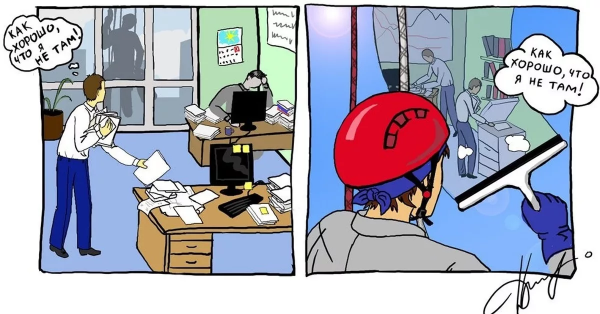
What should a student know about their profession?
When you’re a student, you always try to hide the true motives behind your behavior or choices so as not to seem immature or easily influenced. Therefore, it is very difficult for parents to understand the source of a sudden interest in a particular profession. However, it’s better not to dwell on this; instead, it’s important to communicate certain rules of the game.
- Any job involves a certain degree of routine (up to 100% of the total work) — a student must understand that along with some desired or visual attributes, they will handle numerous routine tasks, which may constitute a significant portion of the work: a programmer writes not whole programs (unless they own a business or are freelancing), but works on their part of the code; a doctor is obligated to fill out piles of paperwork, even if they are an emergency room employee or a surgeon; an astronaut trains for a long time, studies a lot, and must complete a vast number of tasks in space, etc. It's important to understand that there are no professions without such specifics; one should not romanticize work.
- Work is the daily effort of a specialist. If you tie your life to a certain profession, then there is a high probability that it will be forever: every day, with short vacations, bosses, Mondays, complex subordinates, and more.
- The fashion and prestige of a profession can change — often before they finish university. And then there will be two paths: to change qualifications or to become the best in the profession to ensure demand in the job market.
- You cannot transfer your attitude towards a person to the entire field of activity — if you like the profession because it is held by your dad/uncle/brother/movie hero, it does not mean that you will feel equally comfortable in it. Each person should choose what they like and what they are prepared for. There may be examples, but there should be no idols.
- You should enjoy your work and its components. Every job is divided into several components: the main activity and its goals, colleagues, work environment, infrastructure, 'customers' of the work, external environment, and its attitude towards the activity. You cannot accept one thing and refuse everything else, deny the existence of external factors. To work well and gain satisfaction, it's important to find positive aspects in all the mentioned components and, when turning off the alarm, know what you're turning it off for (for reasons beyond just money).
- A great journey begins with a series of small steps — one cannot immediately become great and famous, experienced and leading. There will be mistakes, criticisms, mentors, and rivals; the first steps will seem insignificant and tiny. But in reality, behind each of these steps lies a breakthrough — the foundation of experience. There is no need to fear advancing or to be indecisive about moving from job to job over trivial reasons: a stone in place accumulates moss, while the one who walks will forge a path.

- The beginning of a career is almost always dull — no one will entrust a novice with complex and interesting tasks; you will have to approach everything from the periphery, starting from the basics, learning, mastering, and repeating some incredibly tedious things day after day. But it is precisely through mastering these tasks that a young specialist becomes capable of diving into the deep foundations of their profession. This dullness is inevitable, so one must learn to find some joy in it.
- Managing money is also hard work. This thesis is something our parents didn’t convey to us well, and we seem distanced from it too. It’s important not just to earn or even save, but to be able to manage money and to live within the amount you have during this period of time. This is a valuable skill that teaches you to respect your professional ego and expertise, not to work for pennies, but to appropriately value your worth.
This has turned into a somewhat philosophical section, but this is indeed the support for a student's career orientation from their parents, the first seeds of self-respect as a future specialist.
What and who can help?
Career orientation is a process that shapes the rest of a life, so it is essential to rely on external methods and professional assistance.
- Private career orientation specialist — a person who can truly uncover the hidden desires and capabilities of a child. Often, these are not just social psychologists but practicing HR specialists who evaluate hundreds of candidates and can objectively assess what your child is ready for and what horizons to expect.
 Working with a career orientation specialist also yields results!
- Self-analysis: You need to determine what you really enjoy, what you are willing to do (the routine), what you dislike, and what you would not do for any reward. It's best to write this down on paper and keep it for reference in another iteration. This table will help understand which skills should define the profession.
- Map of Suitable Professions — list all professions that might suit the student based on certain criteria, discuss each one, highlight the pros and cons, and relate them to the admission opportunities at corresponding universities. This way, you can limit yourself to a few directions and think in terms of further professional development. (for example, the professions of cameraman, programmer, automotive engineer, and deep-sea captain remain; among them, there's one vector—technical specialties, a link to some equipment; you can already start exploring the prospects of each profession, assessing what it will be like by the time of graduation, etc. Although the range remains very broad).
- School Teachers — important observers and witnesses to your child's growth; sometimes they can see things that parents overlook. They primarily view the student from an intellectual perspective, recognizing their potential as a future specialist. Talk to them, discuss the professional development question; their observations could be a significant factor.
When you gather and compare this data, it will become much easier to help the teenager choose their specific path.
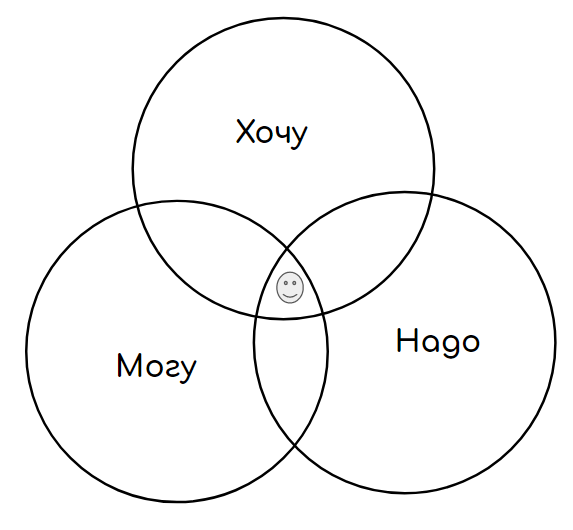 This is a classic career orientation diagram, which clearly shows that a successful career is formed at the intersection of desires, opportunities (including physical ones), and labor market needs.
But we liked its other variation—you can't argue with that!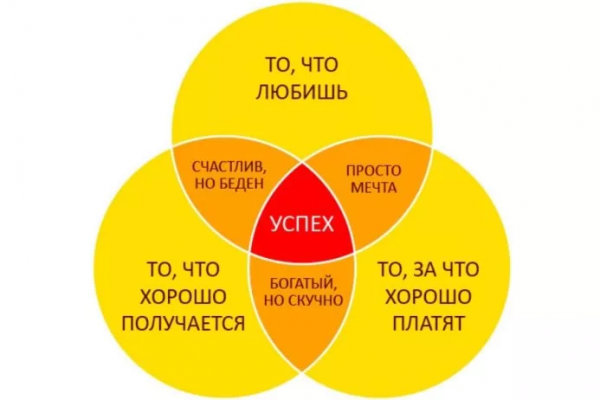
How to Raise an IT Specialist?
If a teenager (or even better, a child under 12) has certain abilities for logical thinking, algorithms, and an engineering perspective on things, don't miss the opportunity to focus on some key areas:
- to books, specifically books on computer science and mathematics — first, these are essential subjects, and second, your student will get used to working with professional literature; in their professional life, a good programmer rarely goes without books.
- to robotics and programming clubs — mentors will teach the child the basic algorithms, functions, and concepts from the IT field (stack, memory, programming language, interpreter, testing, etc.) in a playful manner;
- to the English language — learning the language must be taken very seriously, paying attention to the diversity and depth of vocabulary, as well as the conversational aspect (from communication with peers in apps and via Skype to studying abroad in language schools or camps during holidays);
- about robots and building kits at home — programmable robots are now available in every price range; it’s important to go through homework with the student together and deepen their knowledge;
- if you’re ready to tinker with Arduino and engage your teenager in it — then that's it, the job is almost done.
But amidst gamification and enthusiasm, one must not forget the foundational principles of physics, mathematics, and computer science; they must certainly be present in the life of a school student with a passion for development (and really for any educated person).
Education — it cannot be neglected: the question-answer.
Certainly, even if you have been orienting your child towards their career since the first grade and are confident in their future, it doesn’t mean that you should neglect school education and focus on just one thing.
How to teach 'core' subjects?
Exclusively in-depth, using additional literature, problem sets, and reference books. The goal of education is not just to pass the Unified State Exam (USE) well, but to arrive at university prepared, with an understanding of the subject and its place in a future profession.
How to approach non-core subjects?
In reasonable terms and personal ambitions — study, take tests, write assignments, and not waste too much time on them. Exceptions: the Russian language and foreign languages, as they are core subjects for any specialization, so give them special attention.
How to handle additional workload?
Challenging tasks and Olympiads mark the beginning of a career, without exaggeration. They enhance thinking skills, teach focus on short-term goals, and problem-solving intensity, provide the skills of self-presentation, and the ability to win and endure challenges. Therefore, if you are aspiring to a certain university and the teenager genuinely has career expectations, it's worth participating in Olympiads, conferences, and student research competitions.
Health should come first; this is an important point that parents often forget, while children may not yet understand.
Should I go to a technical school after the 8th/9th grade?
This is exclusively a decision made by the parents and the student themselves. There’s nothing wrong with the technical school + university education scheme; in fact, it has more advantages. However, studying this way is somewhat more challenging.
Should I switch to a specialized school?
It is advisable to switch — this way, the student will have better chances of scoring high on the Unified State Exam (and the same goes for entrance exams if they return in the future — the chances will still be higher). There’s no need to fear psychological trauma; changing the environment has significant advantages: students will get to know some of their future classmates much earlier, which greatly aids adaptation to university. But if the teenager is really attached and values the school environment above all else — then it's better not to force the change and to devote time to additional activities.
Factors for choosing a university?
There are many factors: from relocating to other cities to the university's internal features, it’s all very individual. However, it’s important to consider internship bases (if there aren’t any in mind), the level of language study at the university, the main scientific profile (research laboratories), and the availability of a military department (for those who find it relevant).
When should one start working?
This is a big question — whether to start working in school, and the answer is also individual. However, in my opinion, it’s worth trying to work in the summer between the 9th and 10th grades or between the 10th and 11th grades — simply to understand how interaction in a work team is arranged, how responsibilities are distributed, and what degrees of freedom and restriction exist. However, the summer before university enrollment brings excess stress and workload — therefore, once accepted, it’s better to rest as much as possible.
In fact, this topic can be discussed endlessly, and it requires a deeply individualized approach. However, it seems that if every parent pays attention to at least some points from this article, it will become easier for students to choose their future profession, and moms and dads will avoid the blame of saying, 'I didn't want to go to this university; you decided for me.' The task of adults is not just to feed their children fish but to give them a fishing rod and teach them how to use it. The school period is a huge foundation for their entire future life, so it should be approached responsibly while adhering to three main rules: respect, guide, and love. Believe me, it will return to you manifold.
In the next episode, we will walk through five or six corridors of the university courses and finally decide whether it is necessary or 'maybe to hell with the diploma?' Don't miss it!
Greedy postscript
By the way, we forgot an important point — if you want to grow into an IT specialist, it's worth getting acquainted with open source projects while still in school. This doesn't mean you need to contribute to the largest developments, but it's time to start nurturing your pet project and delve into theory through practice. And if you have already grown up and feel the need for something to advance, for example, a good powerful , visit — we have plenty of interesting offerings.
Source: habr.com
