

In the final days of the Consumer Electronics Show in Las Vegas, we got a glimpse inside the compact Intel NUC computer based on the Ghost Canyon platform. The company released the first Next Unit of Computing back in 2012, and has continuously enhanced the system's capabilities since then. The latest upgrade iteration, where an Intel CPU and a Vega graphics processor (just Vega, you won't find the logo of its creators on the device) coexist on a single board, has turned the NUC into a decent gaming machine for its size. However, these models still lack the ability to install a full-fledged discrete video card, unlike many ultra-compact motherboards with integrated processors and a PCI Express x16 slot.
On the other hand, Intel once experimented with the Compute Card — a closed module that combines all major components (CPU, RAM, storage, wireless modem, etc.) in a case the size of a credit card. The idea was that the owner of the chassis (or rather, the dock for the Compute Card) could easily extract and replace the system core. However, the Compute Card concept ultimately did not take off, and standard NUCs remained at the performance level provided by their factory configuration.
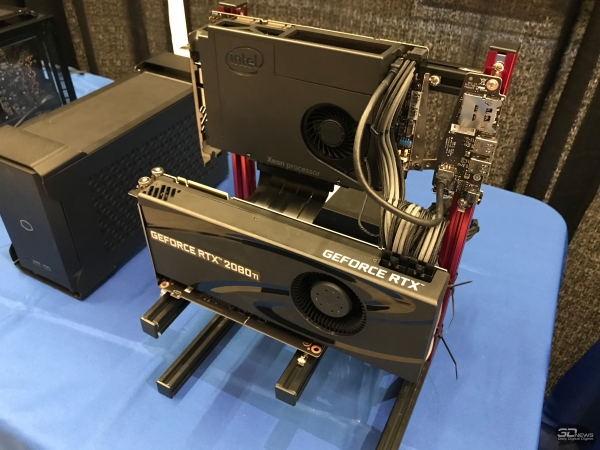
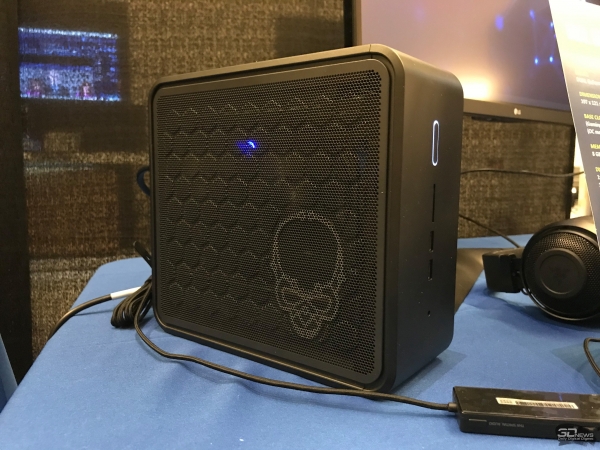
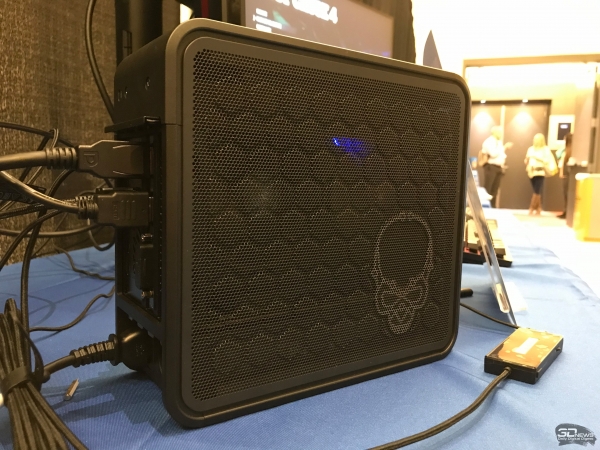
As part of the Ghost Canyon platform, Intel has taken upgrade possibilities more seriously. The new NUC 9 Extreme features a 5-liter barebone chassis with several I/O ports (USB, card reader) and a 500W FlexATX power supply. For all other components, the chassis offers four expansion slots. Half of them can accommodate a discrete video card — and it can be quite powerful, as long as the length fits within 8 inches — or two single-slot devices with 16 and 4 PCI Express lanes can be connected.
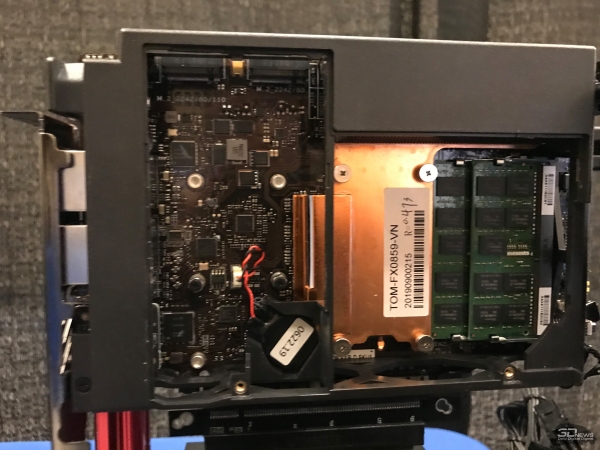
Where are the CPU, RAM modules, and storage located? Intel has assembled these components into what is known as the NUC Element—a cartridge reminiscent of a graphics card, featuring an edge PCI Express x16 connector. The photo shows what the components of the NUC 9 Extreme look like without the chassis (only the GeForce RTX 2080 Ti accelerator chosen for the setup is obviously oversized): in fact, the NUC Element is the entire system, which only lacks a power supply for full functionality. The chassis, the front connector board, and the passive riser, through which the PCI Express boards are connected, are all interchangeable variables in this construct. How Intel loves modular solutions, and it all began with the slot chips of the Pentium II…
 |  |
Inside the NUC Element is a central processor from the Core i5, i7, or i9 series—a L-shaped heatsink with a vapor chamber and an 80mm fan can handle any of Intel's laptop CPUs in a 45W thermal package, all the way up to the octa-core i9-9980HK. In the alternative version of the platform for commercial applications—the NUC 9 Pro or Quartz Canyon—there are even Xeon options. Unfortunately, the processor is soldered and cannot be replaced in any case, but this is the only specification that will need to be chosen in advance. DDR4 memory up to 32GB, two M.2 SSDs with NVMe support, and, of course, the user will buy and install their own graphics card. There are boards of the suitable size even based on the GeForce RTX 2080, but how well such powerful hardware is cooled in the tight confines of the NUC is still an open question. In particular, will the CPU overheat, given that its fan duct is blocked by the graphics card's PCB?
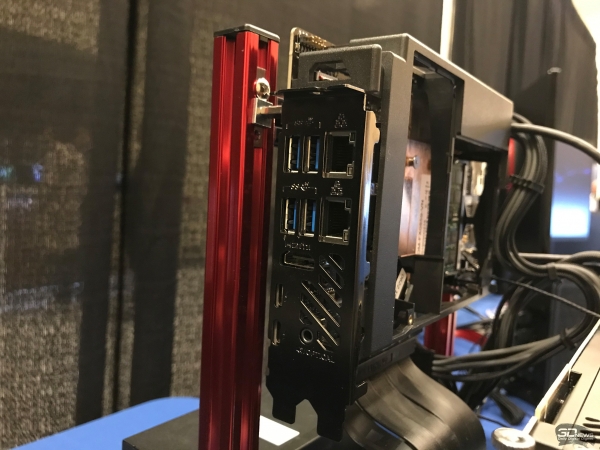
Disregarding the outputs of the discrete GPU and the ports on the front panel, the NUC Element itself boasts a rich set of external interfaces. The Wi-Fi 6 module is soldered directly to the motherboard, and the rear panel features four USB 3.1 Gen2 ports, two Thunderbolt 3, two Gigabit Ethernet, an HDMI output for integrated graphics, and a mini-jack for connecting the sound system (stereo over copper wire or 7.1 over optical). At the very least, as long as Intel supports the Ghost Canyon platform with CPU updates, the communication capabilities within it will also keep evolving.
 |  |
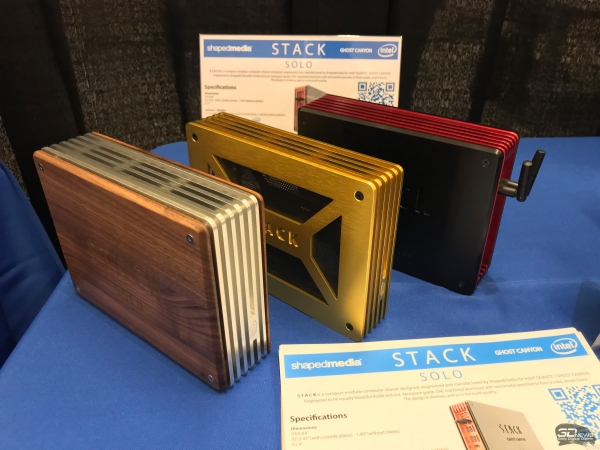
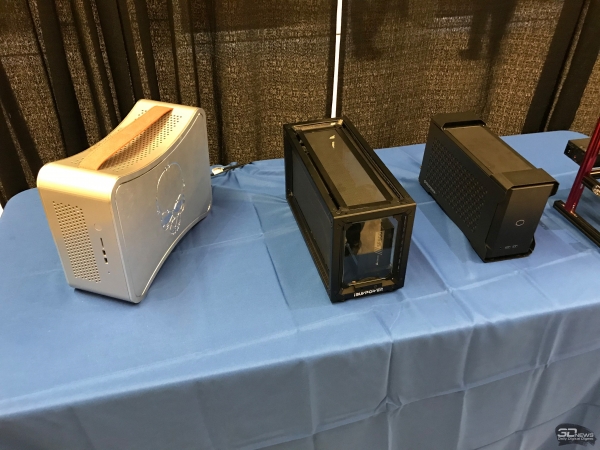
The manufacturer has planned the release of the next iterations of the NUC Element for the next two years, with commercial deliveries of the system starting in March 2020. The base configuration of the NUC 9 Extreme with a Core i5 processor will cost $1050, while versions with Core i7 and Core i9 will be priced at $1250 and $1700, respectively. The higher model comes with a sturdy carrying case—just add a screen with a keyboard, and it will be a powerful portable workstation. It is possible that one of Intel's partners will do just that: the chipmaker has retained the production of CPU cartridges and reference chassis, while third-party companies will establish their own chassis manufacturing. Among them will be compact products without slots for graphics cards and, conversely, spacious versions with enhanced power supplies, without restrictions on the size and power consumption of discrete accelerators.
 |  |
Source: 3dnews.ru
