

Google has introduced the second beta version of the open mobile platform Android 17. A beta testing program has been proposed to evaluate the new features of the platform. Firmware builds have been prepared for the Pixel 6/6a/6 Pro, Pixel 7/7a/7 Pro, Pixel 8/8a/8 Pro, Pixel 9/9a/9 Pro/9 Pro XL/9 Pro Fold, Pixel 10/10 Pro/10 Pro XL/10 Pro Fold, Pixel Fold, and Pixel Tablet. The release of Android 17 is scheduled for the second quarter of 2026.
Among the changes in Android 17 Beta 2:
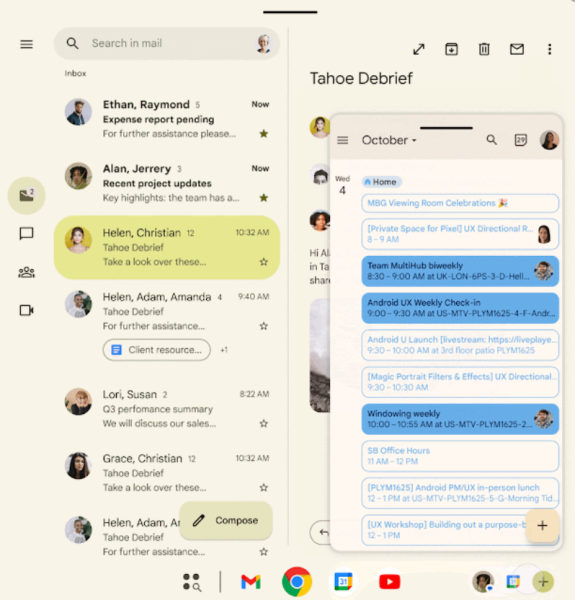
- A new multi-window mode called 'Bubbles' has been added, allowing any app to open in floating windows, similar to notifications for sending messages that appear over other content ('bubbles'), but not tied to a specialized API. Opening an app in a floating window is done by long-pressing the app icon. On larger screens, the floating window icons are displayed in a separate area on the taskbar. Such windows can be grouped, moved, and pinned to the screen.

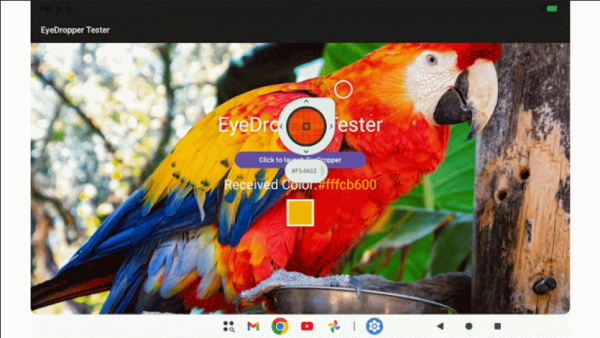
- A system API called EyeDropper API has been added, which allows applications to obtain color information from any pixel on the screen without the need for screen capture permissions. Security is ensured as the user selects the area for color determination through a platform-managed interface with a dropper that is not controllable by the application, meaning the application cannot request information about a specific pixel and cannot recreate the screen's content pixel by pixel.

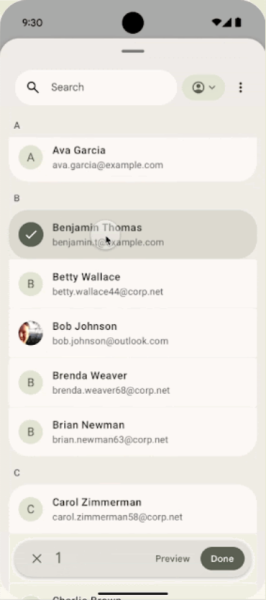
- A system interface for selecting contacts from the address book has been added, accessible with the ACTION_PICK_CONTACTS permission. This interface allows bypassing the READ_CONTACTS permission, which grants access to all contact information. When calling the new interface, the user decides which specific information to share from the address book, with the option to select only certain fields.

- To simplify the implementation of touchpad support in games, mouse and touchpad event handling has been unified—by default, touchpad events related to pointer movement and scroll gestures are now converted to a format with relative coordinates, as is done for a mouse. Access to absolute coordinates is provided when explicitly specifying the POINTER_CAPTURE_MODE_ABSOLUTE mode.
- The ChooserSession object has been updated with the method getInitialRestingBounds(), allowing users to find out the final position and size of the chooser dialog after the animation and data loading have completed.
- The Handoff API has been added, allowing the transfer of the application state to another nearby Android device (e.g., a tablet) to continue working there.
- Two new APIs have been added: the UWB DL-TDOA API for determining device positioning indoors using Wi-Fi for indoor navigation; and the Proximity Detection API for discovering nearby devices over Wi-Fi.
- Methods getStreamingAppMaxDownlinkKbps and getStreamingAppMaxUplinkKbps have been added to determine the maximum bandwidth of the communication channel for selecting the quality level during streaming.
- A new permission ACCESS_LOCAL_NETWORK has been added to restrict applications' access to the local network. This permission allows applications to discover and connect to devices on the local network, such as smart home devices and multimedia systems. The permission was added to prevent malicious applications from scanning resources on the local network, ensuring user environment confidentiality.
- Protection against interception of one-time passwords (OTP) and confirmation codes sent via SMS has been enhanced. Direct access to such messages is now available to most applications only three hours after receipt. In the default SMS reading application, these messages are displayed immediately.
Source: opennet.ru
