

Google has introduced the second beta version of the open mobile platform Android 14. The Android 14 release is expected in the third quarter of 2023. A beta testing program has been proposed to evaluate the platform's new capabilities. Firmware builds have been prepared for the Pixel 7/7 Pro, Pixel 6/6a/6 Pro, Pixel 5/5a 5G, and Pixel 4a (5G) devices.
Changes in Android 14 Developer Preview 2 compared to the first preview version:
- The platform's functionality on tablets and devices with foldable screens has been further enhanced. Libraries have been provided to predict events associated with pointer movement and to ensure low latency when working with styluses. Interface templates for larger screens have been introduced, accounting for uses such as social networking, communications, multimedia content, reading, and shopping.
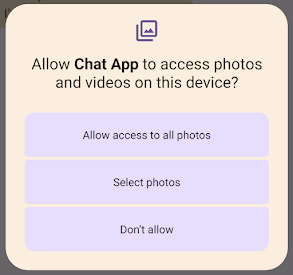
- In the confirmation dialog for application permissions to access multimedia files, it has become possible to grant access not to all files, but only to selected photos or videos.

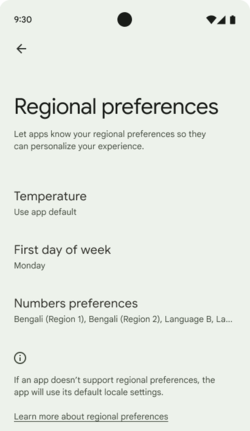
- A section for overriding regional preference settings has been added to the configurator, such as temperature measurement units, the first day of the week, and counting systems. For example, a European living in the USA can set it to display temperature in degrees Celsius instead of Fahrenheit and count Monday as the start of the week instead of Sunday.

- The development of the Credential Manager and its associated API, which allows applications to manage sign-ins using credentials from external authentication providers, has continued. It supports both password-based sign-ins and passwordless methods (Passkeys, biometric authentication). The interface for selecting accounts has been improved.
- A separate permission has been added to allow applications to initiate actions while the app is in the background. Activation while in the background is limited to prevent distracting the user when they are using the current application. Active applications have been given more control over the activation of actions by other applications with which they interact.
- Memory management system optimization has been conducted for more efficient resource allocation to applications running in the background. A few seconds after the application is transitioned to a cached state, background work is limited to handling APIs that manage the application lifecycle, such as Foreground Services, JobScheduler, and WorkManager APIs.
- Notifications marked with the FLAG_ONGOING_EVENT flag can now be dismissed when displayed on a device with an unlocked screen. If the device is in a locked state, such notifications will remain undismissable. Notifications that are critical for system operation will also remain undismissable.
- The PackageInstaller API has been enhanced with new methods: requestUserPreapproval(), which allows the app catalog to defer APK downloads until user installation approval is received; setRequestUpdateOwnership(), which allows the installer to claim future app update operations; and setDontKillApp(), which permits additional functionalities for the app while interacting with the program. Installers can now activate app update installations in the InstallConstraints API at moments when the app is not in use.
Source: opennet.ru
