

Google has introduced the second beta version of the open mobile platform Android 13. The release of Android 13 is expected in the third quarter of 2022. To assess the new capabilities of the platform, a developer preview program has been proposed. Firmware builds are prepared for Pixel 6/6 Pro, Pixel 5/5a 5G, and Pixel 4/4 XL/4a/4a (5G) devices. An OTA update is available for those who installed the first beta release.
At the same time, it has been reported that code with changes, presented days ago in the interim update of Android 12L, is being moved to the open AOSP (Android Open Source Project) repository and utilized in the Android 13 branch. This will be offered for tablets and foldable devices from Samsung, Lenovo, and Microsoft, originally shipped with firmware based on Android 12. The changes primarily aim to enhance performance on large-screen devices, such as tablets, Chromebooks, and smartphones with foldable screens.
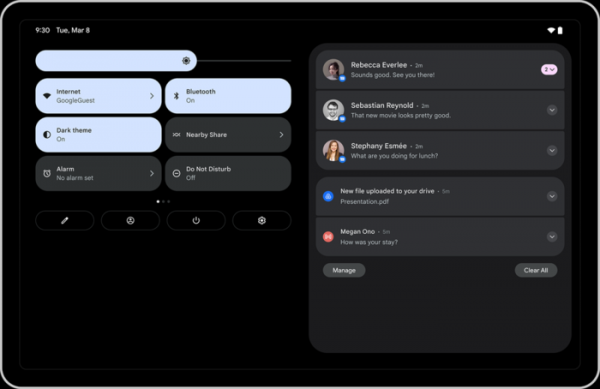
The layout of the notification shade, home screen, and system lock screen has been optimized for large screens, now utilizing all available screen space. The block that appears with a swipe gesture from the top down provides a separation into different columns for quick settings and the notification list on larger screens.
Support for a dual-panel mode has been added in the configurator, where sections of settings are now permanently visible on large screens.
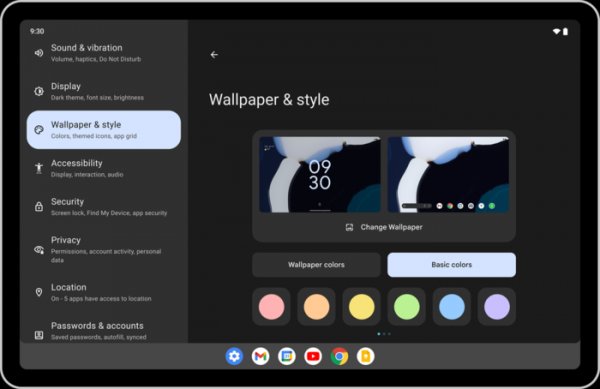
Compatibility modes for applications have been improved. A taskbar has been proposed, showing icons of running applications at the bottom of the screen, allowing quick switching between programs and supporting app transfer through a drag-and-drop interface in the split-screen multitasking mode, which divides the screen into parts for simultaneous work with multiple applications.
Other changes in Android 13 Developer Preview 2 compared to the first preview version:
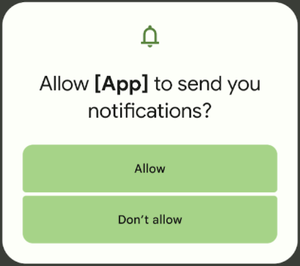
- The requirement for applications to request notification permissions has been implemented. To display notifications, an application must now have the "POST_NOTIFICATIONS" permission; otherwise, notification delivery will be blocked. For previously created applications designed for use with earlier versions of Android, permissions will be granted by the system on behalf of the user.

- An API has been added that allows the application to revoke previously granted permissions. For example, if the need for certain extended rights has disappeared in a new version, the application can revoke those rights in the interest of user privacy.
- The ability to register non-system broadcast receivers (BroadcastReceiver) in relation to their context of use has been provided. New flags, RECEIVER_EXPORTED and RECEIVER_NOT_EXPORTED, have been added to manage the export of such receivers, allowing the exclusion of their use for sending broadcast messages from other applications.
- Support for color vector fonts in COLRv1 format (a subset of OpenType fonts that includes color layer information along with vector glyphs) has been added. Additionally, a new set of multicolor emojis supplied in COLRv1 format has been introduced. This new format offers a compact storage form, supports gradients, overlays, and transformations, provides efficient compression, and allows for the reuse of outlines, significantly reducing font size. For instance, the Noto Color Emoji font in raster representation occupies 9MB, while in vector format COLRv1, it is only 1.85MB.

- Support for Bluetooth LE Audio (Low Energy) technology has been added, allowing for reduced energy consumption while transmitting high-quality audio streams over Bluetooth. Unlike classic Bluetooth, the new technology also enables switching between different usage modes to achieve an optimal balance between quality and energy consumption.
- Support for the MIDI 2.0 specification has been added, along with the ability to connect musical instruments and controllers that support MIDI 2.0 via USB port.

Source: opennet.ru
