

Collabora project release , aimed at creating an open implementation of the standard Monado provides a runtime that fully complies with OpenXR requirements, which can be used to manage virtual and augmented reality experiences on smartphones, tablets, PCs, and any other devices. The OpenXR standard was prepared by the Khronos consortium and defines a universal API for creating virtual and augmented reality applications, as well as a set of layers for interacting with hardware, abstracting the features of specific devices. The project's code is written in C and is under the Boost Software License 1.0, compatible with GPL.
Among the added improvements:
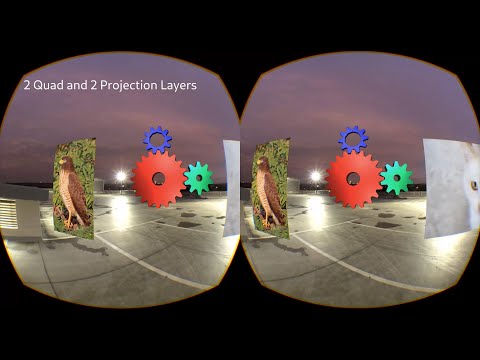
- The composite server now supports multi-layer rendering, allowing applications to place multiple structures and . Working with multiple layers is important for applications that use four layers to render user interfaces, and also serves as the foundation for further support for applications with an overlaid interface on the scene, such as or .

- The composite server and drivers have been moved to separate service processes. to provide the ability to connect multiple OpenXR applications to a single instance of the Monado service and visualize them simultaneously using the XR_EXTX_overlay extension.
- Support for Vive Wand and Valve Index controllers has been provided, allowing for motion control with three degrees of freedom (3DOF, movement in three directions). In the coming months, support for six degrees of freedom (6DOF, forward/backward, up/down, left/right, yaw, pitch, roll) is planned to be added using the tracking system .
- Support for Bluetooth LE has been added, which is utilized in the driver for the Google Daydream 3DOF Controller.
- An Arduino driver has been added for experiments in creating custom controllers;
- The open position tracking system driver .
- User-defined graphs have been added to the user debug interface, currently used to visualize the CPU load during rendering.
- The monado-gui now supports saving settings in the $XDG_CONFIG_HOME/monado and $HOME/.config/monado directories. The ability to configure USB interface stereo cameras for PSMV (PlayStation Move) and PSVR (PlayStation VR) has been added.
- The build system has been overhauled. Added for Ubuntu with Monado packages, OpenXR-SDK, and udev rules for xr-hardware.
- Support added for starting the monado-service via socket activation in systemd.
Platform Composition:
- Spatial awareness engine (object tracking, surface detection, mesh reconstruction, gesture recognition, eye tracking);
- Character tracking engine (gyrostabilizer, movement prediction, controllers, optical motion tracking via camera, position tracking based on data from the VR headset);
- Composite server (direct output mode, video pass-through, lens correction, compositing, workspace setup for simultaneous use of multiple applications);
- Interaction engine (simulation of physical processes, a set of widgets, and a toolkit for virtual reality applications);
- Toolset (hardware calibration, setup ).
Main Features:
- Driver for virtual reality headsets (OSVR Hacker Developer Kit) and
, as well as for PlayStation Move controllers and . - The ability to use , supported by the project .
- Driver for augmented reality glasses .
- Driver for the Intel RealSense T265 position tracking system.
- for configuring access to virtual reality devices without obtaining root privileges.
- Motion tracking components with a framework for filtering and streaming video.
- Character tracking system with six degrees of freedom (6DoF, forward/backward, up/down, left/right, yaw, pitch, roll) for PSVR and PS Move controllers.
- Modules for integration with graphic APIs Vulkan and OpenGL.
- Headless mode.
- Spatial interaction and viewpoint control.
- Basic support for frame synchronization and information (action) input.
- Ready composite server supporting direct output to the device, bypassing the system X server. Shaders for Vive and . Support for projection layers is available.
Source: opennet.ru
