

Simon Peter, the creator of the self-contained AppImage package format, has released version 0.8 of the helloSystem distribution, based on FreeBSD 13, positioned as a system for regular users, particularly appealing to macOS enthusiasts dissatisfied with Apple's policies. The system is free from the complexities characteristic of modern Linux distributions, is fully user-controlled, and offers a comfortable experience for former macOS users. A bootable image has been prepared for those interested, sized at 941 MB (torrent).
The interface resembles macOS and includes two panels—a top one with a global menu and a bottom one with an application panel. The global menu and status bar are powered by the panda-statusbar package, developed by the CyberOS distribution (formerly PandaOS). The Dock application panel is based on the cyber-dock project, also from the CyberOS developers. For file management and desktop shortcut placement, the Filer file manager is being developed, which is based on pcmanfm-qt from the LXQt project. The Falkon browser is offered by default, but Firefox and Chromium are also available optionally. Applications are provided in self-contained packages. The launch utility is used to run applications, which finds the program and analyzes execution errors.
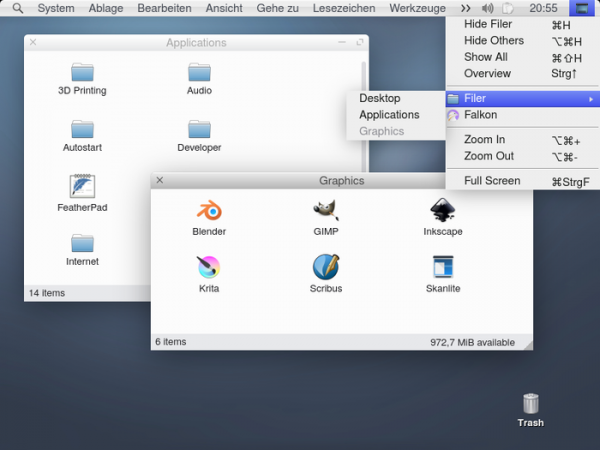
The project is developing a series of its own applications, such as a configurator, installer, mountarchive utility for mounting archives in the file system tree, a data recovery tool for ZFS, a disk splitting interface, a network setup indicator, a screenshot creation utility, a Zeroconf server browser, a volume control indicator, and a boot environment configuration utility. Python and the Qt library are used for development. Among the supported components for application development, listed in order of preference, are PyQt, QML, Qt, KDE Frameworks, and GTK. ZFS is used as the main file system, and UFS, exFAT, NTFS, EXT4, HFS+, XFS, and MTP are supported for mounting.
Key innovations in helloSystem 0.8:
- Transition to FreeBSD 13.1 code base has been completed.
- The launch command used for starting applications in self-contained packages has been adapted to utilize a database of installed applications (launch.db). Initial support has been added for launching AppImage files using the launch command (Debian runtime installation is required).
- VirtualBox extensions for guest systems have been included and activated, allowing clipboard sharing and screen size management when running helloSystem in VirtualBox.
- A prompt to select a language has been implemented, displayed if language information is not set in the EFI variable prev-lang:kbd or not obtained from the keyboard for Raspberry Pi. Keyboard settings are preserved in the EFI variable prev-lang:kbd.
- Support for connecting MIDI controllers has been implemented.
- The initgfx package has been updated, adding support for NVIDIA GeForce RTX 3070 GPU. The drm-510-kmod package has been utilized to support new Intel GPUs, such as TigerLake-LP GT2 (Iris Xe).
- The file manager now displays icons for AppImage, EPUB, and mp3 files. AppImage files are shown in the menu.
- The ability to copy files to the disk or trash has been added by dragging them to the disk or trash icon on the desktop. Support for opening documents by dragging them into an application has been provided.
- Search in the menu now works for submenus as well, with results displayed alongside icons and shortcuts. Local file system search from the menu has been supported.
- The menu now displays icons for active applications and allows for switching between them.
- An option has been added to the system menu for force closing applications.
- Automatic launch of the dock panel has been disabled (it needs to be started manually or through setting up a symbolic link in /Applications/Autostart).
- When attempting to launch an already active application, instead of starting another copy, the windows of the already running program are brought to the foreground.
- Support for the Trojitá email client has been added to the menu (it must be loaded before the first use).
- GPU acceleration has been enabled in browsers based on the WebEngine engine, such as Falkon.
- Double-clicking on document files (.docx, .stl, etc.) now allows for the loading of applications needed to open them, if they are not already installed on the system.
- A new utility for tracking running processes has been added.
Source: opennet.ru
