

the first stable release of the protocol for organizing decentralized communications and related libraries, APIs (Server-Server), and specifications. It is reported that not all envisioned features of Matrix are described and implemented, but the core protocol is fully stabilized and has reached a state suitable for use as a basis for developing independent implementations of clients, servers, bots, and gateways. Project developments under the Apache 2.0 license.
At the same time, a messaging server with the reference implementation It is noted that the main focus during the preparation of Synapse 1.0 was on the correctness of the protocol implementation, security, and reliability. Synapse has now exited the beta testing phase and is ready for widespread use. The Synapse code is written in Python and can use either SQLite or PostgreSQL as a database for storing data. Synapse 1.0 is the last release with support for Python 2.x.
By default, the creation of new chats uses of the Room protocol, but the version with support for server key expiration is also available. When transitioning from previous releases, it should be noted that a valid TLS certificate is now required to connect to the common decentralized network.
Clients that can be used include (available for Linux, Windows, macOS, Web, Android, and iOS), (CLI in Lua), (C++/Qt), (C++/Qt), and (Rust/GTK).
Among the still unverified features in Matrix 1.0 are the ability to edit sent messages (supported in Synapse 1.0 and Riot, but not enabled by default), reactions, threaded discussions, cross-user verification, live statistics on chats. Upcoming work on the server's implementation aims to optimize performance and reduce memory consumption. In addition to the reference server in Python, experimental implementations are also being developed (Rust) and (Go).
The Matrix platform for organizing decentralized communications is evolving as a project that utilizes open standards and places a strong emphasis on ensuring user security and privacy. Matrix offers end-to-end encryption based on its own protocol, which includes the Double Ratchet algorithm (part of the Signal protocol). End-to-end encryption is applied both for direct messaging and in chats (a mechanism is applied ). The implementation of encryption methods has been audited by NCC Group. HTTPS+JSON is used as the transport with the option of WebSockets or a protocol based on +.
The system is formed as a consortium of servers that can interact with each other and are united into a common decentralized network. Messages are replicated across all servers to which messaging participants are connected. Messages propagate across servers in a manner similar to how commits are distributed among Git repositories. In case of a temporary server outage, messages are not lost but delivered to users after the server resumes operation. Various options for user identifiers are supported, including email, phone number, Facebook account, etc.
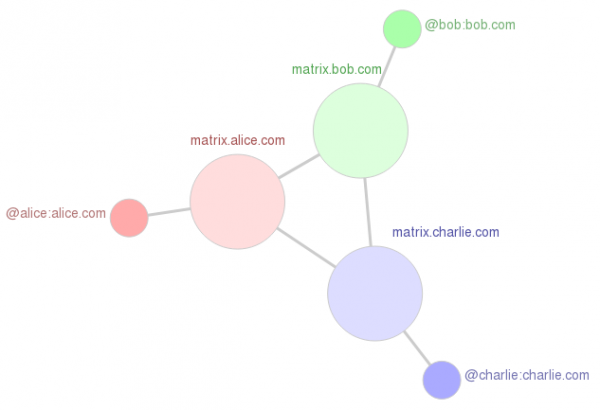
The network does not have a single point of failure or control over messages. All servers involved in the discussion are equal to each other.
Any user can launch their own server and connect it to the overall network. It is possible to create for integrating Matrix with systems based on other protocols, such as services for two-way messaging in IRC, Facebook, Telegram, Skype, Hangouts, Email, WhatsApp, and Slack.
In addition to instant text messaging and organizing chats, the system can be used for file transfers, sending notifications,
organizing teleconferences, making voice and video calls.
Matrix allows for search and unlimited viewing of chat history. It also supports advanced features such as typing notifications, user presence detection online, read receipts, push notifications, server-side search, synchronization of history and client state.
To coordinate the project's development, a non-profit organization has recently been established , which will ensure the independence of the project, develop standards related to Matrix, and act as a neutral platform for collaborative decision-making. The Matrix.org Foundation is governed by a board of five directors, independent of the commercial ecosystem, who are respected in the community and tasked with advocating for the project's mission.
The directors include John Crowcroft (, one of the pioneers of decentralized communications), Matthew Hodgson (Matthew Hodgson, co-founder of Matrix), Amandine Le Pape (Amandine Le Pape, co-founder of Matrix), Ross Schulman (Ross Schulman, a lawyer from the Open Technology Institute specializing in internet and decentralized systems), and Jutta Steiner (Jutta Steiner, co-founder of Parity Technologies, which focuses on blockchain-based technologies).
Source: opennet.ru
