

The release of Kali Linux 2021.4 distribution, designed for testing systems for vulnerabilities, conducting audits, analyzing residual information, and identifying the consequences of attacks by malicious actors, has been announced. All original developments created within the distribution are distributed under the GPL license and are available through a public Git repository. Several versions of ISO images are prepared for download, sized 466 MB, 3.1 GB, and 3.7 GB. Releases are available for i386, x86_64, and ARM architectures (armhf and armel, Raspberry Pi, Banana Pi, ARM Chromebook, Odroid). The default desktop is Xfce, but KDE, GNOME, MATE, LXDE, and Enlightenment e17 are supported optionally.
Kali includes one of the most comprehensive toolsets for computer security specialists: from tools for testing web applications and penetrating wireless networks to software for reading data from RFID identification chips. It comes with a collection of exploits and over 300 specialized utilities for security checks, such as Aircrack, Maltego, SAINT, Kismet, Bluebugger, Btcrack, Btscanner, Nmap, p0f. Additionally, the distribution includes tools for accelerating password cracking (Multihash CUDA Brute Forcer) and WPA keys (Pyrit) using CUDA and AMD Stream technology, allowing the utilization of NVIDIA and AMD GPUs for computational operations.
In the new release:
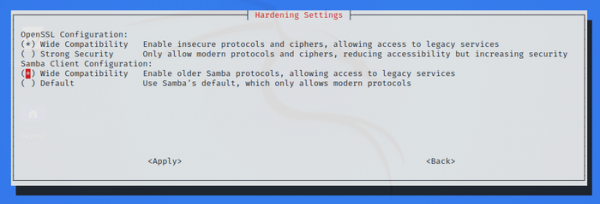
- The Samba client has been reconfigured to ensure compatibility with any Samba servers, regardless of the protocol variant selected on the server, simplifying the detection of vulnerable Samba servers in the network. The compatibility mode can be changed using the kali-tweaks utility.

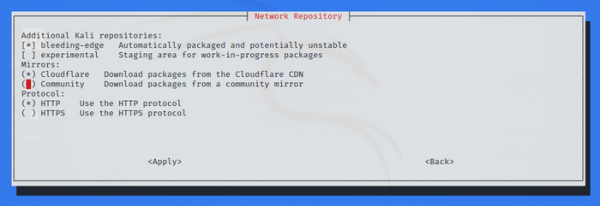
- In kali-tweaks, the mirror settings provide the ability to accelerate the delivery of updates using the CloudFlare content delivery network.

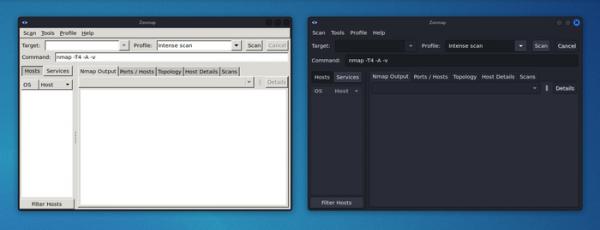
- The Kaboxer utilities now support theme and icon set changes, including the implementation of a dark theme.

- New utilities added:
- Dufflebag — search for sensitive information in EBS partitions;
- Maryam — open-source OSINT framework;
- Name-That-Hash — hash type identification;
- Proxmark3 — attacks on RFID tags using Proxmark3 devices;
- Reverse Proxy Grapher — build data flow diagrams through a reverse proxy;
- S3Scanner — scans unprotected S3 environments and outputs their content;
- Spraykatz — extraction of credentials from Windows systems and Active Directory-based environments;
- truffleHog — analysis of sensitive data in Git repositories;
- Web of trust grapher (wotmate) — implementation of PGP pathfinder.
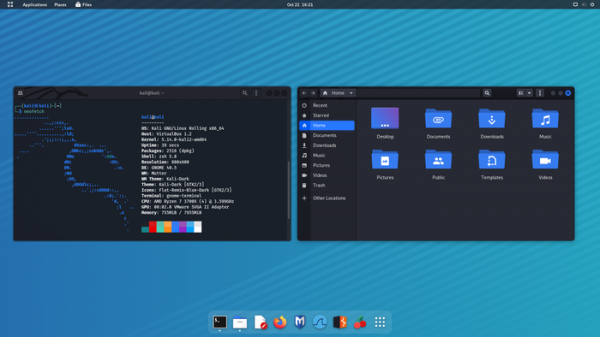
- Desktop versions of Xfce, GNOME 41, and KDE Plasma 5.23 have been updated, and the design of window control buttons has been unified across different desktops.

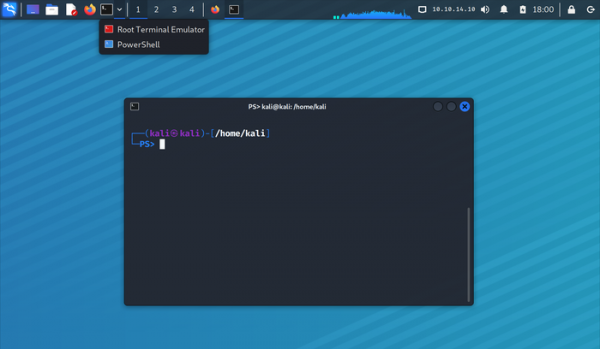
- In Xfce, the layout of items in the panel has been optimized to save horizontal screen space. Widgets for tracking CPU load and displaying parameters have been added to the panel. VPNA more compact mode has been implemented in the task manager, displaying only application icons. While reviewing content virtual desktops Instead of sketches, only button outputs are provided.

- Improved support for Apple systems based on the M1 ARM chip.
- In the ARM version, ext4 is now used by default for the root partition (instead of ext3), support has been added for the Raspberry Pi Zero 2 W board, and the ability to boot from USB drives has been added for Raspberry Pi boards; for the Pinebook Pro laptop, the CPU can now be overclocked to 2GHz.
- At the same time, the release of NetHunter 2021.4 has been prepared, an environment for mobile devices based on the Android platform with a collection of tools for testing systems for vulnerabilities. With NetHunter, it is possible to check for attacks specific to mobile devices, such as emulating USB device operation (BadUSB and HID Keyboard — emulating a network USB adapter that can be used for MITM attacks, or a USB keyboard that performs character substitution) and creating rogue access points (MANA Evil Access Point). NetHunter is installed in the standard Android environment as a chroot image, in which a specially adapted version of Kali Linux runs. The new version includes the Social-Engineer Toolkit and the Spear Phishing Email Attack module.
Source: opennet.ru
