

The release of Kali Linux 2022.1 is designed for testing systems for vulnerabilities, conducting audits, analyzing residual information, and identifying the consequences of attacks by malicious actors. All original developments created within this distribution are distributed under the GPL license and are available through a public Git repository. Several ISO image options prepared for download are sized at 471 MB, 2.8 GB, 3.5 GB, and 9.4 GB. Builds are available for i386, x86_64, and ARM architectures (armhf and armel, Raspberry Pi, Banana Pi, ARM Chromebook, Odroid). The default desktop is Xfce, but KDE, GNOME, MATE, LXDE, and Enlightenment e17 are also optionally supported.
Kali includes one of the most comprehensive toolsets for computer security specialists: from tools for testing web applications and penetrating wireless networks to software for reading data from RFID identification chips. It comes with a collection of exploits and over 300 specialized utilities for security checks, such as Aircrack, Maltego, SAINT, Kismet, Bluebugger, Btcrack, Btscanner, Nmap, p0f. Additionally, the distribution includes tools for accelerating password cracking (Multihash CUDA Brute Forcer) and WPA keys (Pyrit) using CUDA and AMD Stream technology, allowing the utilization of NVIDIA and AMD GPUs for computational operations.
In the new release:
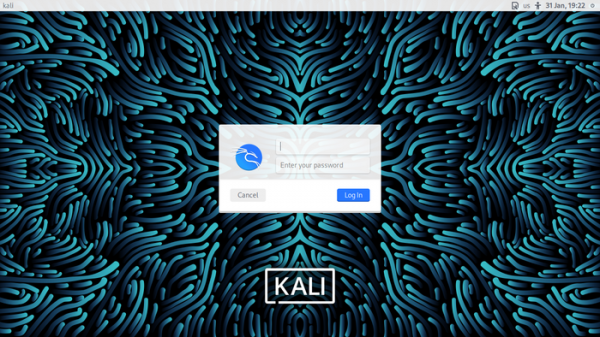
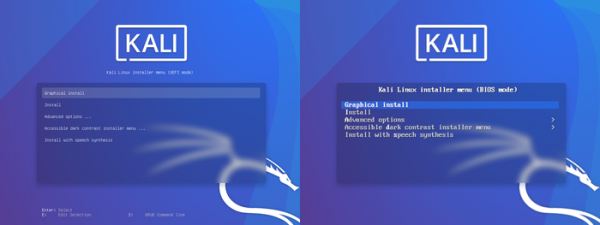
- The design of the boot process, login screen, and installer has been updated.

- The boot menu has been redesigned. Unified boot menu options for systems with UEFI and BIOS, as well as for different ISO image variants (installer, live, and netinstall).

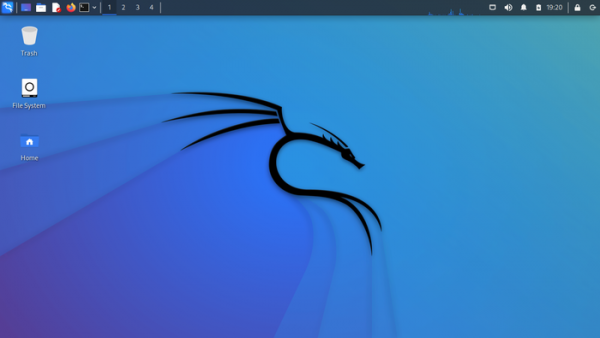
- New wallpapers featuring the distribution's branding have been introduced.

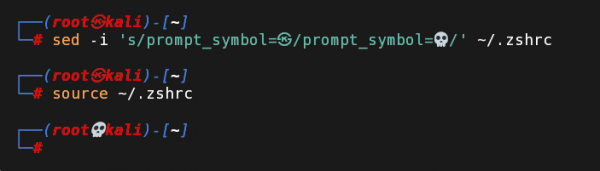
- The zsh command prompt has been modernized. By default, the display of exit codes and the number of background processes is hidden, which could interfere with usage. When using root privileges, the symbol ㉿ is used instead of 💀.

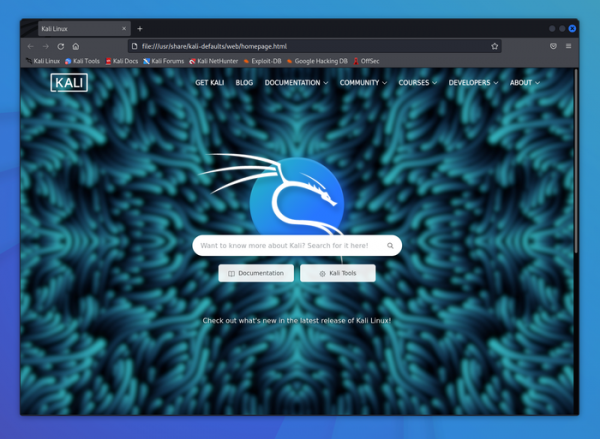
- The default page displayed in the browser has been revamped, adding links to documentation and tools, as well as implementing a search function.

- A complete 'kali-linux-everything' build has been added, including all available packages (except for Kaboxer) for a standalone installation on systems without network connectivity. The size of this build is 9.4 GB and it is available for download only via BitTorrent.
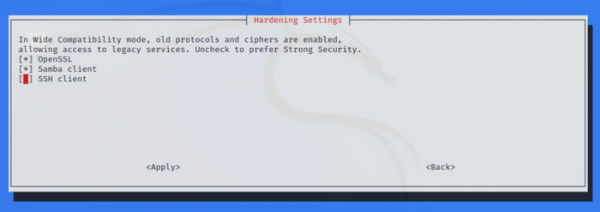
- A new 'Hardening' section has been proposed in the kali-tweaks utility, allowing adjustments to SSH client settings to enhance compatibility with older systems (restoring support for old algorithms and ciphers).

- Improved compatibility with VMware virtualization platforms when running Kali in a guest system using an i3-based desktop (kali-desktop-i3). In such environments, clipboard and drag-and-drop interface support is enabled by default.
- The speech synthesizer has been reinstated in the main composition to facilitate the work of visually impaired individuals.
- New utilities added:
- dnsx is a toolkit for working with DNS, allowing simultaneous queries to multiple DNS servers.
- email2phonenumber is an OSINT utility for determining a phone number from an email by analyzing user information available in open sources.
- naabu is a simple port scanning tool.
- nuclei is a network scanning system that supports templates.
- PoshC2 is a framework for managing Command & Control (C2), supporting proxy operations. servers proxify is a proxy for HTTP/HTTPS that enables traffic interception and manipulation.
- The ARM architecture builds now include the feroxbuster and ghidra packages. Bluetooth functionality issues have been resolved on Raspberry Pi boards.
- At the same time, the release of NetHunter 2022.1, an environment for mobile devices based on the Android platform with a set of tools for testing systems for vulnerabilities, has been prepared. With NetHunter, it is possible to check for mobile-specific attack implementations, such as emulating USB device operations (BadUSB and HID Keyboard – emulating a network USB adapter used for MITM attacks, or a USB keyboard performing character substitution) and creating fake access points (MANA Evil Access Point). NetHunter installs within the standard Android environment as a chroot image, running a specially adapted version of Kali Linux.
- The release of Zabbix 6.0 LTS monitoring system.
Source: opennet.ru
