

The release of the Kali Linux 2023.2 distribution has been introduced, based on the Debian package base and designed for testing systems for vulnerabilities, conducting audits, analyzing residual information, and identifying the consequences of attacks by malicious actors. All original developments created within the distribution are distributed under the GPL license and are available through a public Git repository. Several options for ISO images are prepared, with sizes of 443 MB, 2.8 GB, and 3.7 GB. Builds are available for i386, x86_64, ARM (armhf and armel, Raspberry Pi, Banana Pi, ARM Chromebook, Odroid) architectures. By default, the Xfce desktop is offered, but KDE, GNOME, MATE, LXDE, and Enlightenment e17 are supported optionally.
Kali includes one of the most comprehensive toolsets for computer security specialists: from tools for testing web applications and penetrating wireless networks to software for reading data from RFID identification chips. It comes with a collection of exploits and over 300 specialized utilities for security checks, such as Aircrack, Maltego, SAINT, Kismet, Bluebugger, Btcrack, Btscanner, Nmap, p0f. Additionally, the distribution includes tools for accelerating password cracking (Multihash CUDA Brute Forcer) and WPA keys (Pyrit) using CUDA and AMD Stream technology, allowing the utilization of NVIDIA and AMD GPUs for computational operations.
In the new release:
- A separate image of a virtual machine for the Hyper-V hypervisor has been prepared, pre-configured for using ESM (Enhanced Session Mode, xRDP over HvSocket) and capable of running immediately without additional setup.
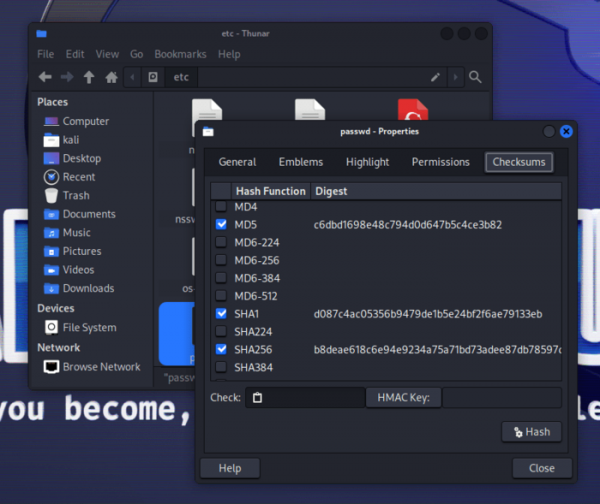
- The default build with the Xfce desktop has transitioned from the audio server PulseAudio to the multimedia server PipeWire (the GNOME build was switched to PipeWire earlier). server The base build with Xfce includes the GtkHash extension in the file manager, allowing for quick checksum calculations in the file properties dialog.
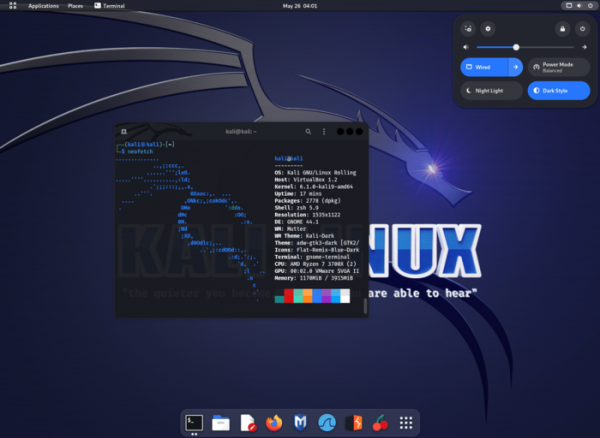
- The GNOME-based environment has been updated to release 44, continuing the translation of applications to use GTK 4 and the libadwaita library (the GNOME Shell user interface and the Mutter composite manager have been translated to GTK4, among other components). The file selection dialog now includes a mode to display content in a grid of icons. Numerous changes have been made to the configurator. A section for managing Bluetooth has been added to the quick settings menu.

- The GNOME-based variant includes the Tiling Assistant extension for working with windows in mosaic mode.

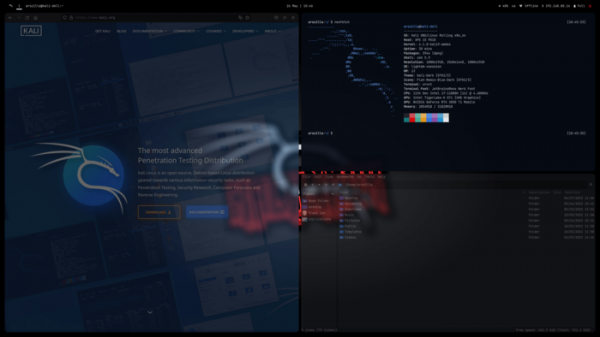
- The option with the mosaic window manager i3 (meta-package kali-desktop-i3) has been completely redesigned, achieving the appearance of a full-fledged user environment.
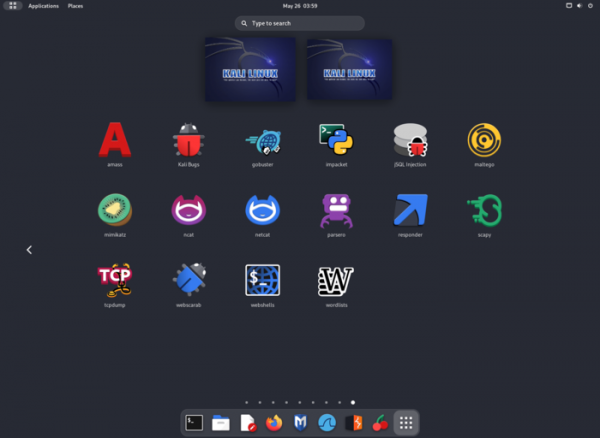
- Icons have been updated and the application menu has been restructured.

- New utilities included in the distribution:
- Cilium-cli — management of Kubernetes clusters.
- Cosign — creating digital signatures for containers.
- Eksctl — command-line interface for Amazon EKS.
- Eksctl — command-line interface for Amazon EKS.
- Evilginx — a MITM attack framework for capturing credentials, session cookies, and bypassing two-factor authentication.
- GoPhish — a phishing toolkit.
- Humble — a HTTP header analyzer.
- Slim — a container image packager.
- Syft — a Software Bill of Materials (SBoM) generator that identifies the software components included in a container image or present in the filesystem.
- Terraform — a platform for infrastructure management.
- Tetragon — an eBPF-based analyzer.
- TheHive — an incident response platform.
- Trivy — a tool for finding vulnerabilities and configuration issues in containers, repositories, and cloud environments.
- Wsgidav — a WebDAV server that uses WSGI.
- The mobile environment has been updated for Android-based platforms — NetHunter, with a set of tools for testing systems for vulnerabilities. With NetHunter, it is possible to perform attacks specific to mobile devices, such as emulating the work of USB devices (BadUSB and HID Keyboard — emulating a network USB adapter that can be used for MITM attacks, or a USB keyboard performing character substitution) and creating fake access points (MANA Evil Access Point). NetHunter is installed in the host environment of the Android platform in the form of a chroot image, where a specially adapted version of Kali Linux runs.
Source: opennet.ru
