

iXsystems has released the TrueNAS SCALE 22.12 distribution, which utilizes the Linux kernel and Debian package base (previously released products from this company, including TrueOS, PC-BSD, TrueNAS, and FreeNAS, were based on FreeBSD). Like TrueNAS CORE (FreeNAS), TrueNAS SCALE can be downloaded and used for free. The ISO image size is 1.6 GB. The source texts specific to TrueNAS SCALE build scripts, web interface, and layers have been published on GitHub.
TrueNAS CORE products based on FreeBSD and TrueNAS SCALE based on Linux are developed in parallel and complement each other, utilizing a shared codebase and a typical web interface. The provision of an additional edition based on the Linux kernel stems from the desire to implement some ideas that are unattainable when using FreeBSD. Notably, this is not the first such initiative—back in 2009, the FreeNAS distribution already branched off into OpenMediaVault, which was transitioned to the Linux kernel and Debian package base.
One of the key improvements in TrueNAS SCALE is the ability to create storage that spans multiple nodes, while TrueNAS CORE (FreeNAS) is positioned as a single-server solution. In addition to increased scalability, TrueNAS SCALE also features the use of isolated containers, simplification for infrastructure management and suitability for creating software-defined infrastructures. The ZFS (OpenZFS) file system is used in TrueNAS SCALE. TrueNAS SCALE provides support for Docker containers, KVM-based virtualization, and ZFS scaling across multiple nodes using the distributed file system Gluster.
To organize access to storage, SMB, NFS, iSCSI Block Storage, S3 Object API, and Cloud Sync are supported. For secure access, connections can be made via VPN (OpenVPN). Storage can be deployed on a single node and then gradually horizontally scaled by adding additional nodes as needs grow. In addition to handling storage management tasks, nodes can also be used to provide services and run applications in containers orchestrated by the Kubernetes platform or in KVM-based virtual machines.
In the new version:
- Improved implementation of the root-less mode, where less privileged users are used instead of root to manage the system, selectively delegated extended rights and lacking access to all virtual machines and isolated applications.
- Added SMB Share Proxy mechanism to redirect access to SMB shares.
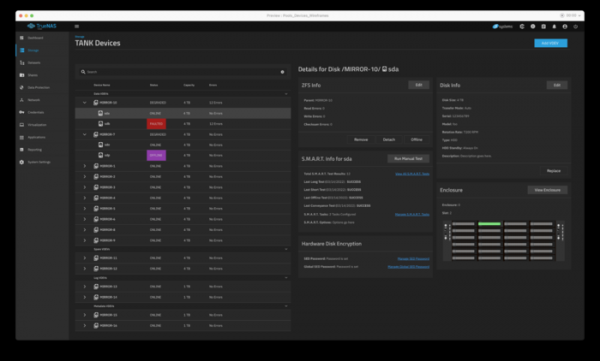
- Enhancements have been made to the web interface. Management of storage pools, devices, and datasets has been significantly improved. A summary page has been implemented showing all statistics.
- Isolated applications have been added for running Home Assistant, Qbittorrent, Pi Hole, Syncthing, Photo Prism, and diskover-community packages.
- Added the ability to update all applications installed in container form at once.
- Support for the All-NVME platform has been added, providing bandwidth of up to 30GB/s and the ability to create an NVMe storage pool of up to 240 TB.
- The option to replace Gluster nodes via API without stopping the storage service has been provided.
- A driver for Kubernetes CSI has been added, allowing TrueNAS SCALE to be used in Kubernetes clusters as cluster data storage. Similar capability is also available for VMware ESXi and OpenStack Cinder.
- Support for using OverlayFS with ZFS has been added to save disk space when running Docker containers.
- Virtualization support has been improved, providing the ability to pass USB devices to virtual machines and bind individual CPU cores.
- Organized access for isolated applications to the GPU has been ensured.
- Support for remote access to the system and applications via Wireguard VPN has been added.
- Work has been done to increase performance, including improved encryption, NFS, and iSCSI performance.
- The ability to selectively grant access to the API and apply a role-based access control (RBAC) system has been provided.
Source: opennet.ru
