

Release of the Ubuntu 19.10 distribution 'Eoan Ermine'. Ready images have been created for , , , , Ubuntu
Budgie, , and UbuntuKylin (China edition).
Key :
- The GNOME desktop has been updated to the release supporting the grouping of application icons in overview mode, an improved wireless connection configurator, a new desktop wallpaper selection panel, and efforts to enhance interface responsiveness while reducing CPU load. Instead of the previously offered dark-themed default design a light theme closely resembling the standard appearance of GNOME.
As an option, a completely dark theme has been proposed, which uses a dark background within windows. The GNOME Tweaks tool can be used to switch themes;
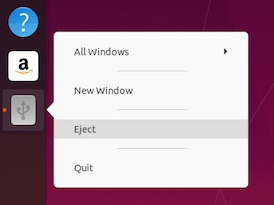
- The ability to access connected USB storage devices directly from the panel has been added. Icons corresponding to connected drives are now displayed on the panel, allowing users to open their contents in the file manager or safely unmount the drive for device ejection;

- The default option for organizing access to multimedia data using the DLNA protocol has been enabled. For example, a user can share a video collection for viewing on a SmartTV;
- In the Wayland-based environment, the capability to run X11 applications with root privileges under Xwayland has been provided;
- Support for wireless network protection technology has been added. ;
- previously the kernel 4.12 was offered). A kernel-preempt option with Real-Time patches is provided for real-time systems. To compress the Linux kernel and the initial initramfs boot image the LZ4 algorithm, which will reduce boot time due to faster data unpacking. The kernel package proposed in Ubuntu 19.10 still contains an unpatched vulnerability in the IPv6 stack, allowing a non-privileged local attacker to crash the kernel.
- The toolkit has been updated to glibc 2.30, GCC 9.2, OpenJDK 11, rustc 1.37, Python 3.7.5, ruby 2.5.5, php 7.3.8, perl 5.28.1, go 1.12.10. Packages for MySQL 8.0 have been added;
- The LibreOffice office suite has been updated to the release . The PulseAudio sound server has been updated to the release . Updated QEMU 4.0, libvirt 5.6, dpdk 18.11.2, Open vSwitch 2.12, cloud-init 19.2;
- Improved support for cross-compilation — tools for POWER and AArch64 architectures now support cross-compilation for ARM, S390X, and RISCV64 platforms;
- All packages have been rebuilt with GCC using the '-fstack-clash-protection' option, which causes the compiler to insert probe checks at each static or dynamic allocation of stack space, allowing the detection of stack overflow incidents and blocking attack methods based on stack and heap intersection related to the execution flow being passed through stack guard pages. The build also includes Control Flow Integrity (CFI) protection techniques, which help identify certain forms of undefined behavior that could potentially disrupt the normal control flow due to the execution of exploits.
- For systems with Intel GPUs, a flicker-free boot mode is provided when switching video modes.
- The installation ISO images include, by agreement with NVIDIA, packages with proprietary NVIDIA drivers. For systems with NVIDIA graphics chips, open-source 'Nouveau' drivers continue to be offered by default, while proprietary drivers are available as an option for quick installation after the installation completes. The distribution has also improved startup stability when using the proprietary NVIDIA driver and optimized performance and rendering quality on systems with NVIDIA graphics cards.
- the delivery of deb packages with the Chromium browser, which are now replaced only by self-contained images in snap format.
- In the repository the distribution of packages for the 32-bit x86 architecture. A separate set of 32-bit packages will be built and supplied for running 32-bit applications in a 64-bit environment, including components necessary for the continued operation of legacy programs that remain only in 32-bit format or require 32-bit libraries.
- In the installer experimental installations on the root partition with ZFS. Support for creating and partitioning ZFS has been added to the installer. A new daemon is being developed for managing ZFS, , allowing multiple parallel systems with ZFS to run on a single computer, automating snapshot creation and managing the separation of system and user session changing data. The main idea is that different snapshots can contain different system states, allowing you to switch between them. For instance, if issues arise after installing updates, you can revert to an older stable state by selecting a previous snapshot. Snapshots can also be used for transparent automatic backups of user data.
- Builds for Raspberry Pi 4 have been added, complementing those for Raspberry Pi 2, Pi 3B, Pi 3B+, CM3, and CM3+.
- In a desktop is proposed, , a set of applications and the Qt 5.12.4 framework. Updated versions of latte-dock 0.9.2,
Elisa 0.4.2, Kdenlive 19.08.1, Yakuake 19.08.1, Krita 4.2.7,
Kdevelop 5.4.2, Ktorrent. Testing of the Wayland-based session continues (after installing the plasma-workspace-wayland package, an optional 'Plasma (Wayland)' entry appears on the login screen); - In a new desktop release has been proposed . Instead of Light Locker for screen locking, the Xfce Screensaver is used, providing integration with Xfce Power Manager and improved support for sleep and standby modes;
- In new applets have been added: Window Previews (replacement for task manager (Alt+Tab)), QuickChar (character map viewer), FuzzyClock, Workspace Stopwatch (timer), and Budgie Brightness Controller (screen brightness management). Integration with GNOME 3.34 has been improved.
- In work has been done to fix issues and improve interface quality. The MATE desktop has been updated to release . A new notification indicator has been added, supporting 'do not disturb' functionality. The default mail client has been switched from Thunderbird to Evolution, and from VLC to (formerly GNOME MPV). Qt4 and the CD/DVD burning program Brasero have been removed from the base package. Proprietary NVIDIA drivers and a localization package for the Russian language have been included in the installation image;
- In a package for organizing video streaming has been added and a session manager for managing audio processing programs.
Ubuntu Studio Controls has added several layers for PulseAudio, implemented a Jack launch indicator, and added the option to select a backend for Jack (Firewire, ALSA, or Dummy).
Updated component versions: Blender 2.80,
KDEnlive 19.08,
Krita 4.2.6,
GIMP 2.10.8,
qJackCtl 0.5.0,
Ardour 5.12.0,
Scribus 1.4.8,
Darktable 2.6.0,
Pitivi 0.999,
Inkscape 0.92.4,
Carla 2.0.0,
Ubuntu Studio Controls 1.11.3, - In only bug fixes marked.
Source: opennet.ru
