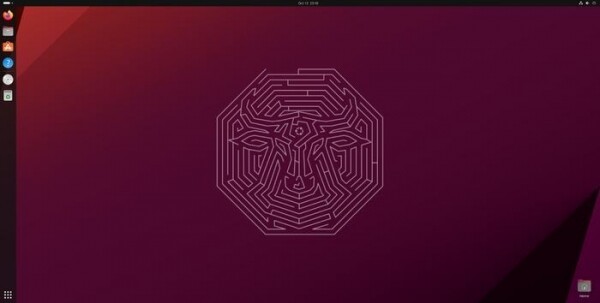
The release of the Ubuntu 23.10 "Mantic Minotaur" distribution has been published, which is classified as an interim release with updates scheduled for the next 9 months (support will continue until July 2024). Installation images have been created for Ubuntu, Ubuntu Server, Lubuntu, Kubuntu, Ubuntu Mate, Ubuntu Budgie, Ubuntu Studio, Xubuntu, UbuntuKylin (the edition for China), Ubuntu Unity, Edubuntu, and Ubuntu Cinnamon.
Key Changes:
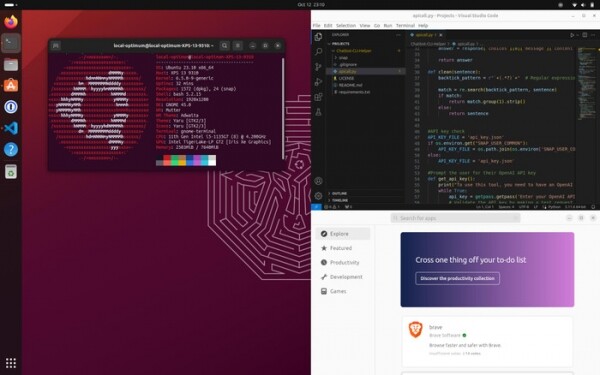
- The desktop has been updated to GNOME 45, which features a dynamic indicator in the panel, virtual desktops, improved search system performance, added a camera on/off indicator, utilized hardware acceleration for video playback, replaced the image viewer and camera application, modified the style of sidebar displays, and updated to GTK 4.12 and libadwaita 1.4. Notably for Ubuntu, the delivery now includes the GNOME Clocks application.

- Included is an extension for GNOME Shell — Tiling Assistant, enhancing tiled interface features, and among other abilities, supporting layouts dividing the screen into 4 sections.

- The Linux kernel has been updated to version 6.5. Specifically for Ubuntu, the kernel package now features module compression using the zstd algorithm, which has reduced boot time. The kernel package has been updated with fresh sets of patches for shiftfs, Apparmor, and LSM. By default, the MGLRU (Multi-Generational LRU) mechanism is enabled, replacing the old implementation of LRU (Least Recently Used) based on two queues with a multi-tier structure, which better identifies which memory pages are actively used and which can be swapped out. Kernel settings have been optimized to reduce delays in desktop-oriented tasks. The ZFS implementation has been updated to version 2.2.0~rc3. In the Ceph file system, support for mapping user IDs during mounting has been transferred.
- Versions of GCC 13.2.0, binutils 2.41, glibc 2.38, systemd 253.5, Python 3.11.5 (Python 3.12.0-rc2 is also available in the repository), Perl 5.36.0, LLVM 16 (LLVM 17 is also available in the repository), Rust 1.71, OpenJDK 21 (OpenJDK 17 is also retained), .NET 7.0.110, Go 1.21 have been updated.
- Subsystems have been updated: Mesa 23.1.7, BlueZ 5.68, NetworkManager 1.44, Pipewire 0.3.79, Poppler 23.08, xdg-desktop-portal 1.17.2, CUPS 2.4.6, PulseAudio 16.1, Snapd 2.60.3.
- Updated user applications include Firefox 117, LibreOffice 7.6, Thunderbird 115.2, GIMP 2.10.34, Rhythmbox 3.4.7, Blender 3.6.2, Krita v5.1.5, Scribus 1.5.8, Darktable 4.2.1, Inkscape 1.2.2, OBS Studio 29.1.3.
- Server packages updated: Nginx 1.24, Apache httpd 2.4.57, Django 4.2, Dovecot 2.3.20, Spamassassin 4 (with DMARC support), Docker n 24.0.5, Containerd 1.7.2, Runc 1.1.7.
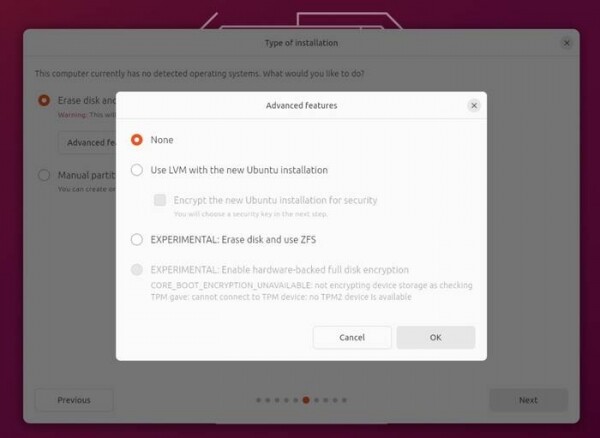
- Experimental support for disk encryption added, allowing for disk unlock without entering a password at boot by storing key decryption information in the TPM (Trusted Platform Module).
- For installing Ubuntu Desktop, the new installer defaults to "minimal" mode. An option for an expanded installation mode is available to install additional applications such as LibreOffice and Thunderbird.
- The installer has restored support for the ZFS filesystem.

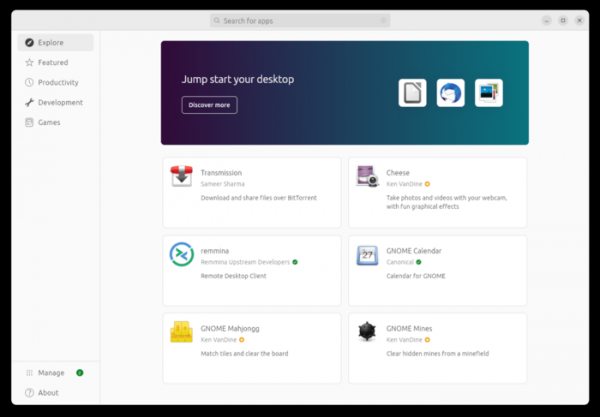
- A new application manager, Ubuntu Store, written in Dart using the Flutter framework and responsive interface design methods for proper operation on screens of any size, has been introduced. Ubuntu Store integrates a combined interface for working with DEB and Snap packages (when both package types are available, Snap is selected by default), allows searching and browsing the Snapcraft.io package catalog and connected DEB repositories, and provides management for installing, removing, and updating applications, as well as installing individual deb packages from local files. The application features a new rating system, where the traditional five-star rating scale is replaced with a like/dislike voting system (+1/-1), based on which a virtual five-star rating is generated. The old Ubuntu Software application manager remains available as an option.

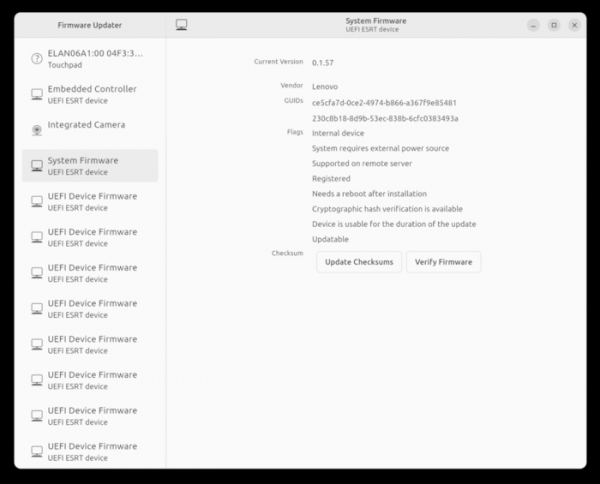
- A new Firmware Updater application has been added, allowing firmware updates to be installed without running a background update management service.

- The package fonts-ubuntu-classic has been added, offering a set of classic fonts used in Ubuntu prior to the 23.04 release.
- Support for hardware-accelerated video encoding and decoding has been implemented in the snap package for the Chromium browser.
- Expanded privacy management tools — a mechanism has been added that requests user permissions when applications require additional rights (for example, to access certain files).
- Improved security for managing PPA repositories. The add-apt-repository utility now adds all PPA repository data to .sources files in deb822 format, instead of separately adding .list files to /etc/apt/sources.list.d/ and gpg keys to /etc/apt/trusted.gpg.d.
- In Ubuntu Desktop, the Netplan system, already used in Ubuntu Server, is employed for storing network interface settings. During system updates, the migration of NetworkManager settings and profiles (from /etc/NetworkManager/system-connections/ to /etc/netplan/90-NM-*.yaml) is performed automatically (a copy of the old settings and profiles is saved in /etc/netplan/01-network-manager-all.yaml.dpkg-backup and /var/lib/NetworkManager/backups/). The configuration file /etc/netplan/01-network-manager-all.yaml has been moved to /lib/netplan/00-network-manager-all.yaml, as it is no longer recommended to modify it manually.
- The Active Directory Certificate Auto Enrollment (ADSys) mechanism has been enabled, allowing automatic retrieval of certificates from Active Directory services when group policies are enabled. Automatic certificate retrieval through Active Directory is also applied when connecting to corporate wireless networks. VPN.
- Official support for camera modules, including some with autofocus, has been added in builds for Raspberry Pi boards. The libcamera library has been updated to version 0.1. The cloud-init settings have been modified to disable password authentication by default in the SSH server.
- Support for the Raspberry Pi 5 and SiFive HiFive Pro P550 boards has been added.
- Access to user namespace is now granted only to programs for which a special AppArmor profile has been added (for example, a profile /etc/apparmor.d/opt.google.chrome.chrome has been created for Chrome, which can be used as a template for granting access to user namespace for other programs). This change will enhance the security of systems using container isolation against vulnerabilities that require access to the user namespace.
- The Ubuntu Core Desktop edition is evolving, based on the Ubuntu Core platform and including only applications packaged using the Snap format.
- Kubuntu features the KDE Plasma 5.27.8 desktop and the KDE Gear 23.08.1 application set.
- Ubuntu Cinnamon utilizes the Cinnamon 5.8.4 desktop environment.
- Xubuntu has updated its environment to Xfce 4.18, featuring new versions of Mousepad 0.6.1, Ristretto 0.13.1, Xfce Power Manager 4.18.2, Xfce Screensaver 4.18.2, Xfce PulseAudio Plugin 0.4.7, Xfce Screenshooter 1.10.4, elementary-xfce 0.18, Greybird 3.23.3, GNOME Disk Usage Analyzer (baobab), GNOME Fonts (gnome-font-viewer), and GNOME Document Scanner (simple-scan). Some Xfce components now have improved interface scaling support. Color emoji have been included, and there’s enhanced support for Bluetooth audio devices. New touch input devices, such as the Apple Magic Trackpad, are now supported.
- Ubuntu Studio has updated to Carla 2.5.6, Audacity 3.3.3, Ardour 7.5.0, Patchance 1.1.0, digiKam 8.1.0, OBS Studio 29.1.3, Blender 3.6.2, KDEnlive 23.08.1, and Freeshow 0.9.7, along with Q Light Controller Plus 4.12.7.
- Ubuntu MATE employs MATE Desktop 1.26.3, with the MATE Panel updated to version 1.27, now featuring additional patches.
- Lubuntu now offers the LXQt 1.3 desktop environment by default.
- Ubuntu Budgie has upgraded its Budgie desktop to version 10.8. A new applet for the trash can has been added, along with support for Magpie, a fork of Mutter. The authentication dialog, displayed when elevated permissions are required, has been improved. A performance profile selection feature (energy saving, balanced power consumption, and maximum performance) has been implemented.
Source: opennet.ru