

The release of the modular operating system Embox 0.7 has been published, aimed at isolated execution on hardware for applications originally created for Linux, but without using Linux. The system can operate in real-time mode (RTOS) on various classes of devices, from standard x86 systems to low-power boards and microcontrollers. The project code is written in C and distributed under the BSD license.
The Embox kernel is divided into a series of libraries that implement various application interfaces (memory management, task scheduler, network stack, etc.). Thanks to its modularity, Embox allows for the use of a minimal set of system components and libraries necessary to run a specific application. A self-sufficient image is created for each application, optimized for a specific task and capable of running on hardware without unnecessary layers and without the use of generic kernels and system environments.
Such a configuration allows existing applications to run with minimal overhead on resource-constrained devices. Embox also provides an additional level of protection—applications are linked to libraries statically, and besides the initially supplied application, no other programs can be executed in the formed environment.
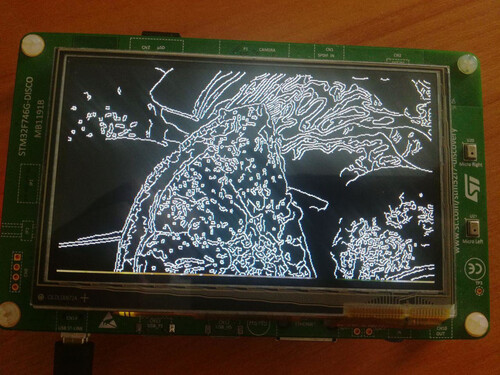
Examples of Embox applications include the creation of a VoIP phone based on the STM32F7 microcontroller and the PJSIP library, launching a graphical interface based on Qt on the STM32F7 microcontroller, executing a visual information processing application using OpenCV on the STM32F769i board, isolated execution of the Dropbear SSH server, launching the Quake3 game, and graphical applications using Mesa.
Key features of Embox:
- Support for processor architectures x86, ARM, RISC-V, Microblaze, SPARC, E2K, PowerPC, and MIPS.
- Support for operation on STM32 microcontrollers and the ability to run programs using Qt, OpenCV, PJSIP, and other popular frameworks.
- Support for boards similar to Raspberry Pi.
- Support for creating environments to run applications in C++, Java, Python, Lua, TCL, Lisp, Ruby, JavaScript, and Scheme.
- POSIX compliance.
- Ability to use FAT and ext2/3/4 file systems.
- TCP/IP stack with support for sockets and standard network protocols (UDP, HTTP, ARP, NTP, ICMP).
- Availability of Unix-like utilities such as ls, cat, and mount.
Among the changes in the new release:
- A subsystem for wireless access has been implemented.
- A subsystem for management via AT commands has been implemented.
- Improved support for the RISC-V architecture. Added support for Milandr MDR1206FI, Baikal-Electronics Baikal-U, and Syntacore SCR-5 platforms.
- Support for MIPS64 processor KOMDIV-64 has been added.
- The build system has been modernized.
- Support for the machine learning platform TensorFlow Lite has been added.
- Support for the Ardupilot framework with autopilot implementation has been added.
- Support for the WebSocket protocol has been added.
- Improvements to SPI, I2C, and MMC subsystems.
Source: opennet.ru
