

The Live distribution grml 2024.12 has been released, offering a collection of tools for tasks commonly encountered in the practice of system administrators (data recovery after a crash, incident analysis, etc.), as well as for processing text data using the texttools package. The distribution is based on the Debian GNU/Linux package base and celebrated its 20th anniversary at the end of October. The graphical environment is built using the Fluxbox window manager. By default, the Zsh shell is offered. The full ISO image size is 917 MB, with a reduced version of 498 MB.
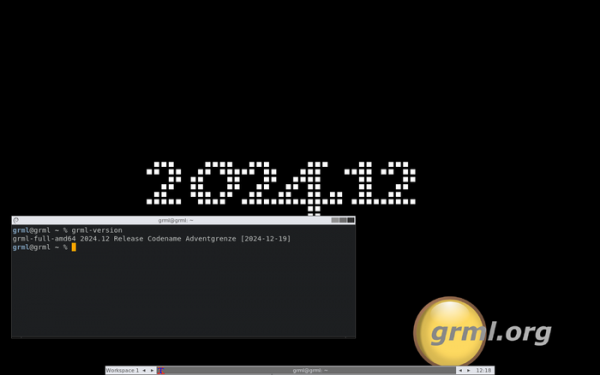
In the new release:
- The formation of builds for ARM64 architecture systems has begun.
- The publication of builds for 32-bit x86 systems has been discontinued.
- Support for booting on systems with 32-bit UEFI has been added to the x86_64 builds.
- Packages have been synchronized with the Debian Testing repository as of December 19. The Linux kernel has been updated to release 6.11.
- The grml-paste script has been updated to use the paste.debian.net service.
- The cpu-screen utility has been rewritten from C to Perl.
- Automatic bootloader selection has been added to the grml2usb utility.
- The project's Git repository and wiki have been moved to GitHub.
- Release building tools have been redesigned.
- The grml-hwinfo utility has been updated to parse output in JSON format when calling programs losetup, findmnt, lscpu, and lsblk. Information about NVMe drives and the ZFS file system has been added.
- Included packages are dracut-install, grub-efi-amd64-unsigned, linux-sysctl-defaults, login.defs, openssh-client-ssh1, openssl-provider-legacy, and scdaemon.
- The base installation has removed packages eborphan, genisoimage, gnupg-utils, gpg-wks-client, gpg-wks-server, haveged, hfsutils, isc-dhcp-client, lrzsz, mksh, policykit-1, reiser4progs, reiserfsprogs, systemd-dev, tdb-tools, uml-utilities, and usr-is-merged.
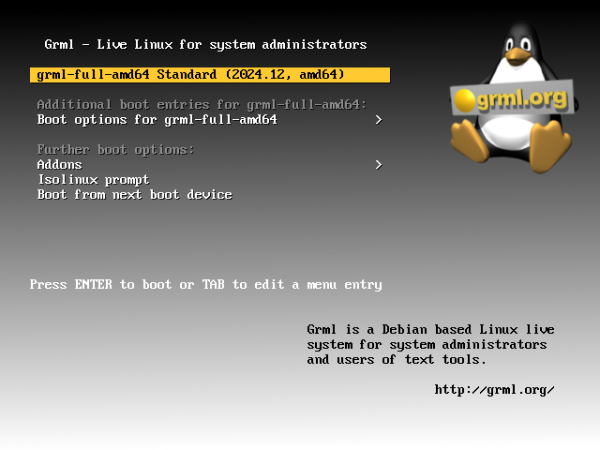
- The splash screen in the GRUB bootloader has been updated.
Source: opennet.ru
