

The release of kafkalet 0.1 has been published, a desktop graphical client for working with Apache Kafka. The application comes as a self-contained binary file of about 15 MB, requiring no installation of JVM, Docker, or launching of server components. The project code is written in Go and TypeScript and is distributed under the MIT license. Builds are prepared for macOS (Intel and Apple Silicon), Windows, and Linux.
Unlike existing web-oriented tools such as Kafka UI and AKHQ, which require deploying a server process in Docker, kafkalet operates as a regular desktop application — similar to DBeaver or DataGrip for databases. The only desktop Kafka client so far has been Offset Explorer (formerly Kafka Tool), written in Java and no longer updated. The kafkalet application is built using the Wails v2 framework, which combines a Go backend with a web interface based on React 18, TypeScript, and shadcn/ui into a single native binary file. For interaction with Kafka, the franz-go library is used, implemented in pure Go without dependencies on librdkafka and CGO.
Main Features:
- A profile system for managing multiple environments (production, staging, dev). Each broker in the profile can have several named accounts with the ability to quickly switch between them. Passwords and tokens are stored exclusively in the OS's system secret storage (macOS Keychain, Windows Credential Manager, libsecret on Linux) and are not written to configuration files.
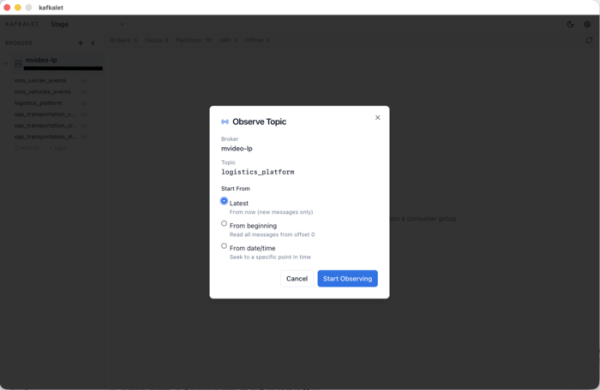
- Observer mode — reading messages from a topic without connecting to a consumer group, without committing offsets and without side effects on the cluster. A separate Consumer mode allows connecting to a group and committing offsets manually.
- Time navigation (seek to timestamp) — the ability to jump to messages by a specified date and time without having to calculate offsets manually. Support for authentication methods: SASL PLAIN, SCRAM-SHA-256, SCRAM-SHA-512, OAUTHBEARER (static token and client credentials flow), TLS with certificate verification server, mTLS (mutual authentication via certificates).
- Streaming message viewing with regex filtering by keys and values in real-time. Simultaneous monitoring of multiple topics in separate tabs is supported. Virtualization of the list allows displaying over 50,000 messages without performance degradation.
- Topic management: creation, deletion, modification of configuration parameters, viewing partitions, leaders, and set of in-sync replicas (ISR).

- Management of consumer groups: viewing lag by partitions, resetting offsets to earliest, latest, or a specific timestamp, viewing group members (client ID, host, assigned topics), deleting groups.
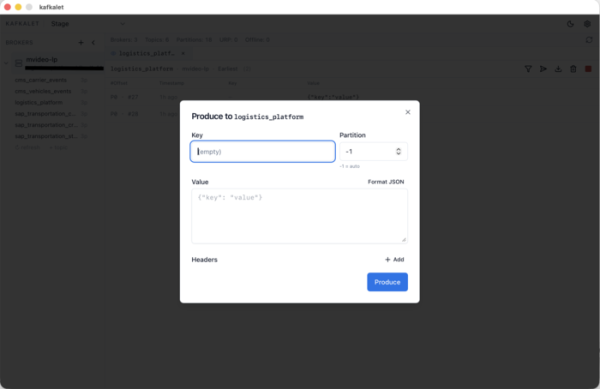
- Sending messages with specified key, value, headers, and target partition.

- Organizing topics: pinning frequently used topics, grouping into named folders, searching with support for regular expressions and filtering by minimum number of partitions.
- Exporting message buffer in JSON or CSV format.
- Integration with Confluent Schema Registry for automatic decoding of messages in Avro format.
- JavaScript plugin system for custom decoding of messages (Protobuf, MessagePack, and other formats).
- Importing and exporting settings in JSON format, including profiles, topic groups, and pinned topics.
Source: opennet.ru
