

Developers of the decentralized communication system Matrix new releases of key client applications . Riot is built using web technologies and the React framework (uses React Matrix SDK is built Key under the Apache 2.0 license.
in the new versions is the default inclusion of end-to-end encryption (E2EE) for all new private chats that are entered through invitation links. End-to-end encryption is implemented based on a proprietary protocol that uses a double ratchet algorithm for initial key exchange and session key management . The second important change is the activation of cross-signing support, allowing a user from an already confirmed session to verify a new session. Previously, when connecting to a chat from a new device, other participants were warned to prevent eavesdropping in case an intruder gained access to the victim's account. Cross-signing allows the user to verify their other devices when logging in and establish trust in the new login or determine if someone has tried to connect without their knowledge.
The second important change is the activation of cross-signing support, allowing a user from an already confirmed session to verify a new session. Previously, when connecting to a chat from a new device, other participants were warned to prevent eavesdropping in case an intruder gained access to the victim's account. Cross-signing allows the user to verify their other devices when logging in and establish trust in the new login or determine if someone has tried to connect without their knowledge. The second important change is the activation of cross-signing support, allowing a user from an already confirmed session to verify a new session. Previously, when connecting to a chat from a new device, other participants were warned to prevent eavesdropping in case an intruder gained access to the victim's account. Cross-signing allows the user to verify their other devices when logging in and establish trust in the new login or determine if someone has tried to connect without their knowledge.
The second important change is the activation of cross-signing support, allowing a user from an already confirmed session to verify a new session. Previously, when connecting to a chat from a new device, other participants were warned to prevent eavesdropping in case an intruder gained access to the victim's account. Cross-signing allows the user to verify their other devices when logging in and establish trust in the new login or determine if someone has tried to connect without their knowledge.
To simplify the setup of new logins, it is now possible to use QR codes. Verification requests and results are now saved in history as directly sent messages. Instead of a pop-up modal dialog, verification is now performed in the sidebar. Among additional features, a layer is noted , allowing connections to encrypted chats from clients that do not support E2EE, as well as a client-side for searching and indexing files in chat rooms with encryption.
It is worth noting that the platform for organizing decentralized communications, Matrix, is evolving as a project that utilizes open standards and places great importance on ensuring user security and privacy. HTTPS+JSON is used as transport, with the possibility of using WebSockets or a protocol based on +. The system is formed as a consortium of servers that can interact with each other and combine into a common decentralized network. Messages are replicated across all servers to which participants of the message exchange are connected. Messages are distributed across servers similarly to how commits are propagated between Git repositories. In the case of a temporary server outage, messages are not lost but are delivered to users once the server resumes operation. Various user identifier options are supported, including email, phone number, Facebook account, etc.
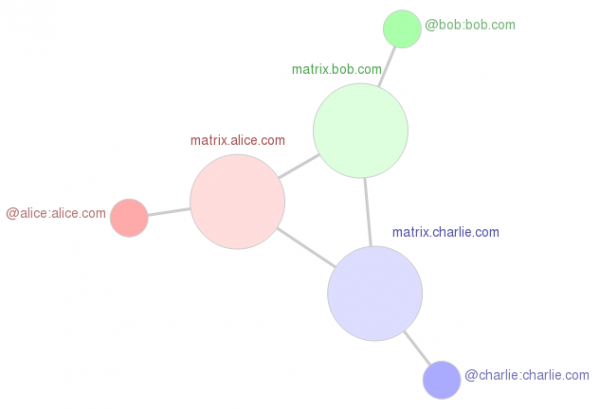
The network does not have a single point of failure or control over messages. All servers involved in the discussion are equal to each other.
Any user can launch their own server and connect it to the overall network. It is possible to create for integrating Matrix with systems based on other protocols, such as services for two-way messaging in IRC, Facebook, Telegram, Skype, Hangouts, Email, WhatsApp, and Slack.
In addition to instant text messaging and organizing chats, the system can be used for file transfers, sending notifications,
organizing teleconferences, making voice and video calls.
Matrix allows for search and unlimited viewing of chat history. It also supports advanced features such as typing notifications, user presence detection online, read receipts, push notifications, server-side search, synchronization of history and client state.
Source: opennet.ru
